Written by Granite Guy Inc., Southborough, Massachusetts
Updated: September 15, 2026
Taj Mahal quartzite countertops are the warm, marble-look natural stone more Massachusetts kitchens are asking for than any other right now, and they hold up better than anything else that looks like them.
💎 The Quick Answer: Taj Mahal is a natural quartzite from Ceará, in northern Brazil, typically a creamy background with soft gold veining. It's harder than granite and it doesn't etch. It costs more than quartz, it varies a lot from slab to slab, and the only way to buy it well is to stand in front of the slab you're getting.
I've been fabricating and installing countertops in Massachusetts since 1995, and for the last few years this is the material my crew has seen more than any other. This guide is what I tell clients in my showroom. For quartzite beyond this one color, see my quartzite countertops page.
⭐ Why Choose Taj Mahal Quartzite for Your Kitchen Countertops?
Because it solves the problem marble can't. Homeowners want the soft, warm look of a veined white marble, and they also want to cut lemons on it. Taj Mahal gives you the look and takes the abuse.
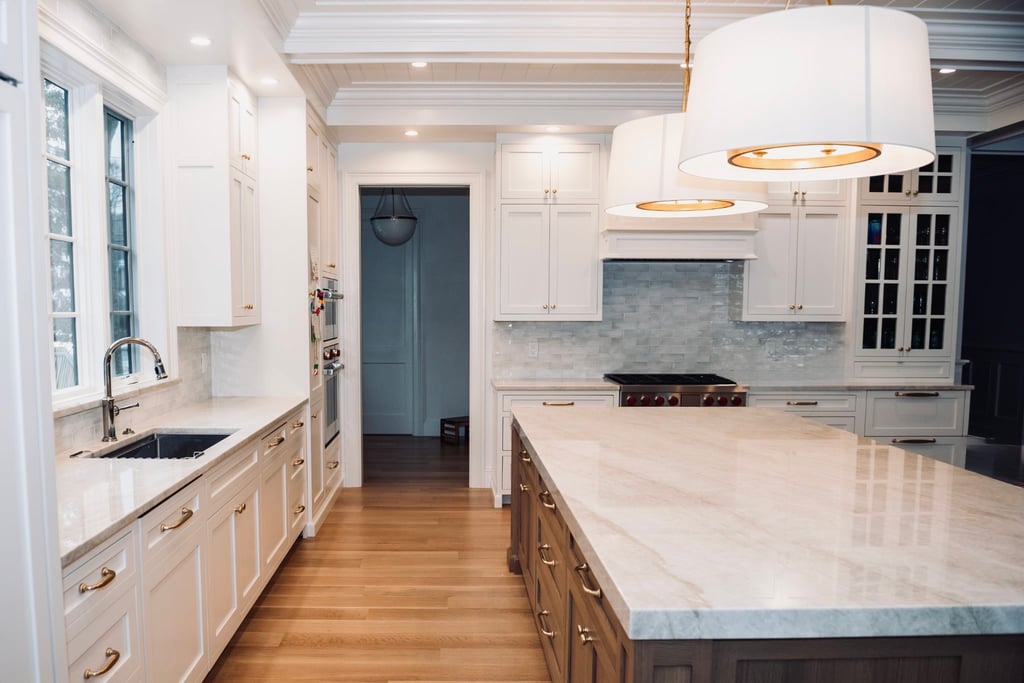
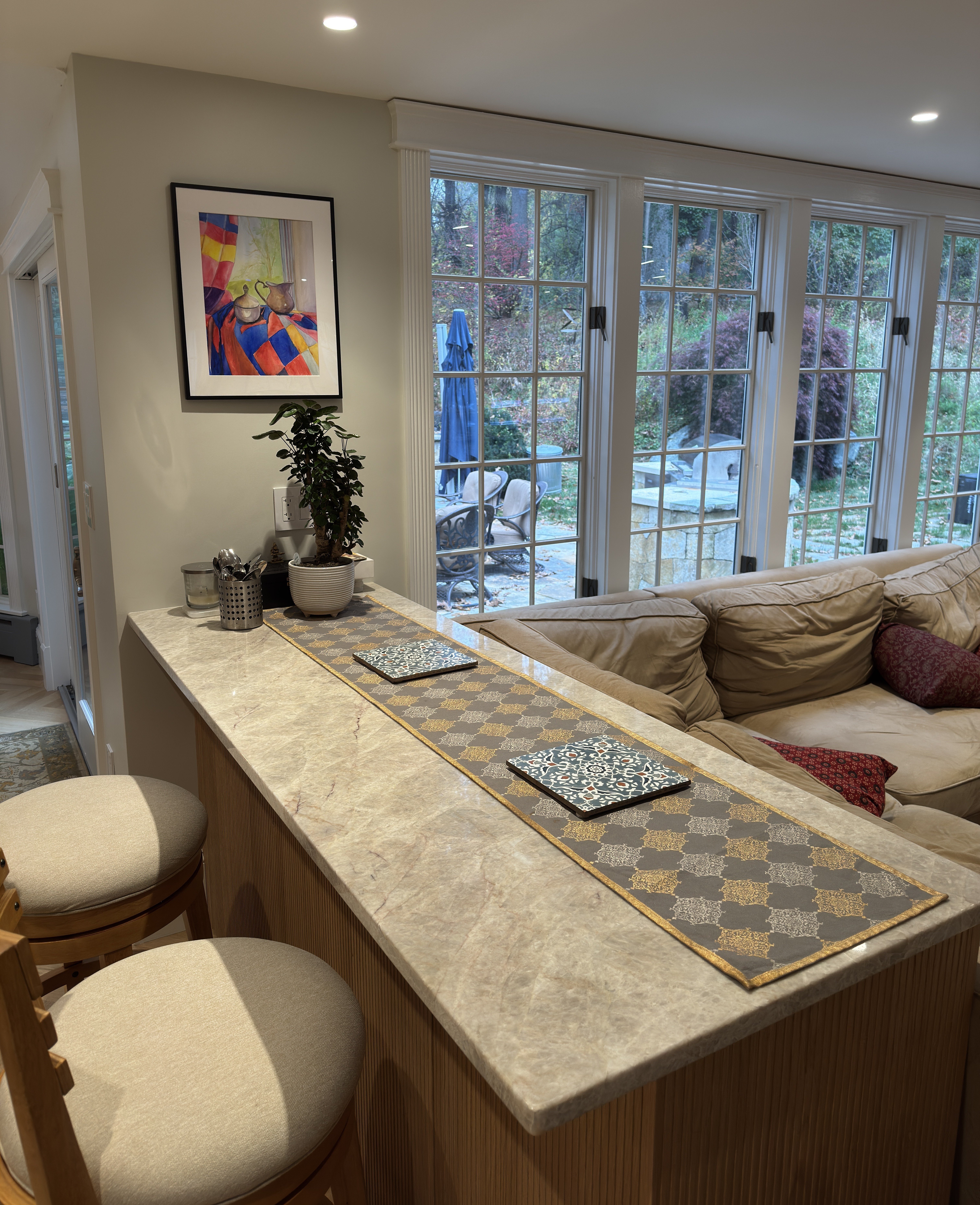
It typically reads as a soft ivory background with wispy veining in warm gray, beige, and light gold, calmer than most marbles from across a room. It's natural, so every slab is one of one, and it's mostly quartz, so it doesn't absorb the way marble does.
📋 Quick look: Taj Mahal quartzite
- Stone type: Natural quartzite. Not granite, not quartz.
- Origin: Ceará, northern Brazil
- Hardness: About 7 on the Mohs scale, harder than granite
- Etching: No
- Standard thickness in New England: 3cm, about an inch and a quarter
- Finishes: Polished, honed, leathered
- Look-alikes: Perla Venata, Cristallo, Naica, and a growing number of lots sold under the Taj Mahal name
❓ Is Taj Mahal Quartzite Outdated?
No. New England has wanted this color for about 25 years, and only the stone carrying it has changed.
✦ The same color, three stones deep
In the late nineties it was Giallo Veneziano, a warm gold Brazilian granite that went into half the kitchens in MetroWest. Through the 2010s it was Giallo Ornamental, same family, a little calmer. In the twenties it's Taj Mahal.
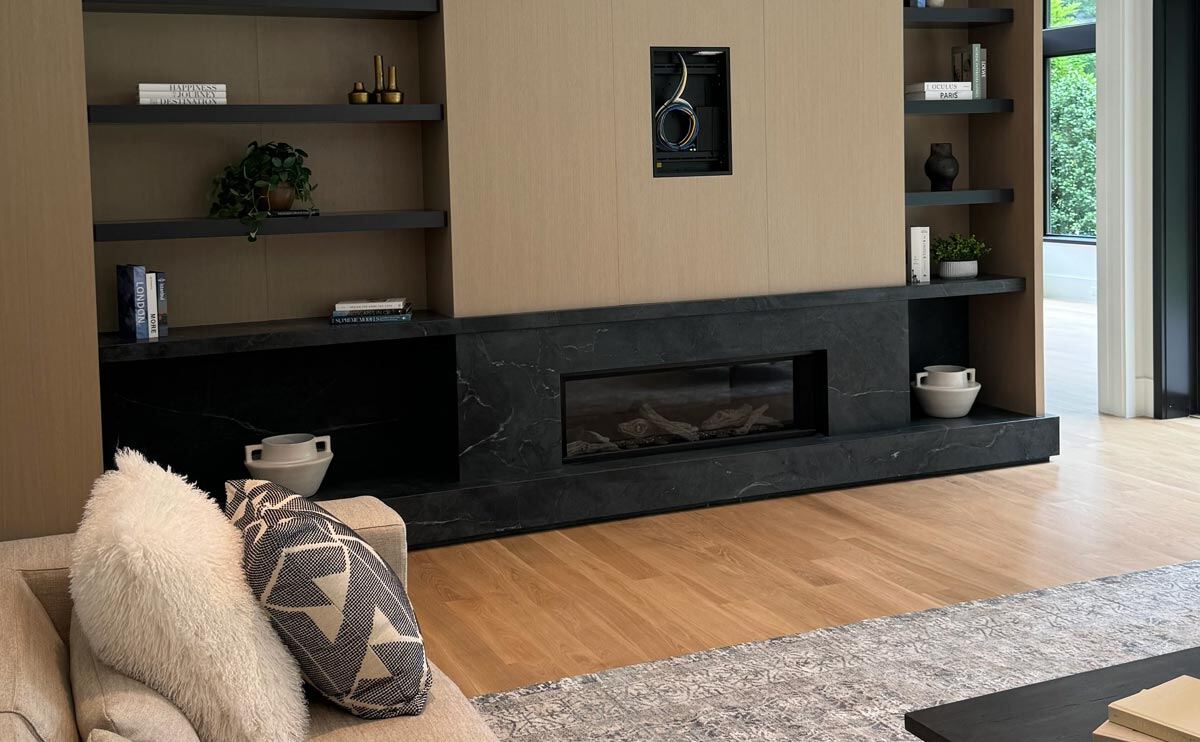
My theory is the gray winter. Florida buys the loud exotics. New England buys warm and quiet, and it always has, which is why white oak cabinetry and exposed beams are back alongside it.
✦ What my own shop saw
This year the demand got extreme. It turned into a thing the whole company was saying, fabricators, installers, everyone: oh my god, it feels like every other kitchen is Taj Mahal.
✦ The part nobody says
Colors cycle, and someday the stone carrying this warm gold will change again. But the color itself has outlasted three trends and two decades of gray.
If you're choosing Taj Mahal because you want warm and quiet, you're picking the safest thing in the showroom. If you're choosing it because a designer said it's the hot one this year, ask yourself what you'll think of it in ten.
❓ Is Taj Mahal Granite, Quartz, or Quartzite?
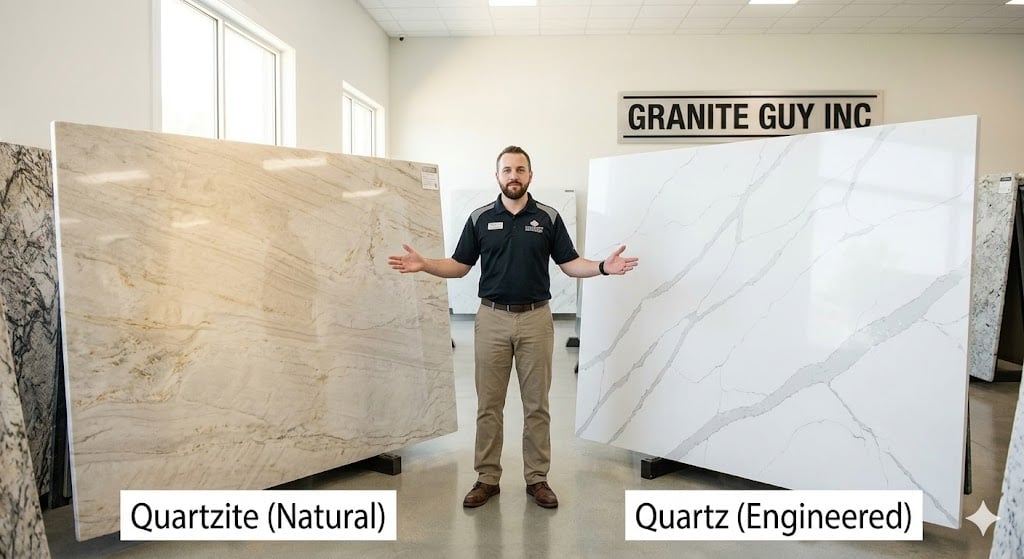
Taj Mahal is 100% natural quartzite. It's often called a granite because it's sold in granite yards and priced like one, but it isn't granite, and it isn't quartz either.
✦ Not granite, not quartz
Granite countertops are cooled magma, speckled and granular. Taj Mahal has flowing veins, not speckles, and the quartzite vs granite difference shows up on the saw as much as on the surface.
Quartz countertops are engineered, crushed quartz pressed with resin and pigment. Taj Mahal has nothing manufactured about it beyond cutting and polishing. If you want the full breakdown, I wrote a quartz vs quartzite comparison that covers it.
✦ What makes it quartzite
It started as sandstone and got buried, heated, and squeezed until the grains fused into a dense crystalline rock. The impurities caught between the grains became the veining, and they're also the stone's weak points, which matters when you fabricate it. That's what quartzite is in one paragraph.
✦ The soft-quartzite problem
For years, some quartz-rich Brazilian marbles were sold as "soft quartzite" or "young quartzite." They etched, homeowners found out, and those colors paid for it in reputation.
I sold a lot of that same Brazilian marble in those years and called it marble. The quartzite vs marble difference is the one that matters most with this stone, because marble countertops etch and real Taj Mahal doesn't.
💎 Is There a Quartz That Looks Like Taj Mahal?
Yes, several manufacturers make one, and most clients who walk in asking for it leave with the natural stone once they hear why they asked. I keep a couple of the quartz versions in stock because they sell, so you can see both.
✦ Why you're asking
When a client asks for the quartz version, the reason is almost never the look. It's that they don't want to seal anything. On Taj Mahal, that's not the problem it is on marble, and I cover why in the sealing section below.
✦ What you give up and what you gain
Taj Mahal has translucency. Light travels a little way into the surface before it comes back, which is why the veining reads soft instead of printed. Quartz is opaque, and if you hold a piece of each up to a window you'll see it in seconds.
You also give up the one-off. A quartzite slab is a slab nobody else has. Engineered material repeats on a pattern cycle.
What you gain is consistency. Every slab in a run matches the next one, so if you're doing two bathrooms and a kitchen and want them identical, quartz countertops have a real advantage.
✦ When quartz is the right call
Budget. Demand has pushed natural Taj Mahal up over the last year or two, and it usually costs more than the quartz version now. If that's the deciding factor, quartz is a good surface and I'll tell you so.
💡 Pro tip: Bring a white sheet of paper. Taj Mahal typically reads warm and creamy next to it. Most of the quartz versions read slightly cooler.
🔨 How Taj Mahal Quartzite Holds Up
Better than anything I've installed that looks like it. I've never seen a Taj Mahal counter stain, scratch, burn, or etch, on the bench or in a kitchen, and I don't get callbacks on it.
✦ The hardest material my shop ever learned to cut
Taj Mahal is the hardest material the fabrication industry has dealt with, it takes two to three times the saw time of quartz, and my price doesn't change for that. Here's why.
Diamond tooling cuts by wearing down its metal bond to expose fresh diamond. On Taj Mahal the abrasive glazed over and stopped cutting, the machine pushed harder, and that force cracked slabs and opened the stone's natural weak points. For years it meant an eighth of an inch per pass and a mitered edge was nearly out of the question.
Tooling took four or five years to catch up.
Waterjet finished the job, because a waterjet doesn't push. It erodes. I remember the first Taj Mahal job we did like it was yesterday, because nothing worked.
✦ Heat, scratches, and stains
It handles heat that would damage other materials, it dulls knives before knives mark it, and spills sit on top of it. It's also UV-stable, which matters in a New England kitchen where the winter sun comes in low and sits on the counters for hours.
✦ Does Taj Mahal quartzite etch?
No. The stone is mostly quartz, and quartz doesn't react to the acids in lemons, wine, vinegar, or tomatoes.
If a countertop sold to you as Taj Mahal etches, you weren't sold Taj Mahal. You were sold one of the marbles I described above, and it's one more reason to buy from someone who's cut enough of it to know the difference on sight.
✦ Sealing, and the test I actually use
There's no sealing schedule. Pour water on it, let it sit, and if the spot darkens the stone took it in and it's time to seal. If it beads and wipes clean, leave it alone.
Every natural stone is porous and Taj Mahal is no exception, but the slabs come resined from the factory, which is like a sealer applied before the material reaches you, and the quartz content doesn't absorb much to begin with. Here's the tell I see on the bench: on most stone you can watch water darken along the saw line after a cut. On Taj Mahal you don't.
⚖️ Pros and Cons of Taj Mahal Quartzite
✅ Pros
The marble look without the marble problems. Warm and veined, and it doesn't etch. This is why it exists.
Harder than granite. About 7 on the Mohs scale, and it takes a busy kitchen for decades without showing it.
Every slab is one of one. The veining runs where it runs.
❌ Cons
It costs more. More than quartz, more than most granite, and the price has climbed with demand.
It varies, a lot. Two slabs with the same tag can look nothing alike. See the whole slab before you commit.
It's not indestructible. Heavy impact on a corner or an unsupported overhang can still chip it.
🪨 Choosing a Taj Mahal Slab: Look at the Slab, Not the Label
Buy the slab in front of you, not the name on the tag. Two slabs can both say Taj Mahal and look nothing alike, and this year the name got looser than it's ever been.
✦ Why the name got loose
A stone comes from one place on earth, but that place can be miles wide. The quarry that named Taj Mahal sits in Ceará, and the quarries around it pull very similar material out of the same ground. Similar, not the same: some run browner, some greener, some with heavier veining, and the same block sliced horizontal or vertical changes the whole face of the slab.
This year demand got so high that the market started calling all of it Taj Mahal. Material that used to sell under other names now arrives with the Taj Mahal tag, and it used to be that asking for one of those other names got you a better price. Now nearly everything in the family carries the Taj Mahal price, but walk the rack and you'll see the lots vary, and so do their prices.
✦ What I look for on the rack
I turn the slab under the lights and then away from them, because the gold reads differently in each.
I look for the crackly ones, slabs where the crystals never fully fused, because those fall apart on the saw. And I check the fills. Every quartzite slab has them, because it comes out of the mountain with cavities, some big enough to nearly fit your hand, and the factory fills them with crushed stone of the same material and polishes over.
Most homeowners never spot one. I can, and I'll point them out.
✦ Light or dark Taj Mahal
There isn't a light version and a dark version, there are lots. Some are commonly very pale, almost a white background with faint gold. Some carry a light olive-green cast, some have deep brown veining, some are wavy and some are streaky with a tighter pattern.
Honed and leathered slabs typically read a few shades lighter and more muted than the same stone polished. The lighter lots go into the bright, white-oak kitchens that are everywhere in MetroWest right now.
The darker ones hold up against darker cabinetry and hide more. Neither is the real one, and the only way to pick is to see the slab.
✦ What I saw in Brazil
Last year I spent a full day on the floor of a natural stone factory in Brazil, walking the line from block to finished slab. Newer methods wrap the whole block and pull the resin into every cavity under vacuum, which is why breakage on the saw is a fraction of what it used to be and why the slab reaches you already sealed at the surface.
Once in a while a piece still breaks in my shop. When it does, I repair it the way the factory does.
✦ Slab size and thickness
A typical Taj Mahal slab runs about six feet tall by ten and a half feet long, and I've had them close to seven by eleven. That size decides if your island is one piece or a seam.
In New England, it's three centimeters, about an inch and a quarter thick, and that's nearly everything the suppliers stock here. California, Florida, and Brazil run mostly two centimeters and build up the edge to look thick. I sometimes wish New England did the same, because the weight my crew carries would drop by a third, but three is noticeably stronger and there's no edge build-up, which means less labor at a time when labor is the cost that keeps climbing.
✦ Seeing one in person
The quartzite slabs on my floor are photographed individually, but no photo shows you translucency or how the gold moves when you walk past it. Come stand in front of a few. It's a 20-minute decision once you're looking at the real thing.
✨ Polished, Honed, or Leathered: Pick It When You Pick the Slab
Pick the finish when you pick the slab, not after. Taj Mahal comes off the rack in all three, and changing it later costs more.
✦ Why the timing matters
On this material refinishing is slow work. I'll hone a vanity or a bar top in-house, but a full-slab job goes to a dedicated slab-resurfacing line built for exactly that. Four slabs of matching honed Taj Mahal for an outdoor kitchen in Wellesley this month went that route, because that's how all four come back identical.
The one exception is the slab you fall in love with that doesn't exist in the finish you want. Then we talk.
✦ Which one
Polished is what most kitchens get, and it's where the gold shows most. Honed calms the whole thing down. Leathered gives it texture and reads more like old stone.
I've written up honed vs polished quartzite and leathered quartzite countertops separately. Come run your hand across all three in the showroom.
🔍 Taj Mahal vs Perla Venata, Cristallo, and Naica
These four are geological neighbors from Brazil and they look nearly identical to an untrained eye. They aren't, and the difference is in the veining and the depth, not the color.
✦ Taj Mahal (the standard)
Typically a warm, creamy background with golden undertones and smooth, wispy veins with real translucency. Best for kitchens that want a warm glow, with cream cabinets, warm wood, and brass.
✦ Perla Venata (the lighter sibling)
Typically a lighter, whiter background with less gold and cooler undertones. Instead of flowing veins it often has a crystalline, crackly structure, the kind that can come apart on the saw. Best for a brighter palette with gray cabinets and chrome.
✦ Cristallo (the rare one)
Commonly a bright white background with the most translucency of the family and very little veining. Almost glass, and it's the one you backlight. I cover it in my Cristallo quartzite guide.
✦ Naica (the neighbor)
Typically beige or gray-white, but flatter and more opaque than the others. Hold it next to a real Taj Mahal slab and the difference is in the depth.
👨🔧 The fabricator's take
Pick based on warmth. Cozy and warm, go Taj Mahal. Crisp and bright, look at Perla Venata.
If the material is the centerpiece and the budget is open, Cristallo is in a class by itself. And always look at the full slab.
📅 Update, September 2026: When I first wrote the comparison above, you could still order these as separately named materials, and choosing one of the other names often meant a better price. That's changed. Demand for Taj Mahal ran so high this year that suppliers started putting the Taj Mahal tag on nearly everything in the family. Ask for Naica or one of the others by name now and most of the time you'll get a blank look. The material still varies the way it always did, lot to lot and slab to slab, and the prices still vary with it. The names just stopped doing the work. Which is why I keep saying it: look at the slab, not the label.
🏡 What Goes With Taj Mahal Quartzite
Almost anything, which is why it's become the default answer in so many MetroWest kitchens. Here's what I see most and what I'd avoid.
✦ Cabinets
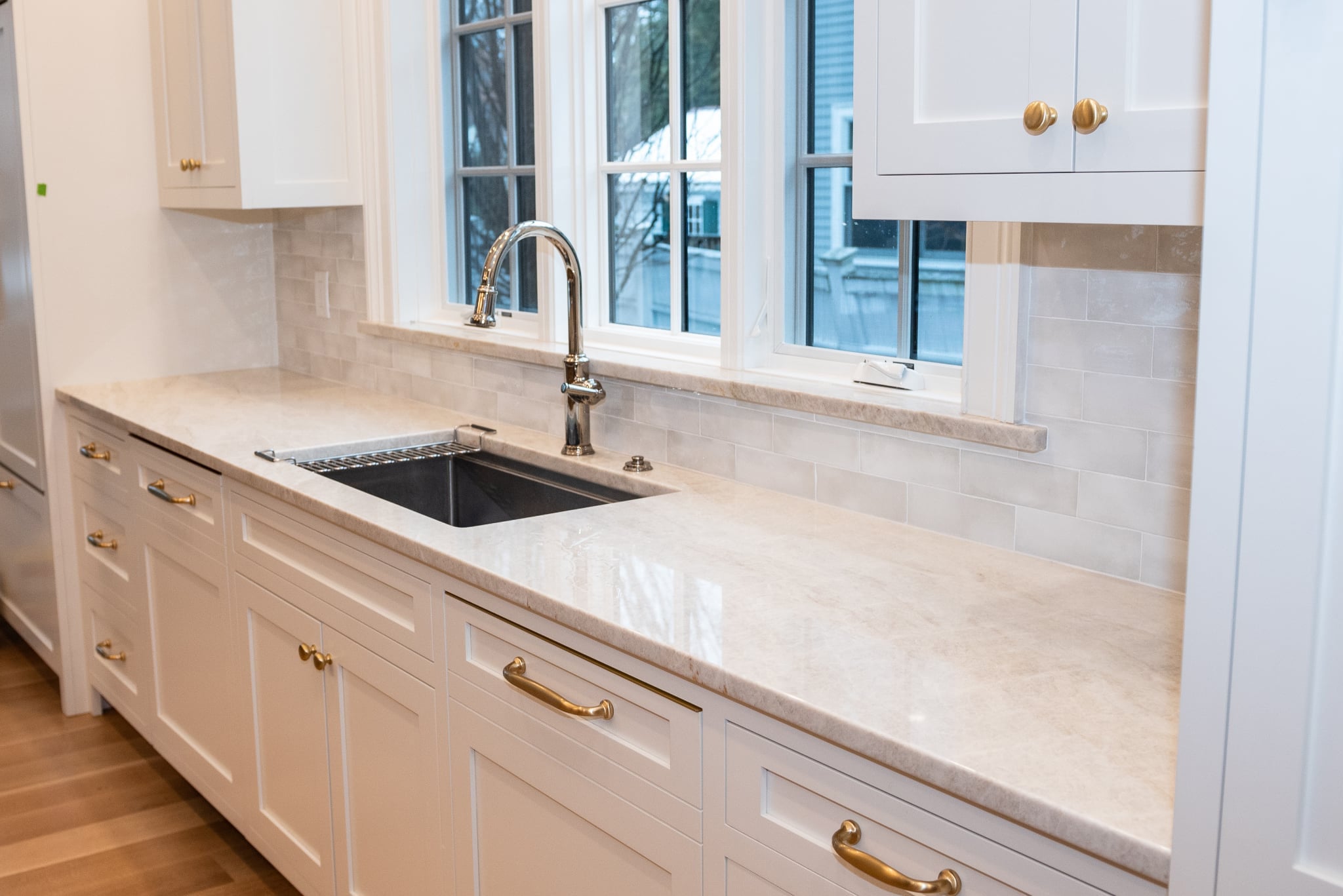
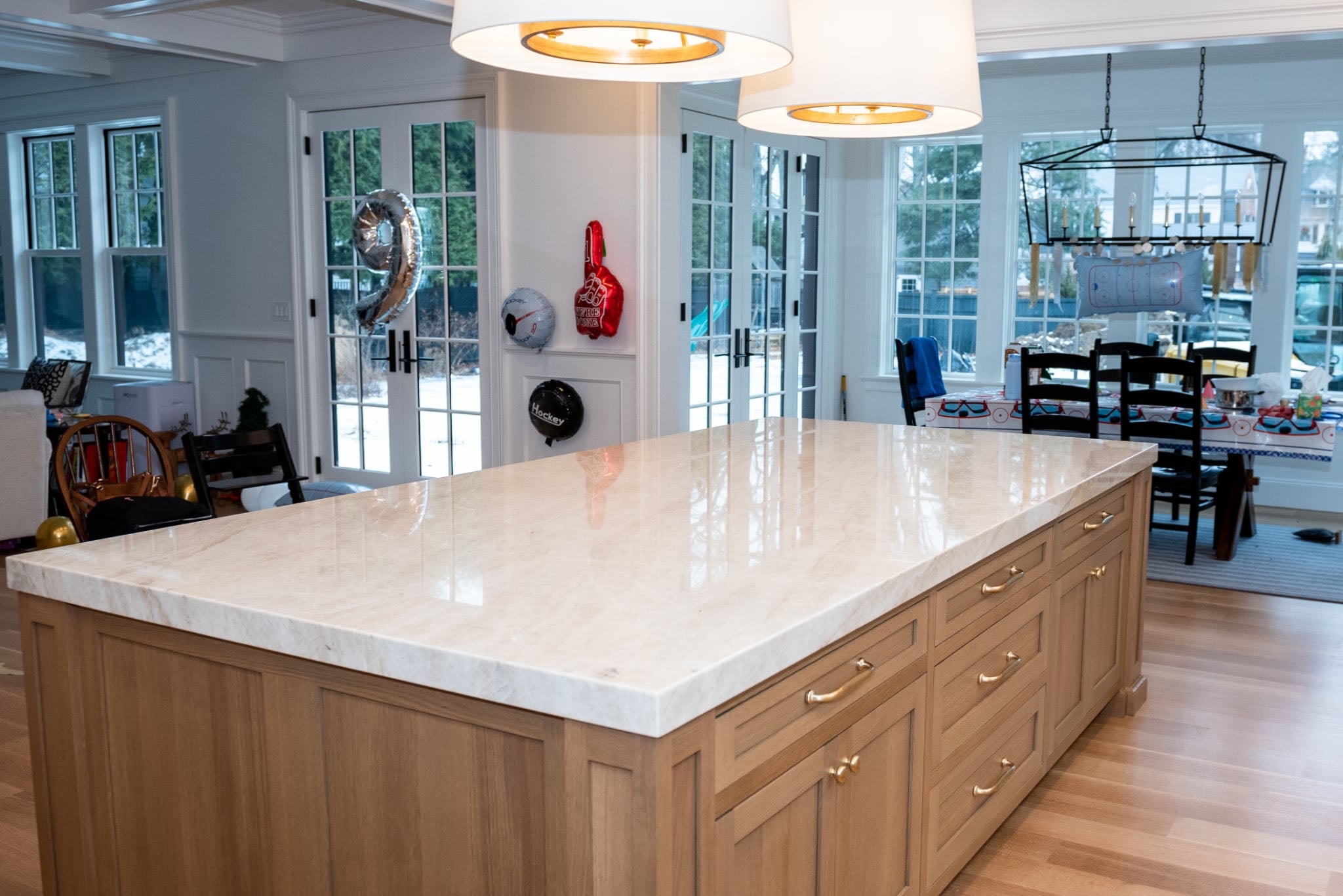
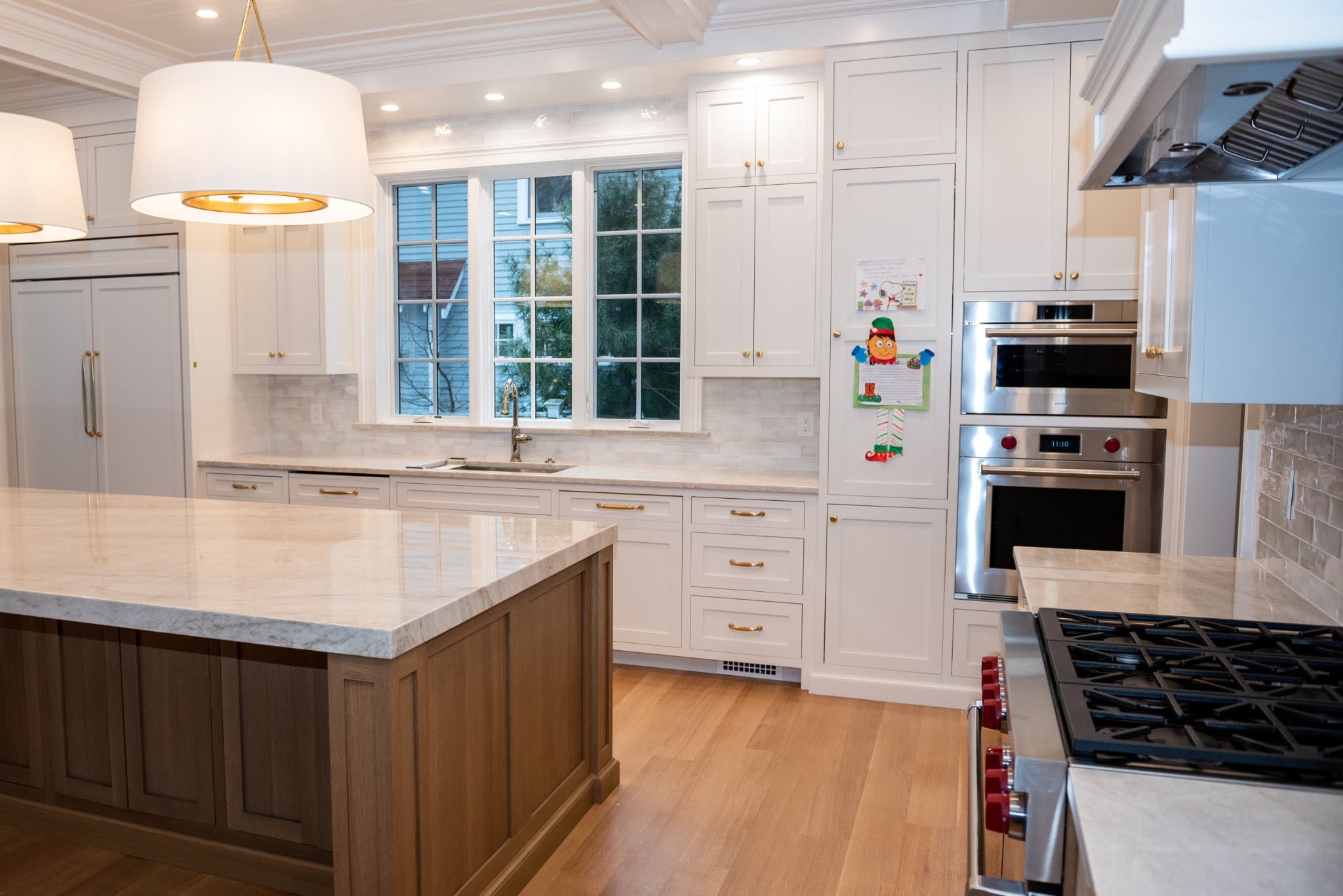
White or cream is the most common pairing and the safest. White oak and natural walnut are close behind, and a kitchen island in Taj Mahal on a wood base is the version I fabricate most. Navy or charcoal turns the counter into the focal point, and sage green has been showing up more this year.
✦ Backsplash
White subway tile is the classic choice and it lets the veining do the work. A full-height slab backsplash in the same stone gives you a continuous face with no grout lines. Avoid busy patterns that fight the veining, warm beige tile that goes flat against it, and anything yellow or orange.
✦ Hardware and floors
Brushed brass pulls the warm undertones forward, brushed nickel stays neutral, matte black gives contrast. White oak flooring is the pairing I see most and the one I'd choose.
💰 Pricing Information for Taj Mahal Quartzite
These figures are for Taj Mahal quartzite specifically. If you're pricing quartzite in general, my guide to quartzite countertops cost covers the whole category.
Understanding Countertop Pricing
To understand costs, you can find that about half of all countertop materials price between $30 and $50 per square foot. This price is for the material only. This doesn't mean cheaper materials are poor quality, they're simply less desirable in the marketplace.
Taj Mahal Pricing in Massachusetts
Expect $100-150+ per square foot fully installed for Taj Mahal kitchen countertops in Massachusetts. This includes the slab, all fabrication work, and installation at your home.
Important: Authentic Taj Mahal can vary a lot in price. This depends on the unique veining patterns and the supplier. More attractive slabs with subtle veining command higher prices than busier slabs.
The Granite Guy Inc.'s Pricing Insight
"The $100-150 range covers everything, material, cutting, polishing, delivery, and installation. What drives pricing up or down is primarily slab selection and any pattern-matching requirements for the delicate veining."
Factors Affecting Cost:
- Specific slab quality and pattern desirability
- Thickness (3cm vs 2cm)
- Edge details and customization
- Pattern-matching requirements for unique veining
Typical Investment for Massachusetts Homeowners
For a standard kitchen with island (50-60 sq ft): $5,000-9,000+ installed
A typical kitchen island alone costs $2,500-4,000 installed
How Much is a Full Slab of Taj Mahal?
A full slab costs $3,000-5,000 for material only. Average slab sizes are about 6' x 10' (roughly 60 square feet).
📅 Update, September 2026: That $3,000 to $5,000 range was accurate when I last updated this article. A few things have changed since. Demand kept climbing, tariffs on imported stone climbed with it, and by my estimate Taj Mahal slabs are up somewhere between 25 and 50 percent. Unfortunately, the average slab is now creeping up toward the $5,000 mark and beyond, depending on the lot and the supplier.
Why Slab Purchasing Gets Complicated
Every countertop project is like a puzzle, fitting your pieces onto available slabs while minimizing waste. With thousands of materials and suppliers available, this creates an overwhelming process.
The Granite Guy Inc.'s Solution for Massachusetts Customers
We maintain warehouse inventory that you can browse from home at Granite Guy live inventory. View actual photos of every Taj Mahal slab in stock, to scale, before visiting our Southborough showroom.
Select from visible inventory with set per-square-foot pricing. No slab calculations, waste worries, or delays. You see exactly what you're getting, pay only for what you use, and we handle the complexity for a stress-free experience.
🧽 Care and Maintenance of Taj Mahal Quartzite
Warm water, mild dish soap, a soft cloth. That's the whole routine, and it's one of the reasons this material has held up on every job I've installed.
✦ What to keep off it
Abrasive pads and powders won't scratch the stone, but they'll wear the polish over time. Harsh acidic cleaners and bleach won't etch it, but over years they'll break down whatever sealer is on it. For disinfecting, a mix of 70% isopropyl alcohol and 30% water is safe.
✦ Sealing
Use the water test from the durability section above, and if the day comes, my quartzite sealer guide covers the how. The full cleaning routine is in my guide to cleaning quartzite countertops.
❓ Frequently Asked Questions About Taj Mahal Quartzite
📚 Related Articles
- Quartzite backsplash guide: 4-inch vs full-height options in MA
- Eased edge countertop: a fabricator's guide to the best choice
🏠 Visit Our Southborough Showroom
The fastest way to know if Taj Mahal is your stone is to stand in front of three or four slabs and watch the gold move. Our countertop store has them on the floor, and you can see how a job runs from slab to install on our process page.
Granite Guy Inc.
📍 43 Turnpike Road (Route 9), Southborough, MA 01772
📞 508-460-7900
✉️ info@graniteguyinc.com
Contact us to set up a visit, or just come by. I'm usually on the floor.