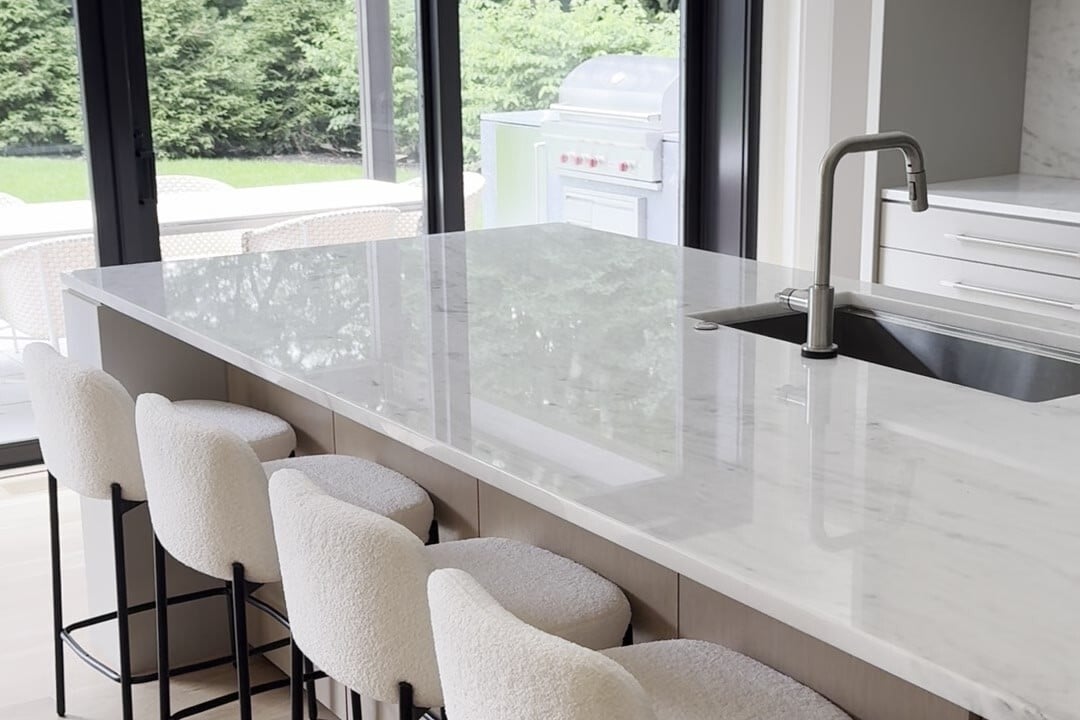
Quartzite Edge Profiles: Best Styles for MA Kitchens

Written by Granite Guy Inc., Southborough, Massachusetts
Published: January 2026
The honest truth about quartzite edges from a fabricator who's installed thousands of dramatic slabs
I've fabricated and installed thousands of quartzite countertops across Greater Boston since 1995.
Here's something that surprises most homeowners: even though quartzite is one of the hardest natural stones we work with, I still recommend the same simple edges I'd put on marble.
Not because quartzite can't handle elaborate profiles. It absolutely can.
But because simple edges let quartzite do what it does best: steal the show.
When you're investing in a slab of Taj Mahal quartzite or dramatic Calacatta Lux, the last thing you want is an ornate edge competing with those natural veins. The stone is the star. The edge should disappear.
Let me walk you through which edges work best on quartzite, and why.
💡 Quick Summary for Homeowners:
- Best Overall: Eased Edge (1/8" radius) — works with any kitchen style
- Best for Bold Statement: Mitered Edge for dramatic appearance
- Why Eased Wins: Clean lines, versatile, showcases stone without competing
- Mitered as Alternative: Thicker appearance, more dramatic, makes a statement
🪨 Why Quartzite Is Different From Every Other Stone
Before we talk edges, you need to understand what makes quartzite unique.
Quartzite rates around 7 on the Mohs hardness scale. That's as hard as granite and significantly harder than marble (3-4).
This hardness comes from quartzite's formation: sandstone subjected to intense heat and pressure until the quartz grains fuse into a dense, crystalline structure.
What does this mean for edge profiles?
✦ The Hardness Advantage
Unlike marble, where I actively discourage elaborate edges due to chipping risks, quartzite can technically handle almost any profile you throw at it.
Those ogee curves and DuPont details that would chip within months on marble? Quartzite can hold them for decades.
But "can" doesn't mean "should."
✦ Why I Still Recommend Simple Edges
Here's what 30 years of fabricating quartzite has taught me: the stone's dramatic veining is the whole point.
Taj Mahal quartzite has soft golden waves. Calacatta Lux has striking white backgrounds with dramatic veins.
Sea Pearl has oceanic blues and greens. Calacatta Bormal has flowing marble-like movement.
Every one of these stones demands attention. An elaborate edge profile interrupts the visual flow and competes with the natural patterns you're paying premium prices to showcase.
Simple edges let your eye follow those veins uninterrupted from surface to face.
🏆 The Eased Edge: The Clear Winner for Quartzite Countertops
Most of our quartzite kitchen countertops use an eased edge. Our kitchen countertops page covers the rest of the job, from slab to install.
The eased edge—also called a pencil edge—features a subtle 1/8-inch radius. It's simple, and that's exactly why it works.
✦ Why It Wins
Works with any kitchen style. Modern, transitional, traditional—it complements everything without forcing a specific aesthetic. Clean lines won't compete with your countertop or the rest of your kitchen design.
Doesn't compete with your stone. Your countertop is the star. A simple edge doesn't get in the way.
Most cost-effective. No extra fabrication complexity or premium pricing.
Easy to maintain. No grooves or crevices. Just smooth transitions you can wipe clean.
Simple is also smartest.
💎 The Mitered Edge: Making a Bold Statement
If you want to make a bold statement, the mitered edge is where it shines.
A mitered edge isn't a traditional profile. It's a fabrication technique where we cut the stone face at a 45-degree angle and glue an apron piece to create whatever thickness appearance you want.
Your 3cm slab can look like it's 4, 5, or 6 centimeters thick.
✦ Why Mitered Makes an Impact
Because we're cutting at 45 degrees, the veins flow off the top surface and continue down the vertical face without stopping.
You can't tell the two pieces are glued together—it looks like one solid, thick piece of stone. That's bold. That makes a statement.
✦ The Fabricator's Honest Take
Mitered quartzite requires precision and the right equipment.
Quartzite's hardness makes it challenging to cut cleanly at 45 degrees. The seam where the two pieces meet needs to be nearly invisible.
That means careful vein matching during layout and precise fabrication.
At our shop, we use Slabsmith digital layout software to map every vein before we make a single cut.
You'll see exactly where the seams fall and how the veins will match before fabrication begins.
⚠️ Quartzite Fabrication Note: Quartzite is extremely hard to cut, shape, and polish for edges. This requires specialized tooling and expertise. At Granite Guy, we have the equipment and know-how to handle quartzite edges, but they require extra precision and care.
📐 Thickness and Build-Ups: What You Need to Know
If you've seen photos of thick, chunky quartzite islands and wondered how they're made, here's the reality: that stone didn't come out of the ground that way.
✦ Standard Thickness Options
3cm (approximately 1¼ inches): This is the standard for over 95% of kitchen countertops in New England. It's thick enough to install directly on cabinets without plywood support.
Fireplaces and other applications also commonly use 3cm.
2cm (approximately ¾ inch): Common for bathroom vanities, backsplashes, and thresholds. For kitchen countertops, 2cm typically requires a plywood underlayment.
For quartzite specifically, I always recommend 3cm in kitchens. The extra mass provides better durability and a more substantial feel.
✦ Creating the "Thick" Look
If you want that substantial 2-inch or 3-inch appearance for your island, we fabricate it using one of two methods:
Mitered Edge (My Recommendation)
We cut the edge at 45 degrees and join it to an apron piece. The veins flow continuously from top to side.
The seam sits right at the corner where it's nearly invisible.
This is more expensive but preserves what makes quartzite beautiful: uninterrupted vein flow.
Laminated Edge
We stack a strip of stone underneath the main slab and polish them together. This creates a horizontal seam line running along the edge.
On heavily veined quartzite, this breaks the pattern and looks obvious. I don't recommend lamination for dramatic quartzites like Calacatta Lux or Taj Mahal quartzite.
For subtle quartzites with minimal veining, lamination can work.
But honestly, if you're paying quartzite prices, you probably chose it for the veining. Go mitered.
⚠️ Edges to Avoid on Quartzite (Even Though It Can Handle Them)
Here's where my advice for quartzite differs from marble.
On marble, I tell people to avoid elaborate edges because marble will chip.
On quartzite, the stone can absolutely handle those profiles. But I still discourage them for different reasons.
✦ Full Bullnose: The Spill Problem
The full bullnose has a completely rounded edge that curves from top to bottom.
It looks soft and safe, which is why families are drawn to it.
The problem isn't chipping. It's physics.
When liquid spills on a full bullnose edge, it follows that curved surface all the way around and often drips directly into your cabinets below.
Instead of a straight drip off the counter face, you get liquid traveling underneath.
On quartzite, which requires sealing, any liquid that travels to areas you can't easily see or wipe becomes a potential staining issue. Keep your spills on top where you can address them quickly.
An eased edge gives you soft corners without the spill-travel problem.
✦ Ogee and DuPont: Better for Decorative Pieces
The ogee is that classic S-curve you see in traditional design magazines. The DuPont features multiple curves and transitions. Both were popular decades ago, and they can still work—just not in the places most people think.
These elaborate edges work better on decorative pieces like powder room vanities or furniture pieces. For everyday kitchen countertops, design trends have shifted toward cleaner lines, and the eased edge simply works better.
📋 Other Quartzite Edge Options
While most of our quartzite installations use eased and mitered edges, here are other profiles we fabricate and my honest assessment of each.
✦ Half Bullnose
A rounded top edge with a flat bottom. This is a reasonable compromise if you want softness without the spill problems of full bullnose.
The flat bottom stops liquid from traveling underneath. It works well on quartzite and still lets the stone's beauty show. I'd rank this as my third choice after eased and mitered.
✦ Quarter Radius
Similar to an eased edge with a slightly more pronounced curve. Some homeowners prefer this slightly softer look while maintaining clean lines.
On quartzite, this works beautifully. The extra curve still doesn't interrupt veining, and the profile remains easy to clean.
✦ Bevel Edge
A 45-degree angled cut on the top edge only. This adds subtle definition and catches light differently than an eased edge.
It works on quartzite's hard surface, but those angled corners are more prone to showing wear over time. I prefer eased for most applications.
✦ Chiseled or Rock Face
A raw, natural-looking texture that reveals the stone's crystalline character. This actually works well on quartzite because you're showcasing the stone's natural structure.
We use this primarily for fireplace surrounds and outdoor applications rather than kitchen countertops. The rough surface would collect debris in a cooking environment.
✦ Pencil Edge
A rounded edge with a tighter radius than half bullnose. On quartzite, this works fine, though I find the eased edge more versatile for modern kitchens.
✦ Profile Edges: When They Make Sense
We can also fabricate custom profile edges like ogee, DuPont, and many others. These require additional hand work and tooling, so they cost more.
However, over the last decade or so, design trends have shifted toward simpler, cleaner lines and more uniform aesthetics. Most customers now prefer eased and mitered edges.
Elaborate profile edges are typically reserved for decorative spaces like powder rooms or to match existing historic details in traditional homes.
💰 Edge Profile Pricing
I know you might wonder why mitered edges cost more than standard profiles.
For standard edges like eased, half bullnose, and bevel, pricing is straightforward. These are simple cuts that our machines handle efficiently.
Mitered edges cost significantly more — approximately $60 per linear foot. Here's why:
Mitering means cutting two pieces at precise 45-degree angles and gluing them together.
Quartzite's extreme hardness means we have to go slow and carefully to avoid chipping the edges. The material itself demands extra care.
Then comes the labor: gluing the pieces together, finishing the seams, polishing until they're nearly invisible.
Most mitered countertops also need a substrate underneath to match the thickness, which we fabricate at the shop to ensure precision and avoid complications.
It's meticulous work, but the result is worth it—that uninterrupted vein flow from top to vertical face.
✅ Choosing the Right Edge for Your Quartzite
After fabricating quartzite and other stone materials over my 30 years in the business, here's my honest guidance:
Choose an eased edge — it's the simplest, most cost-effective, and most widely used for a reason.
Clean lines won't compete with your countertop or the rest of your kitchen design. It matches today's trends perfectly and works with any style.
Choose a mitered edge if you want to make a bolder statement.
It's essentially an eased edge but thicker, creating that solid, substantial look that catches attention on islands and feature countertops.
Skip elaborate profiles like ogee and DuPont for kitchen countertops.
These work better on decorative pieces like powder rooms, vanities, or furniture. For everyday kitchen use, the eased edge simply works better.
❓ Frequently Asked Questions
Q. What is the best edge for quartzite countertops?
A. The eased edge with a 1/8-inch radius. It works with any kitchen style and showcases your countertop as the main focus.
Q. Can quartzite handle elaborate edge profiles?
A. Yes. Quartzite is as hard as granite, so it can hold ogee, DuPont, and other elaborate profiles without chipping. But with today's design trends moving toward cleaner lines and simpler cabinetry, simple edges complement quartzite better.
Q. How much do mitered edges cost on quartzite?
A. Mitered edges cost more because they require precision 45-degree cuts on an extremely hard material, careful gluing and finishing, and skilled labor. You need the right equipment and expertise to do it correctly.
Q. Is a bullnose edge safe for quartzite?
A. Quartzite won't chip like marble, but full bullnose creates spill problems on any material. Liquids follow the curved surface underneath and can drip into cabinets.
Q. What edge shows off quartzite veining best?
A. For surfaces, the eased edge lets veins flow uninterrupted. For islands, a mitered edge makes your countertop look substantially thicker by continuing the veins seamlessly from top to side.
Q. Quartzite vs marble edges: What's the difference?
A. Marble is softer and less durable than quartzite, so elaborate edges on marble require more maintenance and careful handling. Both stones look best with simple eased edges that keep your countertop as the main focus.
Q. Does the edge profile affect quartzite maintenance?
A. Not significantly. The main difference is cost — elaborate profiles require more fabrication work and labor. All profiles are relatively easy to maintain with regular cleaning and periodic sealing.
Q. What edge should I choose for Taj Mahal quartzite?
A. Eased for most applications. For islands where you want the golden veining to flow down the face, a mitered edge creates a beautiful effect.
📚 Related Articles
- What Is Quartzite? Complete Guide from a 30-Year Fabricator
- Taj Mahal Quartzite: Complete Guide
- Eased Edge Countertop: A Fabricator's Guide to the Best Choice
🏠 Visit Our Southborough Showroom
Ready to see quartzite edge samples in person? Reading about profiles only goes so far.
At our showroom, you can see and feel actual edge samples on quartzite specifically.
You'll understand how light catches each profile on Taj Mahal versus Calacatta Lux, and you'll get honest guidance on what works best for your kitchen.
Visit our countertop store at 43 Turnpike Road (Route 9), Southborough, MA 01772.
📞 508-460-7900📧 info@graniteguyinc.com