Written by Granite Guy Inc., Southborough, Massachusetts
Updated: October 2, 2026
The best stone fireplace ideas start with one decision: a surround fabricated from slab, instead of tile, veneer or stacked stone. Instead of many small pieces and grout lines, you get a few large solid pieces.
The quick answer: For the classic New England look, choose a narrow surround in honed black granite with a white mantel. For a modern look, run the stone from floor to ceiling. Skip quartz near any fireplace.
After 30+ years of experience and 10,000+ projects completed in Massachusetts, here is what I'd tell you at the counter about each look. Black granite, the same stone we fabricate as granite countertops, is still the one I install most around a fire.
Stone Fireplace Ideas That Start With a Slab
When a fabricator builds your surround, it comes out of a slab, the same material your countertops come from. A standard surround is three pieces, a full-height wall can be one, and either way there are no grout lines to clean. It gives you a cleaner look, whether the house is modern or traditional.
We do slab work only, in natural stone and porcelain. Every idea below comes down to two questions: how much of the wall do you want covered, and should the fireplace be the showpiece of the room, or something subtle that blends in?
The Classic New England Surround
The true New England fireplace is subtle: a band of stone 8 to 10 inches wide around the opening, with woodwork around it. The stone is there for fire protection, and a hearth sits in front so embers don't burn the floor.
Most surrounds are three pieces of stone, two legs and a piece across the top, and most come with a matching hearth in front from the same slab. That takes very little material, so a piece from our stone remnants in stock may be all the job needs.
Three pieces is what most homeowners choose, and it's the smart way to buy. A surround fabricated as one piece with the opening in the middle takes a much larger slab, and you pay for the stone that comes out of the center.
Honed Absolute Black With a White Mantel
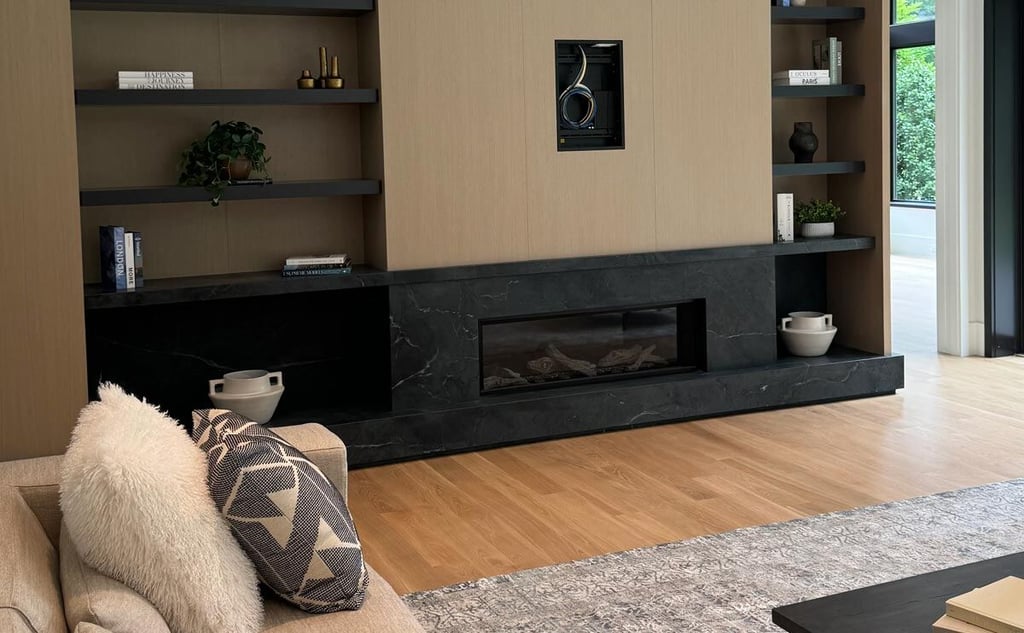
The number one stone I install on fireplaces is Absolute Black granite in a honed finish. Honed means no shine: typically a matte, near-solid black, though every slab varies a little, so see yours in person.
Pair it with a matte black fireplace insert and the two blend together like one piece. A white or off-white mantel completes it, and that is the most common fireplace design in New England.
What an Older Home Adds
Last year we did thirteen fireplaces in one older home in Weston: five on the first floor, four on the second and four on the third. Most were Carrara marble and some were honed Absolute Black.
Every one was different. The owners kept the antique woodwork, so we adapted each surround to it, with different depths and a lot of improvising on site.
The floors in an older house are never level either. You can't set a level piece of stone against a wall and floor that aren't, so expect some compromise where the stone meets the wood.
Floor-to-Ceiling Stone Fireplace Walls
A floor-to-ceiling slab turns the fireplace into the showpiece of the room. For a long time a marble fireplace wall was the standard, with granite now and then. Lately quartzite is very common.
Picture a fireplace five or six feet wide and ten feet tall. That is a whole slab, around a thousand pounds, with a big opening in the middle for the firebox.
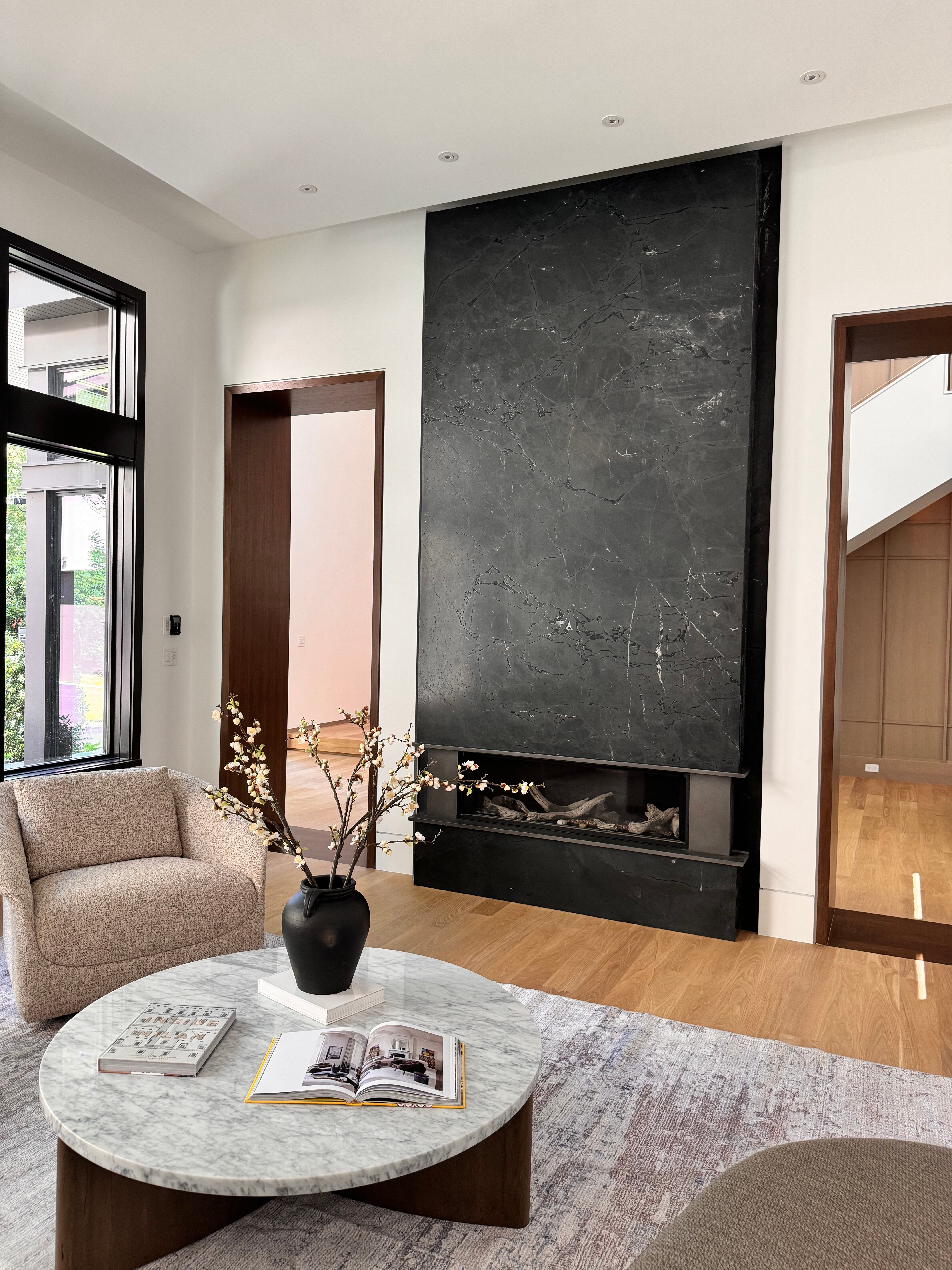
These are the trickiest jobs I do. A piece that large shows every high spot on the wall and a firebox that is out of plumb, so have the wall and the box checked before fabrication starts.
Where the Seam Goes
The best place for a seam is on top of the two legs. When the wall can't be one piece, we can also build it as four: the bottom, the two legs, and the top as its own piece.
Seams are overrated. A planned seam cuts the weight almost in half and lets us carry the stone into the house, and the job goes easier for it.
We lift the top piece, set it tight against the ceiling and support it. Then we trim the legs to size and put them right in.
Before any of that, your slab becomes a digital slab. We move the pieces around on a digital layout until the pattern flows across the seam, and we will not move to fabrication until you approve it.
What Holds the Stone on the Wall
Thinset holds most fireplaces, and sometimes epoxy, chosen because it handles the heat. It takes less than you'd think.
A big motorcycle weighs a thousand pounds or more, and when it's standing straight up, anybody can hold one. A fireplace is the same idea: once the stone is vertical on the wall, the weight wants to go straight down.
Modern Stone Fireplace Looks
A modern stone fireplace surround is flat and quiet: a clean opening, often a long gas unit, and no mantel. The material does all the work, so the slab you pick matters more than any detail around it.
When brick sticks out from the wall, sometimes four inches or more, the modern answer is a box made of stone. We miter the edges so the corners read as one thick block, and that adds work to the job.
The narrow surround with a hearth is still the fireplace we build most. But for the longest time New England had one design, stone around the opening and woodwork around that, and that is changing.
Homeowners see a lot more now, on social media and in the design magazines, and I get ideas there myself. Once you've seen a big slab wall and liked it, you may want to go for it, and if you want one feature the whole room is built around, that's the one.
The Best Stone for a Fireplace
Granite, marble, quartzite, soapstone and porcelain all work around a fire, and each one gives a different look. Quartz is the one I steer you away from.
Granite Fireplace Ideas
Granite is still very popular for fireplaces, and black granite is the one I install most. A lot of the time it's the blacks with pronounced veining, and the solid blacks as well.
Granite works for both looks: a narrow band around the opening or a full granite fireplace wall. Exotic granites go on fireplaces too.
Clients choose black for the look, and the heat resistance comes with it. Our black granite countertops guide covers the varieties, and even a solid black varies slightly from lot to lot, so pick your slab in person.
Marble and Quartzite Fireplace Ideas
Marble is the traditional choice, and Carrara was the pick for most of the thirteen fireplaces in that Weston home. Carrara typically shows soft gray veining on a white ground, and no two slabs match, so see yours in person.
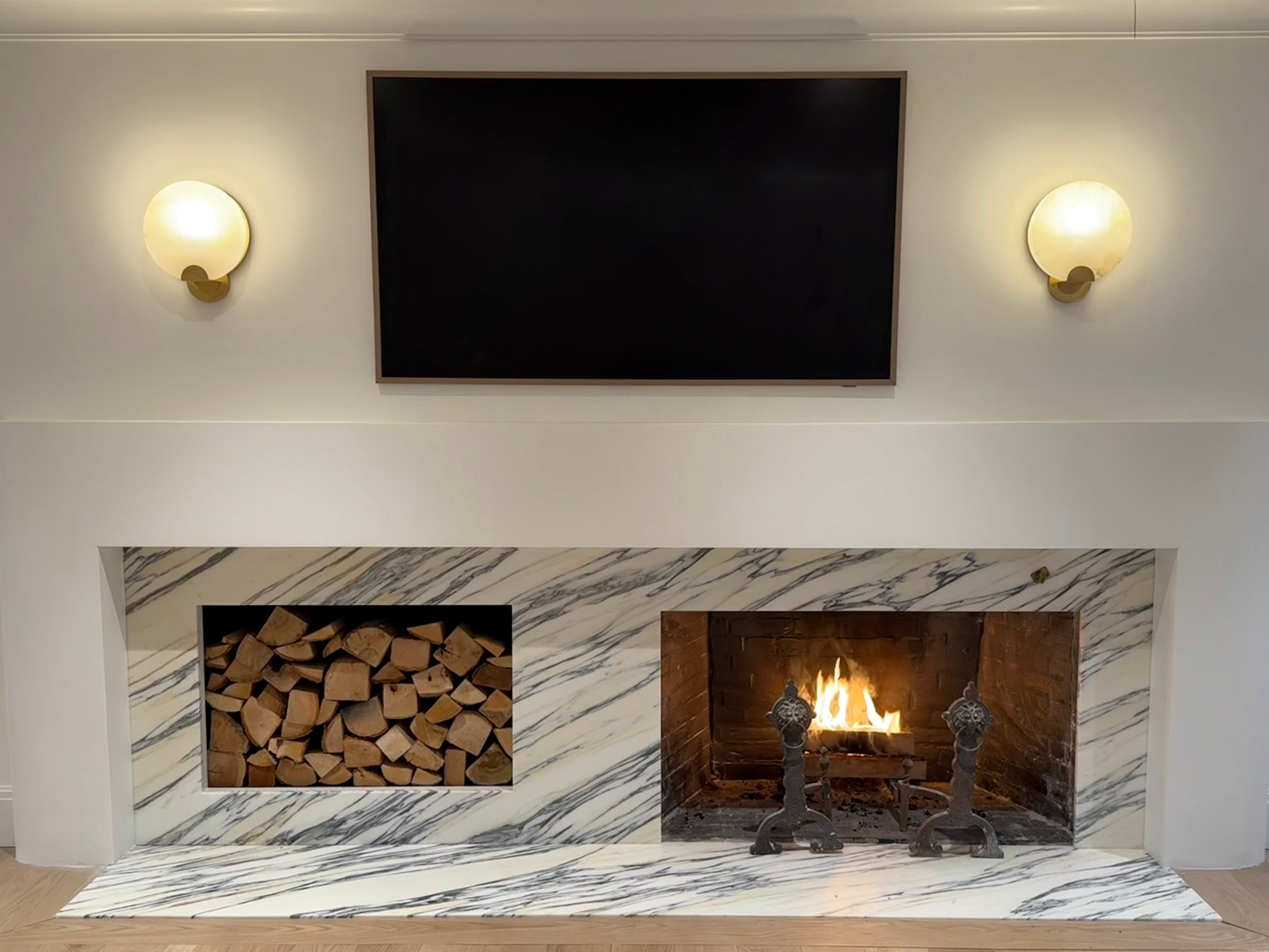
The slabs are the same ones we fabricate as marble countertops. For marble types, polished versus honed and bookmatching, see our guide to marble fireplace surrounds.
Quartzite is very common on new full-height walls lately. It typically has the veining of marble in a much harder stone, the same one we fabricate as quartzite countertops.
That hardness makes quartzite difficult to mill down when a piece has to be thinned. Our guide to quartzite fireplace surrounds covers varieties and finishes.
Soapstone, the Stone Fire Doesn't Bother
Heat and fire don't bother soapstone a bit. That's why it is used on actual wood stoves.
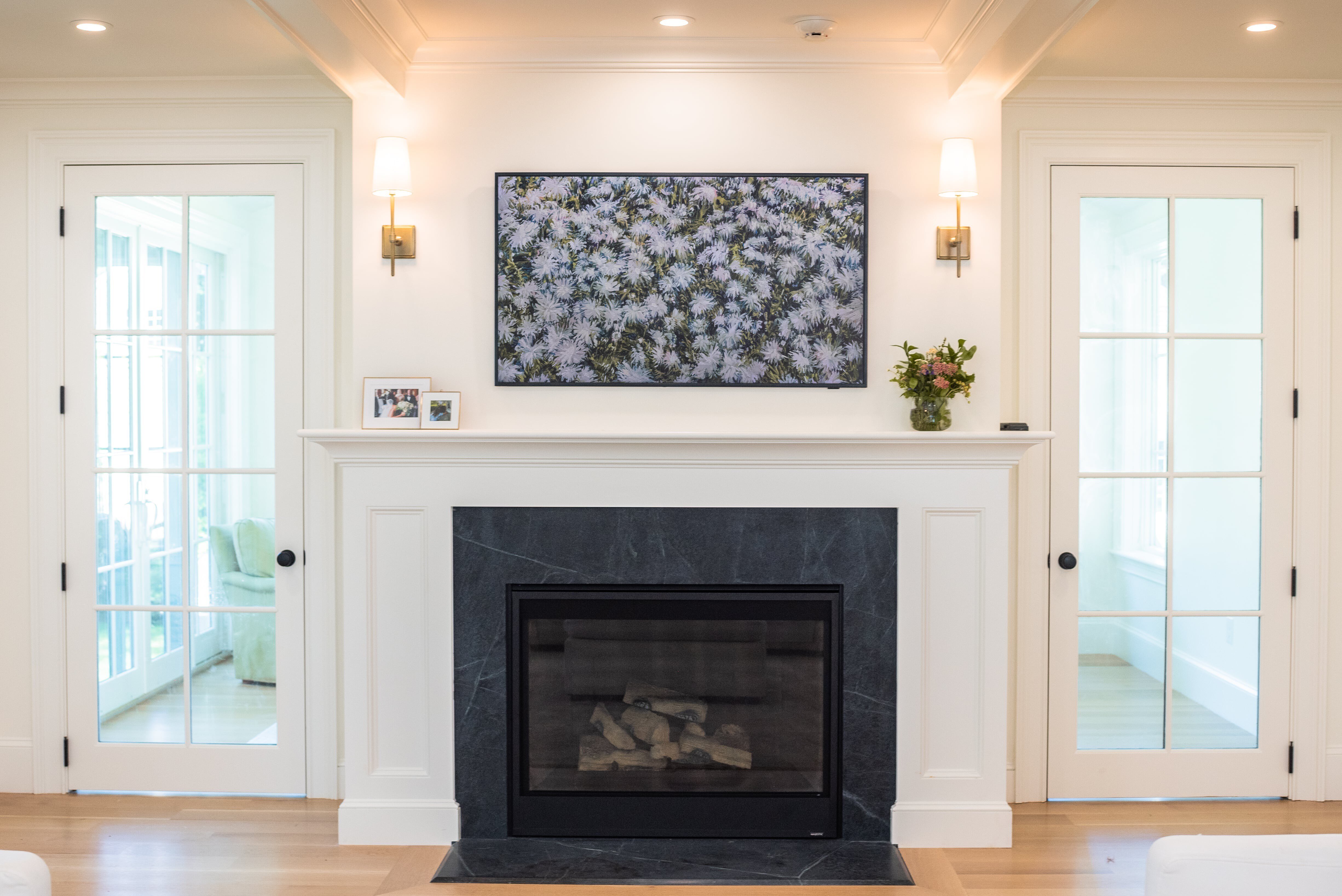
Soapstone is typically dark gray to black, often with light veining, and it varies from slab to slab. It is the same material we fabricate as soapstone countertops, so come see what is in the warehouse.
Porcelain Slab for the Flat Modern Wall
Large-format porcelain and sintered stone are changing New England fireplaces: bigger walls, flatter faces, a more modern look. Porcelain is tough and heat resistant when it's fabricated properly.
It is also unforgiving. Quality varies a lot from one maker to the next, and a piece can snap even when everything is done right.
Warning: A perfectly square inside corner on a porcelain fireplace opening will crack. We round those corners, even on the modern square opening.
No seams is what porcelain promises, and it is not that simple. One piece is not the best choice every time, for porcelain or for stone. Our porcelain countertops page has more on the material.
Can You Use Quartz Around a Fireplace?
No. I don't recommend quartz around any fireplace, even an electric one.
When quartz was first introduced, I won't lie, I used it on some fireplace surrounds, and they all cracked. A fireplace heats up and cools down over and over, and quartz cracks from that in a short time.
Extreme heat or direct flame is worse, because quartz can actually combust. The discoloring you hear about is mostly from UV light and hot pans, which is a kitchen issue, and quartz countertops belong in the kitchen.
One manufacturer published a special way to build a quartz fireplace that they said would not crack. It made the job far more complicated, and after what I had seen, I still prefer to avoid it.
Surround and Hearth From the Same Stone
When the surround and hearth come from the same stone, raised or flush with the floor is the design decision.
Some clients say, "I want it flush." I can't promise that. We don't know what's under the tile until it gets removed.
The tile you're replacing is usually thinner than a stone hearth, so the new hearth wants to sit higher than the floor. In a remodel, it is easier to put the stone in first and let the hardwood crew feather into it.
For depth, thickness and what a flush hearth takes, see our fireplace hearths page.
Plan the Stone Before the Woodwork and Floors
The order the trades work in decides how the stone can sit. Bring your fabricator in before the woodwork and the flooring are finished.
The easiest fireplace is in a new house, because everything gets planned ahead of time. A remodel is close behind: the contractor is already there, so when the demo turns up a surprise, there is someone on site to deal with it.
The hardest job is changing only the fireplace in a house where nothing else is going on. We do the slab fabrication and installation only, so the demolition is yours or your contractor's, and demolition is where one thing leads to another. Sometimes it takes a jackhammer.
We also don't build the wall or control how the stone gets into the house. The flatter the wall, the better the stone sits, and in New England, where every house is framed in wood, a truly flat wall is rare.
Before I measure, I mostly ask questions. What do you have now, is it a metal insert or a wood-burning fireplace, and how do you plan to finish around it?
For the full picture on the job itself, from the materials we recommend to putting a TV above the fire, see our fireplace surrounds page.
Pro tip: Fireplaces are the trickiest jobs in my trade, and they use very little material. Small in stone and high in difficulty is why the planning matters.
What Fire Does to Stone Over Time
Normal use typically will not take the finish off a stone surround. Run a fireplace hard enough, or let the flame reach it, and some stones can crack or stain, so it's best to keep direct flame off the surround.
A wood-burning fireplace will leave soot and smoke marks on whatever is around it over time. That is part of what a real fire is.
A surround usually does not need sealing, because nothing liquid gets spilled on it. Sealer closes the pores to stop liquids from getting in. It may help a little against soot on a wood-burning fireplace, and it does not hurt.
For cleaning, a soft cloth and a pH-neutral cleaner are enough. Our guides on how to clean marble countertops and how to clean granite countertops list the products to keep away from stone.
Are Stone Fireplaces Still in Style?
Yes. Stone fireplaces are still in style, and what dates is the color, not the stone.
In New England, trends come and go, and what lasts is the subtle, neutral, safe colors. I used to install a rose pink marble from Iran that was huge back in the day, and you don't see it anymore.
The really exotic stones tend to go the same way. If it's your own house and you love it, there is nothing wrong with a bold stone.
The best proof is an old house. We spent months this year at a 19th-century estate in downtown Southborough, a house built in 1840 with no modern heat. Everything was fireplaces, so there were a lot of them, and some are very fancy, in old European marbles you don't see anymore.
We did not remove or replace any of it. A damaged hearth and a few other pieces had to be matched with new stone, or as close as we could get, and the original marble stays where it has been for nearly two centuries.
How Much Do Stone Fireplaces Cost?
On a fireplace, the work drives the price more than the stone: a mitered box over brick, or a floor-to-ceiling wall that takes a whole slab, costs more than two legs and a piece across. The rest, sourcing, size, complexity, waste, is the same for every material, and we break it all down on our pricing page.
Is a Stone Slab Fireplace Right for You?
Choose a stone slab fireplace if:
- You want a few solid pieces with no grout lines.
- You like the classic New England surround, or a modern floor-to-ceiling wall.
- You can bring the fabricator in before the woodwork and floors are finished.
Consider alternatives if:
- You want stacked stone, veneer or tile. That is a mason's or tile setter's work.
- You have your heart set on quartz. I don't recommend it near a fireplace.
- You expect an existing wall and floor to come out perfectly flush without making it a bigger project.
My Recommendation
My honest opinion: I prefer subtle, the New England style, and by subtle I mean the colors. Neutral, safe colors are what last here. The design itself can be as detailed as you like, and some of the most intricate fireplaces I've built are in quiet colors.
Things are changing, though. Beautiful designs are getting more popular every year, and it's hard to pick, so the right choice is the right design for your house, not the one I'd pick for mine.
If you want the showpiece, do the floor-to-ceiling wall and plan it properly. Have the wall checked, put the seam on top of the legs, and approve the layout before fabrication.
Either way, come see it in person.
Frequently Asked Questions About Stone Fireplaces
Q. Do you install stacked stone, veneer or tile fireplaces?
A. No. We fabricate and install slab stone only, so stacked stone and veneer go to a mason and tile goes to a tile setter.
Q. Can a stone fireplace go over existing brick?
A. Yes. How we do it depends on the brick and what you want the finished fireplace to look like, so it's a conversation at the showroom, not a one-size answer.
Q. Does a stone fireplace surround need to be sealed?
A. Usually not. Sealer is for liquids, and nothing liquid gets spilled on a surround.
Q. Can a floor-to-ceiling stone fireplace be one piece?
A. Sometimes. It depends on the size of the fireplace and the size of the slab, and one piece is not the best choice every time.
Q. Which stone handles a wood-burning fireplace best?
A. Soapstone. It is the one material heat and fire don't bother, which is why it is used on wood stoves.
Q. Can I use quartz around an electric fireplace?
A. I don't recommend it, even around an electric unit. Quartz can crack from thermal shock, the rapid heating and cooling a fireplace puts it through.
Q. What is a mitered edge on a fireplace?
A. It is two edges cut at 45 degrees and joined to turn the corner. The seam almost disappears, so even a thin material like porcelain can read as a thick block of stone.
Related Articles
- Carrara Marble Countertops: Massachusetts Fabricator's Complete Guide
- What Is Quartzite? Complete Guide from a 30-Year Fabricator
- What Is Soapstone? A 30-Year Fabricator's Complete Guide
Visit Our Southborough Showroom
Still figuring out which stone is right for you? Come see us. Nothing beats standing in front of the actual slabs, comparing colors, patterns, and finishes in person. That's how you make the right decision.
Stop by our countertop store at 43 Turnpike Road (Route 9), Southborough, MA 01772 during business hours. We keep a large inventory in our heated warehouse, so there's always plenty to see.
Already done your homework and know what you want? Email us or give us a call.
Phone: 508-460-7900
Email: info@graniteguyinc.com