Quartzite vs Granite Countertops: A MA Fabricator's Honest Comparison
Quartzite and granite are both natural stones formed deep in the earth, and they share a lot of the same qualities: durability, heat resistance, and lasting good looks. But nature makes them slightly different, and those differences matter when you're choosing countertops for your Massachusetts home.
After 30 years of fabricating and installing both materials across Greater Boston and MetroWest, I can tell you this: there's no wrong choice here. Both are excellent for busy kitchens. The real question is which one fits your style and budget.
💡 The Short Answer: Budget-conscious and want maximum color options? Granite. Love the marble look with serious durability? Quartzite. Both are excellent for busy kitchens — the "right" choice comes down to your style and what you're willing to spend.
🪨 What's the Difference? How Nature Makes Them
Let's start with how these stones are born. Understanding what is quartzite versus what is granite helps explain why they look and perform differently.
Granite is an igneous rock. It forms when molten magma cools slowly beneath the earth's surface. That slow cooling creates the crystal structure you see in granite slabs, those flecks and speckles of quartz, feldspar, and mica.
Quartzite is a metamorphic rock. It starts as sandstone, then gets transformed by intense heat and pressure over millions of years. The sand grains fuse together into interlocking quartz crystals, creating one of the hardest natural stones available. (Don't confuse this with the quartz vs quartzite debate — quartz countertops are engineered, while quartzite is 100% natural stone.)
Both are quarried, cut into slabs, and polished. But that difference in formation gives each stone its own personality.
🎨 Appearance: Bold vs. Elegant
This is where most homeowners notice the biggest difference.
✦ Granite's Look
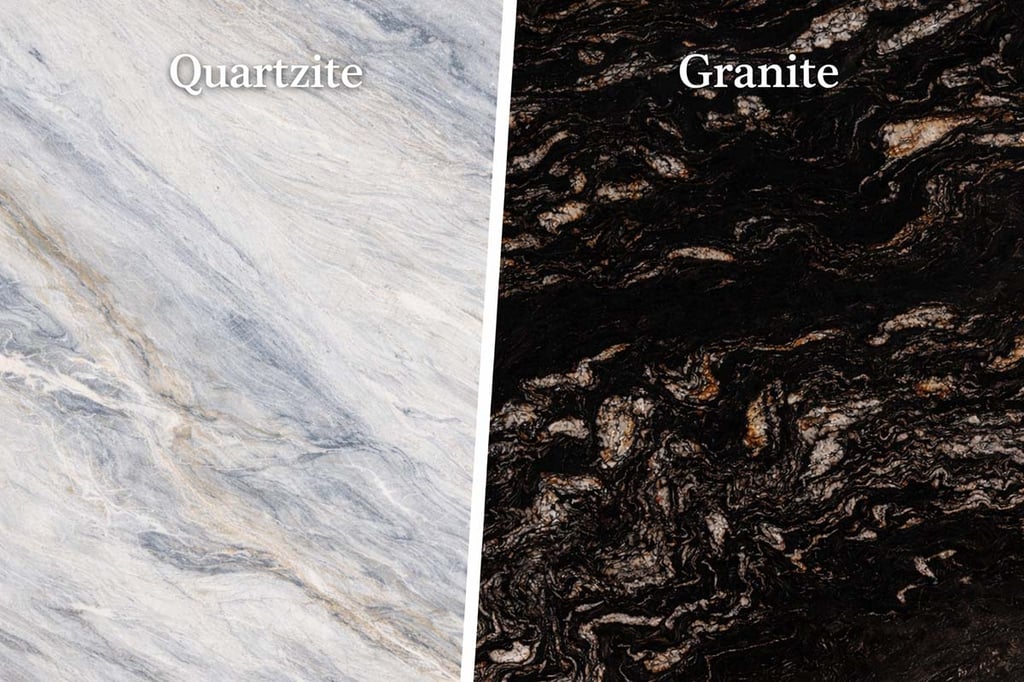
Granite is bold and exotic. You get dramatic movement, speckles, flecks, and crystals that catch the light. Colors range from classic blacks and whites to deep blues, rich greens, and warm golds.
If you want a countertop that makes a statement, granite delivers. The patterns are often busier and more complex, with visible mineral deposits throughout the slab.
✦ Quartzite's Look
Quartzite has a more refined, marble-like appearance. Think soft veining, flowing patterns, and a luminous quality that's hard to replicate. Most quartzite comes in lighter tones: whites, creams, soft grays.
If you love the look of marble but want something tougher, quartzite is your answer. It gives you that elegant, high-end aesthetic without marble's maintenance headaches.
💡 Pro Tip: If you're torn between the two, visit a showroom and see full slabs in person. Photos never capture the depth and movement of natural stone. What looks perfect online might feel completely different when you're standing in front of a 10-foot slab.
💪 Durability: Both Are Workhorses
Here's the good news: both granite and quartzite are extremely durable. You can't go wrong with either in a busy New England kitchen.
✦ Hardness
On the Mohs hardness scale (which measures scratch resistance), granite typically rates 6-7. Quartzite comes in slightly higher at 7-8.
In practical terms? Both resist scratches from everyday use. I still recommend using cutting boards, not because you'll damage the stone, but because you'll dull your knives.
✦ Heat Resistance
Both stones handle heat beautifully. You can set a hot pan down without panic. For the full story, see our guide on how quartzite handles heat. That said, I always recommend trivets as a habit. Thermal shock (rapid temperature changes) can stress any natural stone over time.
✦ Chip Resistance
Granite has a slight edge here. Its crystalline structure absorbs impact a bit better. Quartzite is harder, but that hardness can make it slightly more brittle at the edges. Both are tough, but be mindful around corners.
⚠️ Warning: Never drag heavy cast iron across any natural stone countertop. Lift it. This applies to both granite and quartzite.
🧽 Maintenance: Easy for Both
Both granite and quartzite are low-maintenance stones. Wondering how to clean quartzite countertops? Same as granite: mild soap and water, or a stone-specific cleaner. Avoid harsh chemicals, acidic cleaners, and abrasive scrubbers.
✦ Sealing
Both stones are porous and benefit from sealing. Most slabs come pre-sealed from the fabricator, but how often you reseal depends on the specific stone and how you use it.
Here's a quick test: drop a few water droplets on your countertop. If they bead up, you're good. If they soak in within a few minutes, it's time to reseal.
✦ Stain Resistance
Granite tends to be slightly more stain-resistant out of the box. Quartzite can be more variable. Some quartzites, like Taj Mahal or Sea Pearl, are very dense and resist stains well. Others are more porous and need more attention.
When you're shopping, ask about the specific slab's porosity. Not all quartzites are created equal.
✦ Acid Resistance
True quartzite resists etching from acidic substances like lemon juice and vinegar. This is one of quartzite's genuine advantages.
A word of caution: Some stones labeled "quartzite" are actually dolomitic marble or hybrid materials. These will etch. If acid resistance matters to you, ask your fabricator to confirm you're getting true metamorphic quartzite.
🏠 Best Applications
✦ Kitchens
Both are excellent for kitchen countertops. Quartzite kitchen countertops and granite kitchen countertops both hold up to daily abuse in busy households with kids.
Granite's wider color range makes it easier to match existing cabinetry and flooring. Quartzite's lighter tones work beautifully in bright, modern kitchens common throughout MetroWest and Greater Boston.
✦ Bathrooms
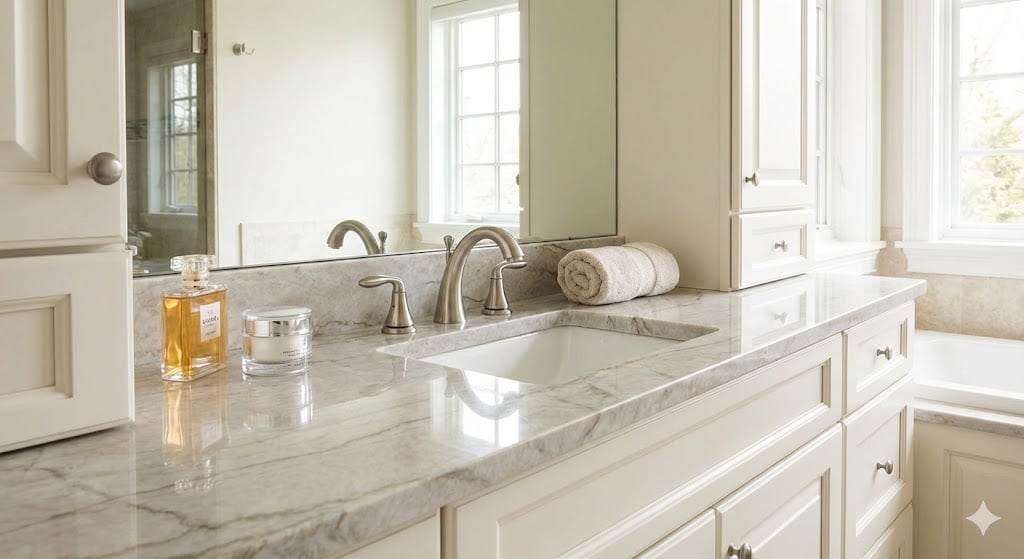
Both work well in bathrooms. Quartzite bathroom countertops are especially popular for master bath vanities where you want that spa-like feel. The same material can extend to a quartzite backsplash for a seamless look.
✦ Outdoor Kitchens
Granite has a slight advantage for outdoor applications in New England. It handles freeze-thaw cycles well. Some quartzites can be used outdoors, but check with your fabricator about the specific slab's suitability for Massachusetts weather.
🔧 Finish Options
Both stones come in multiple finishes. Your choice affects both appearance and maintenance. The honed vs polished quartzite debate applies equally to granite.
✦ Polished
High gloss, reflective surface. Shows off the stone's depth and color. Easier to clean but shows fingerprints and water spots more readily. A polished finish also highlights whatever quartzite edge profile you choose.
✦ Honed
Matte finish with a soft, velvety feel. More forgiving of daily wear. Can be slightly more prone to showing stains since the surface is more open.
✦ Leathered
Textured finish that hides fingerprints and water spots well. Very popular for both granite and quartzite. Gives a more organic, tactile feel.
My preference for busy kitchens? Leathered finishes on darker stones, polished on lighter ones. But this comes down to personal taste and how you use your kitchen.
💰 Pricing: Why You Need to Talk to a Fabricator
For reference, most natural stone projects fall in the $55-150 per square foot range installed — but the variation within that range is significant depending on material selection, sourcing, complexity, and waste.
Rather than throw generic numbers at you, we've written a comprehensive guide that breaks down quartzite countertop cost in detail. Read our quartzite pricing guide — it covers entry-level to exotic materials, supplier sourcing, fabrication complexity, and real cost drivers.
The short version: granite tends to have more budget-friendly options, while quartzite generally starts at mid-range and goes up. But your specific project, the exact slab you choose, and your location all matter.
✅ Granite Is the Right Choice If...
You want maximum variety. Granite offers the widest color selection of any natural stone. Blacks, whites, blues, greens, golds, reds. Bold patterns, subtle patterns, everything in between. If you have a specific vision, granite probably has a slab that matches.
You're budget-conscious but want natural stone. Granite has more price tiers than quartzite. You can find beautiful, durable entry-level granites that look great and last decades. Quartzite doesn't have that same affordable range.
You prefer bold, exotic looks. Granite's crystal structure creates dramatic movement, visible mineral flecks, and depth that catches light. If you want your countertop to make a statement, granite delivers.
You're doing an outdoor kitchen. Granite handles New England freeze-thaw cycles reliably. It's a proven outdoor material in Massachusetts.
You value a proven material. Granite has been used in homes for generations. There's no guessing about how it performs long-term.
✅ Quartzite Is the Right Choice If...
You love marble but hate the maintenance. Quartzite gives you that elegant veining, soft movement, and refined look that marble is famous for. But it's significantly harder and more durable. You get the aesthetic without the anxiety.
Your kitchen is bright and modern. Quartzite's lighter color palette (whites, creams, soft grays) works beautifully in contemporary kitchens with lots of natural light. It brightens the space without looking cold.
Scratch resistance is a priority. Quartzite is one of the hardest natural stones available. If your household is tough on surfaces, quartzite handles abuse slightly better than most materials.
You cook with a lot of acidic ingredients. Lemon, vinegar, tomatoes, wine. True quartzite won't develop dull spots from acid exposure over time. This matters if you do a lot of food prep directly on the counter.
You're investing in a forever home. Quartzite is a premium material with premium pricing. If you're staying long-term and want the best, it's worth the investment.
🛠️ My Honest Take
After fabricating thousands of countertops in both materials, here's what I tell customers:
Start with the look. Stand in front of both materials in a showroom. Which one speaks to you? Granite's bold drama or quartzite's quiet elegance? Your gut reaction matters more than specs.
Then check the budget. If you're working with a tighter budget but want natural stone, granite gives you more options. If budget allows and you're drawn to quartzite's look, it's worth the investment.
Don't overthink durability. Both are excellent. Both handle busy Massachusetts kitchens. Both last decades with basic care. You're not going to regret either choice on durability alone.
If I had to pick one for a typical Massachusetts kitchen remodel? Granite. More options, more price flexibility, and a proven track record that goes back generations. But when a client falls in love with quartzite's elegance and the budget allows, I never talk them out of it. You're choosing between two winners.
The right stone is the one you'll love looking at every morning for the next 20 years. Come see full slabs in person. Touch the finishes. The decision usually becomes obvious once you're standing in front of the material.
❓ Frequently Asked Questions
Q. Is quartzite more expensive than granite?
A. Generally yes. Granite has more entry-level options, while quartzite typically starts at mid-range pricing and goes up from there.
Q. Which is harder, granite or quartzite?
A. Quartzite is slightly harder (7-8 on the Mohs scale vs. granite's 6-7). Both are extremely durable for kitchen use.
Q. Do both need to be sealed?
A. Yes. Both are porous natural stones that benefit from sealing. How often depends on the stone — use the water test to check.
Q. Can I put hot pans on granite or quartzite?
A. Yes, both handle heat well. I still recommend trivets as a good habit to protect against thermal shock.
Q. Which scratches more easily?
A. Neither scratches easily with normal use. Quartzite is technically harder, but you should use cutting boards on both to protect your knives.
Q. Which has more color options?
A. Granite by a wide margin. You'll find everything from blacks to blues to golds. Quartzite tends toward whites, creams, and grays.
Q. Is granite outdated?
A. Absolutely not. Granite remains one of the most popular countertop materials. The "granite is dated" myth comes from specific colors that were trendy in the 90s, not the material itself.
Q. Which is better for busy families?
A. Both are excellent. If your household is particularly hard on surfaces, quartzite's extra hardness offers a slight edge.
Q. Which is better for outdoor kitchens in Massachusetts?
A. Granite is the safer choice. It handles freeze-thaw cycles reliably. Some quartzites work outdoors, but verify with your fabricator first.
Q. How do I know if my quartzite is real quartzite?
A. Ask your fabricator. Some stones labeled "quartzite" are actually dolomitic marble. Real quartzite won't etch from acids.
📚 Related Articles
🏠 Visit Our Southborough Showroom
Ready to see granite and quartzite slabs in person? Visit our countertop store at 43 Turnpike Road (Route 9), Southborough, MA 01772.
📞 508-460-7900
📧 info@graniteguyinc.com