Written by Granite Guy Inc., Southborough, Massachusetts
Updated: November 3, 2026
There are more types of black granite countertops than most homeowners expect, and the names can fool you. Steel Grey and Silver Grey are both black granites, and some of the blackest stones don't have "black" in their name at all.
The quick answer: The black granites we fabricate most are Absolute Black, Black Pearl, Steel Grey, Silver Grey, Black Galaxy, Jet Mist, Silver Waves, Titanium Gold and Via Lactea. All of them work in a kitchen. The real difference is the look: plain black, flecked, or veined.
I've been fabricating and installing countertops in Massachusetts since 1995, and I've worked with every one of these. If you're narrowing down granite countertops in black, this is what I tell homeowners in our Southborough showroom.
Types of Black Granite Countertops We Work With Most
"Black granite" is a trade name. It covers several rock types, each with its own makeup, which is why two black slabs can look so different on the rack.
For what black granite does well overall, heat, scratches and upkeep, see our black granite countertops guide. This post is about the varieties.
Black Granite Colors: Plain, Flecked or Veined
- Plain: Absolute Black and Black Pearl. Close to solid black from across the room.
- Flecked or textured: Steel Grey, Black Galaxy and Jet Mist. A black base with gray spots, metallic specks or a soft white dusting.
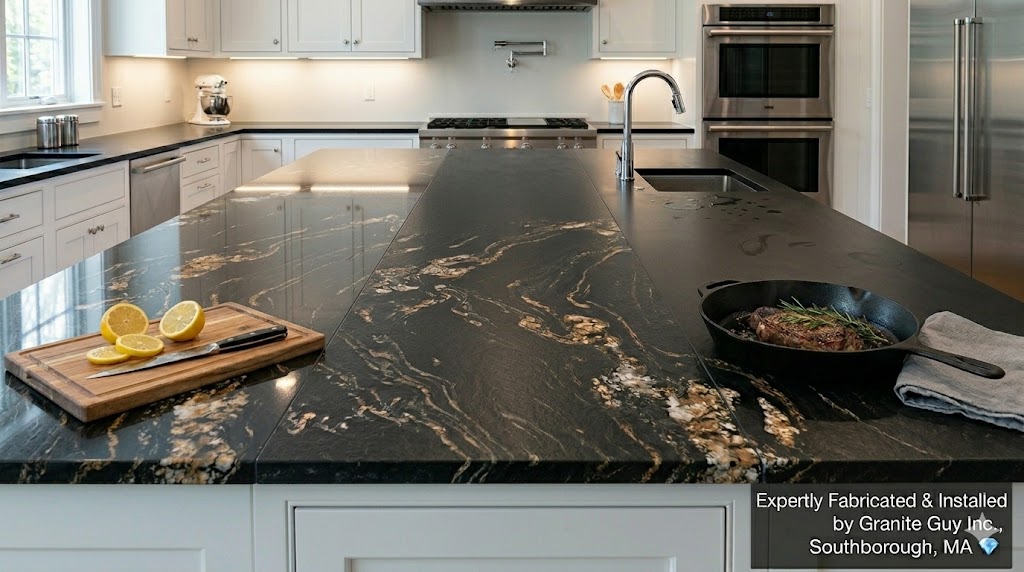
- Veined: Silver Grey, Silver Waves, Via Lactea and Titanium Gold. Lines of white or gold running across the slab.
These are natural stones, so what follows is what each one typically looks like. Two slabs with the same name can differ, so always see the actual slab before you commit.
Plain Black Granite: Absolute Black and Black Pearl
Absolute Black
Absolute Black is the closest thing to solid black in granite. Our Absolute Black comes from India, and the cleanest slabs are almost a flat color, with barely any speckles.
It does vary. Some slabs commonly show tiny silver specks up close and some run more speckly; the cleanest ones are what some suppliers sell as Premium Black.
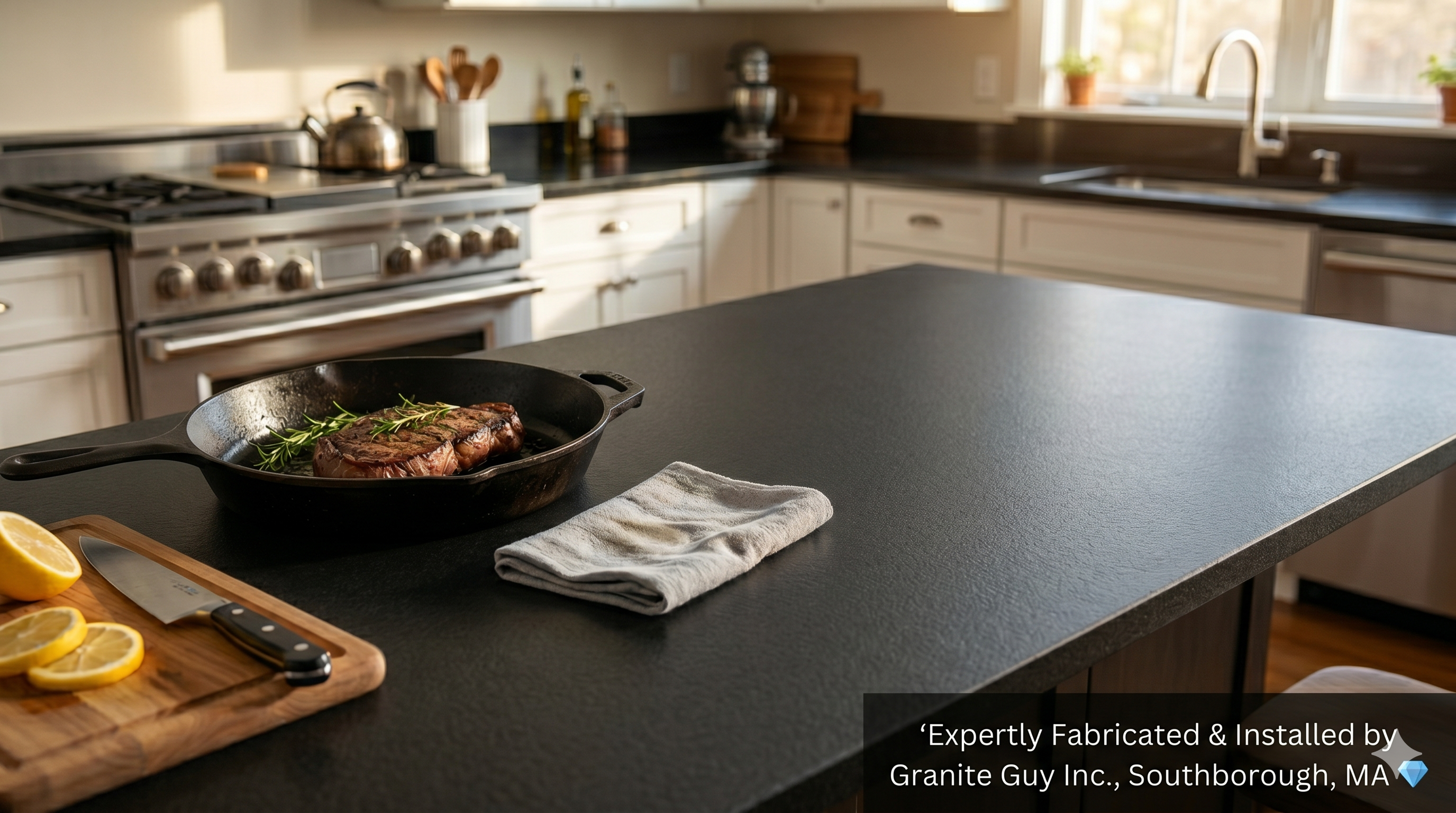
Honed Absolute Black is a popular pick, and here's what I tell every customer up front: honed shows fingerprints. Even the oil from your hands leaves a mark, so think about where it lands in a busy kitchen.
Where honed Absolute Black really works is a fireplace surround. Matte black stone next to a black metal insert blends in instead of fighting it, and we do a lot of those.
Black Pearl
Black Pearl is almost as black as Absolute Black, typically with a faint gold cast you notice up close. It's more a light shimmer in the color than flecks, and it's one of the lower-priced black granites.
Where Black Pearl really shines is leathered. It looks rich, with a feel close to soapstone countertops, so for a farmhouse kitchen that wants that look without soapstone's scratches and dents, it's one to see.
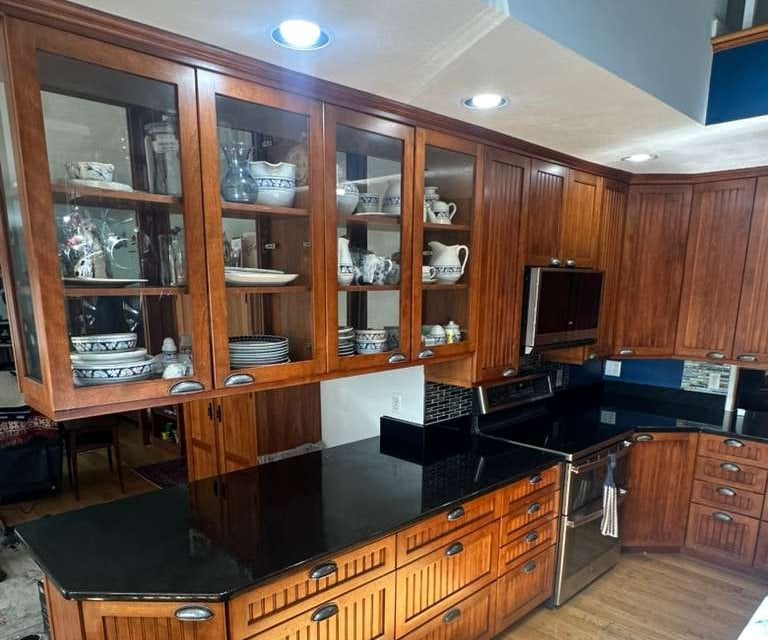
Steel Grey, Silver Grey, Black Galaxy and Jet Mist
Steel Grey
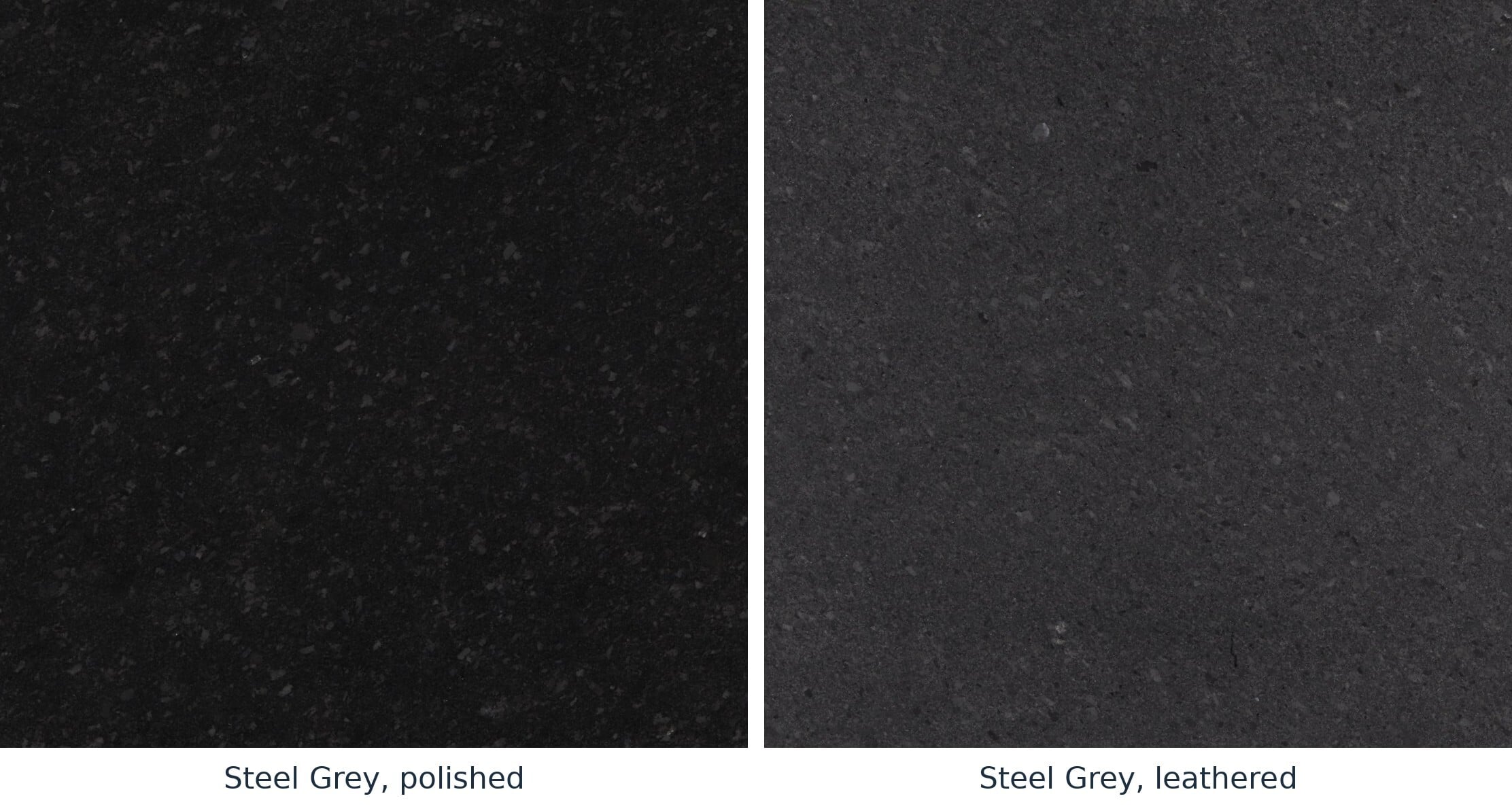
Don't let the name fool you: Steel Grey is a black granite. It comes from India and typically has a black base with a grayish cast and gray spots about the size of a dime, sometimes a nickel.
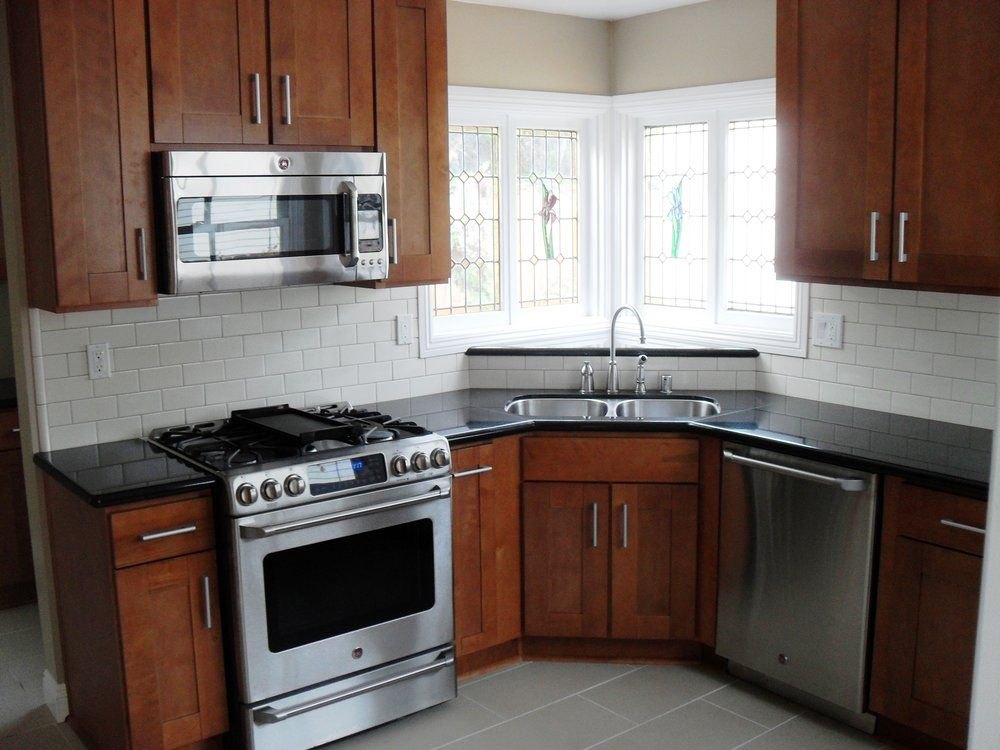
On a counter it reads as black, and it sits well next to stainless steel appliances. It's one of the lower-priced black granites, which is a big part of why it gets picked so often.
Where it's most popular might surprise you: outdoors. Leathered, Steel Grey goes noticeably grayer, and that gray matches New England hardscape, the walkways, patios and pavers already in the yard.
So it ends up on grill counters and outdoor bars all over MetroWest. Our outdoor countertops page covers which stones hold up outside and why.
Silver Grey
Silver Grey is a different stone from Steel Grey, not a lighter lot of it. It comes from Brazil, and it typically carries thin white veins across a gray-black base, finer and quieter than Silver Waves.
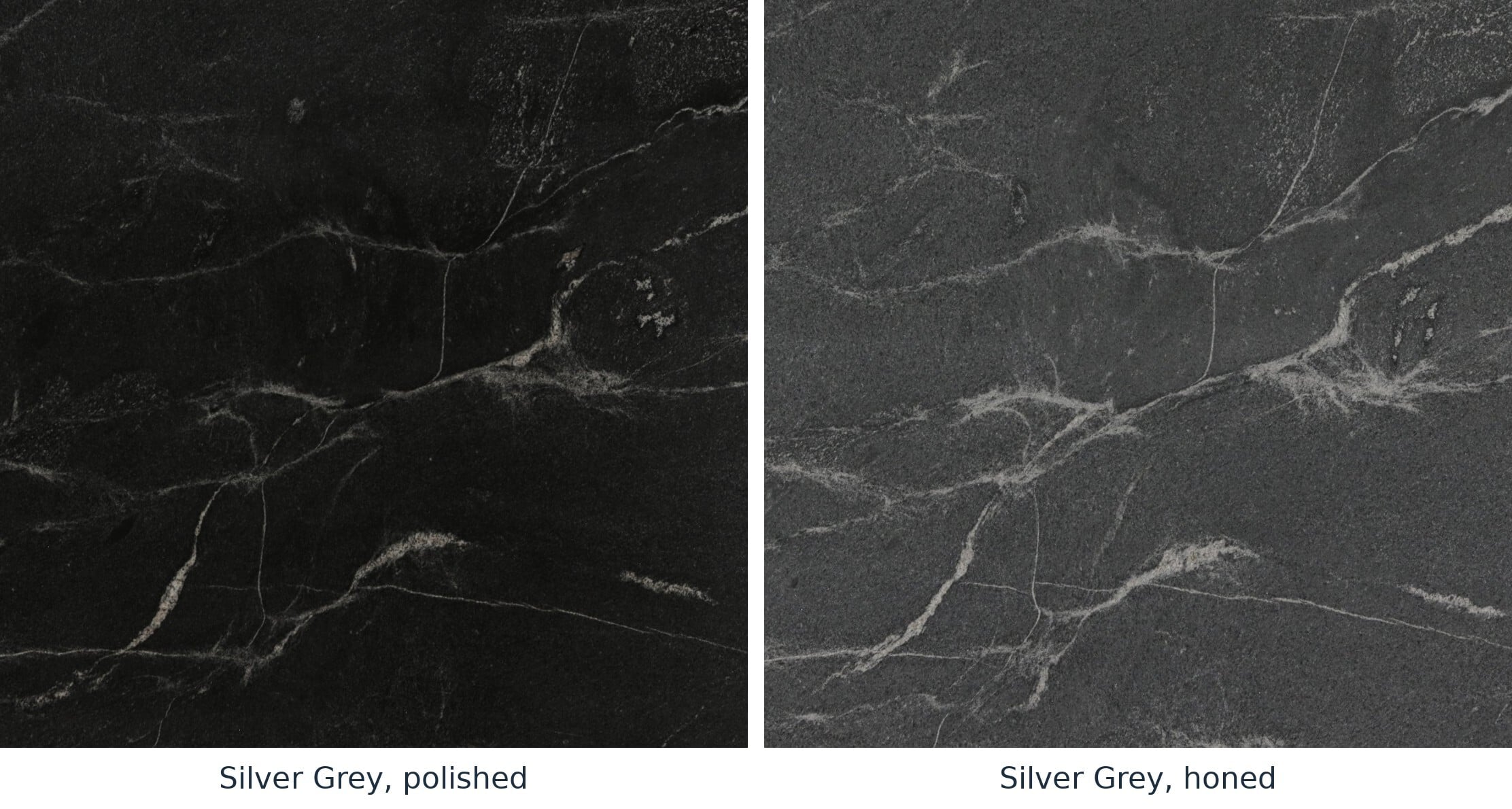
Polished, it typically reads as a lighter, grayish black. Honed or leathered, it looks more gray than black, and it runs a little above Steel Grey in price.
Black Galaxy
Black Galaxy is quarried in India and typically has a black base with specks that are mostly copper, with some gold and some silver. The silver version was sold for a while as Silver Star.

We've fabricated a lot of Black Galaxy, and the specks change from slab to slab. It's a natural product, and you can't control nature.
If two slabs side by side sparkle differently, that's not a defect. Picture slicing one piece out of a mountain, then months later another piece far from the first: it's going to be a little different, so look at the slab you're buying, not the sample.
Jet Mist
Jet Mist is a classic black granite in New England, and it's quarried in Virginia (more in our guide to marble and granite quarries in the USA). It typically shows a soft white dusting over a black base.
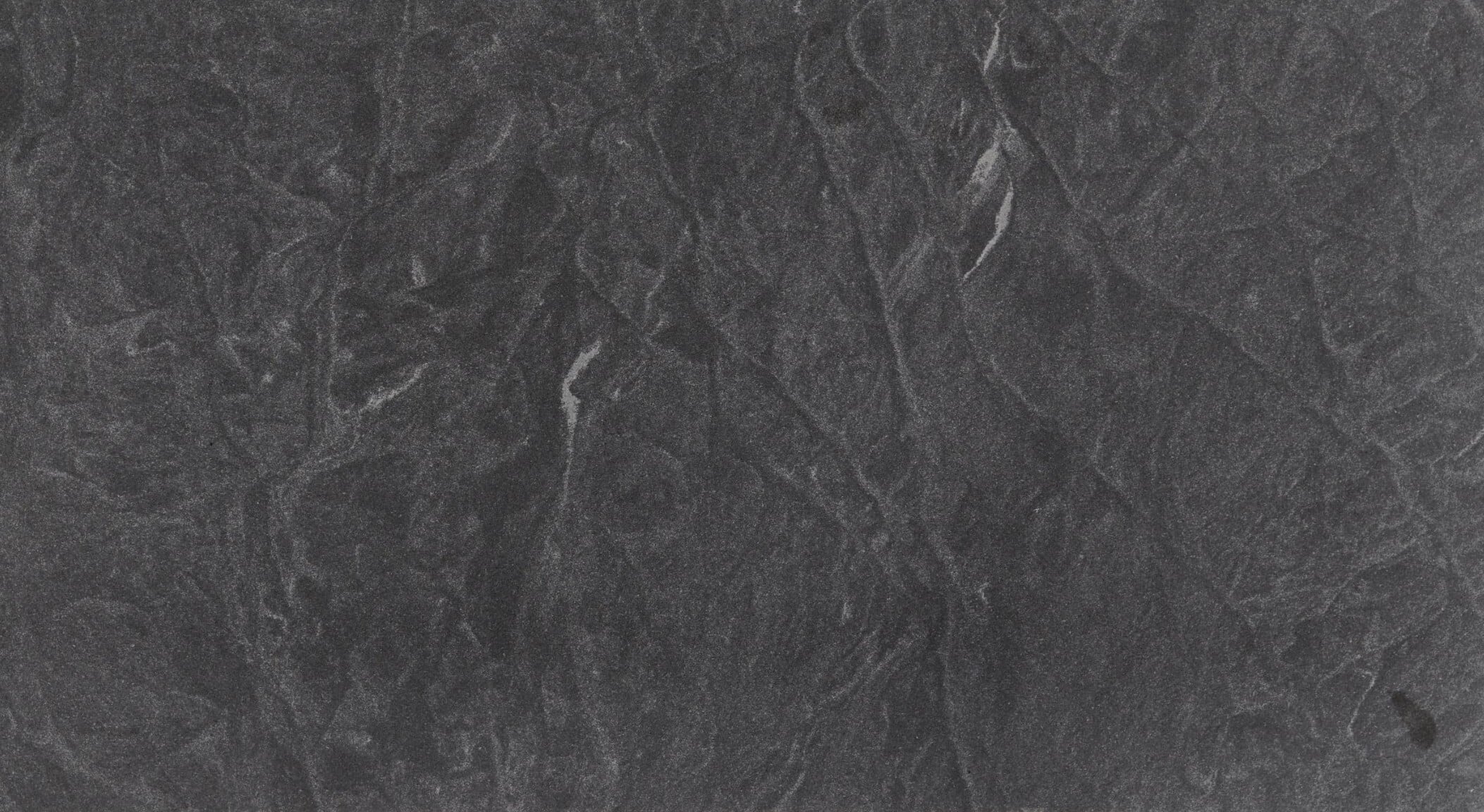
It's still a steady seller. White stones and quartzites lead today, but Jet Mist keeps going into kitchens, laundry rooms, fireplaces and pantries, and we see more of it outside too, in pavers, landscaping and monuments.
We have thousands of colors to choose from today, and only a dozen or two are the big sellers at any one time. Jet Mist has stayed in that group.
Veined Black Granite: Silver Waves, Via Lactea, Titanium Gold
If you want black but bold, these are the three to see. All of them carry veins on a black background; the difference is the vein.
Silver Waves
Silver Waves comes from India, and it's the dramatic one of the group. It typically has a grayish black background with wavy white veining that has real movement.
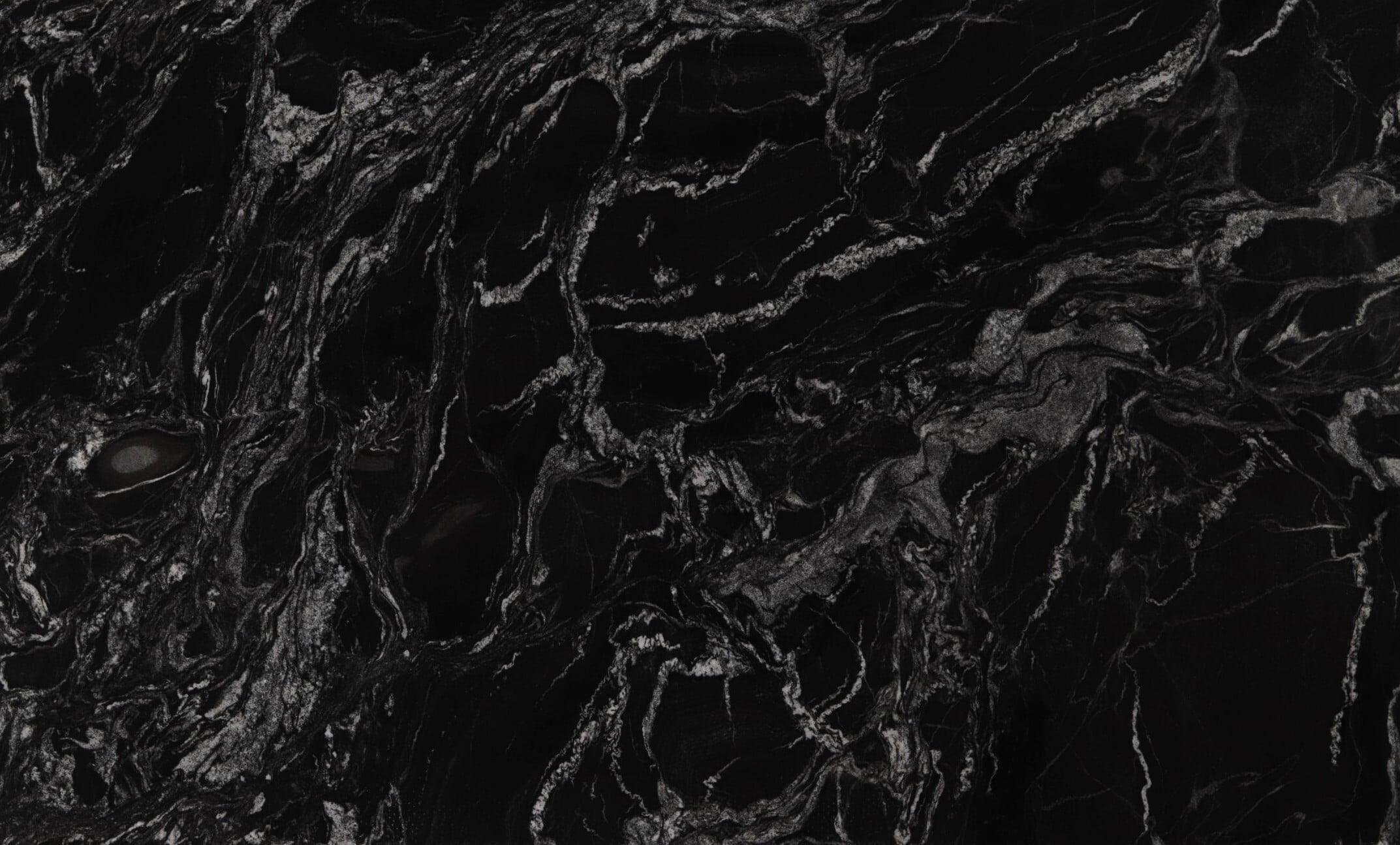
It's also a popular pick outside. The gray and white tones sit naturally against New England stone walls and walkways.
Via Lactea
Via Lactea typically has fine veins in a linear pattern. Which way they run depends on how the block was sliced: slabs come off a block in many directions, sometimes at 45 degrees.
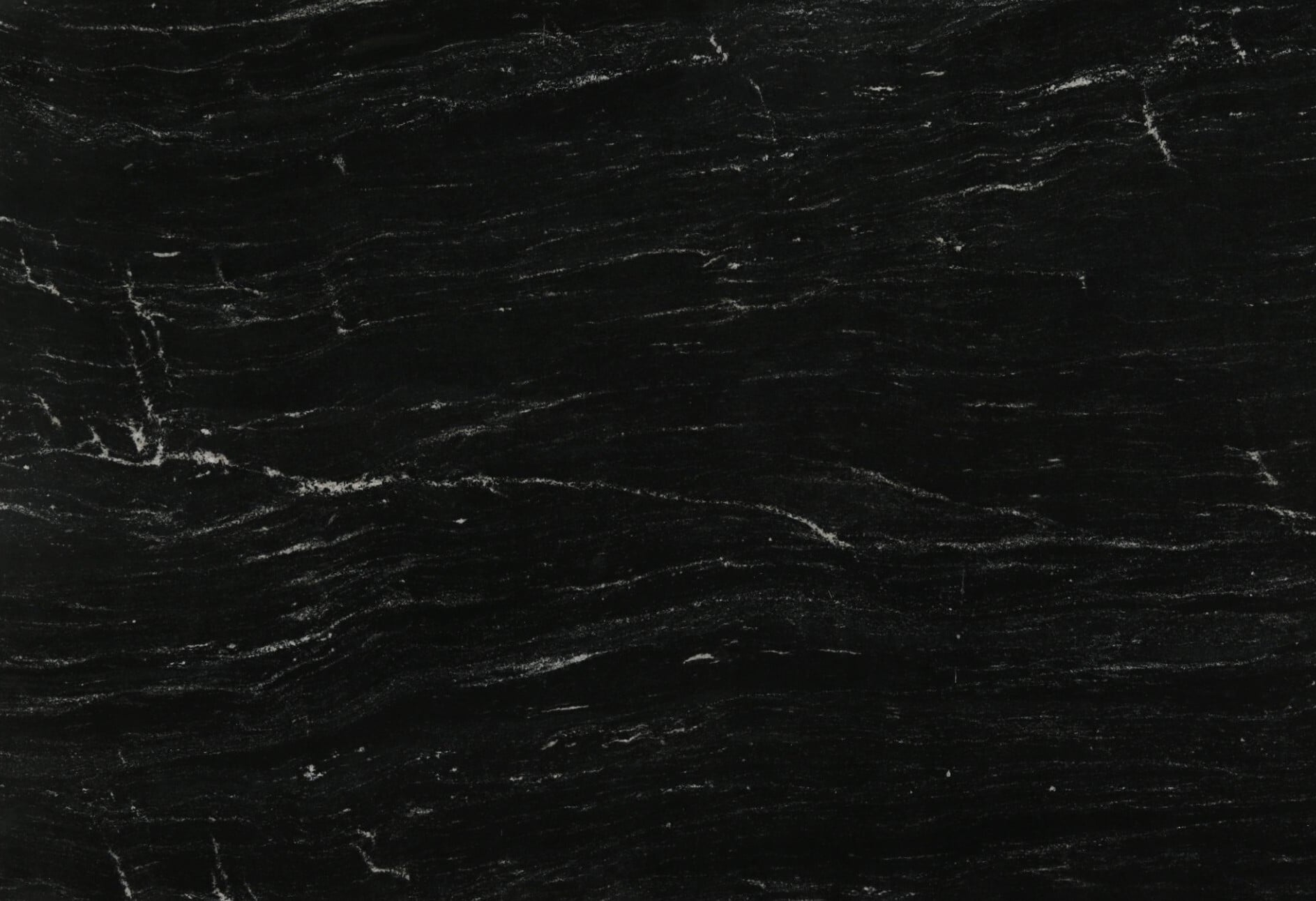
If you love the look of Nero Marquina but worry about marble countertops in a busy kitchen, this is the stone to see. Same feel, and it's granite, so it takes heat and daily use without etching.
Titanium Gold
Titanium Gold typically has wider, heavier veins than Via Lactea, white and silver with gold running through them. It reads warmer than Via Lactea, and it's the one customers stop at when they want the counter to be the point of the room.
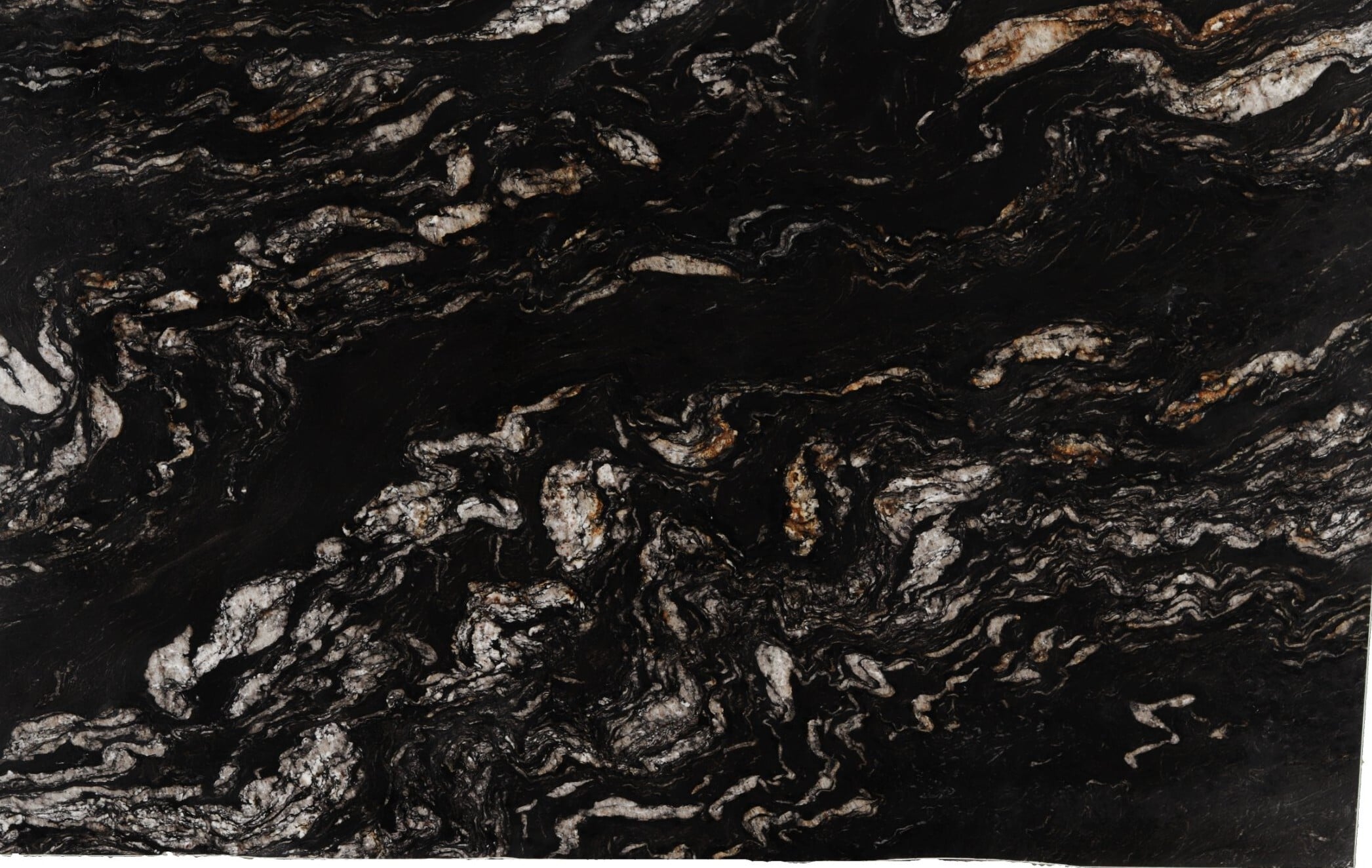
Both of these are a little more delicate as slabs than the other black granites. The veining is a different mineral that leaves weak spots, so they usually come with a mesh on the back, which matters for the finish (more on that below).
Which one is right comes down to the look: finer and cooler, or bolder and warmer. Bring a cabinet sample and stand in front of both.
Other Black Granite Names You'll Hear
One mountain range can hold many quarries, and every quarry gives its stone its own name. Carrara marble and Taj Mahal quartzite work the same way, which is why the list of names keeps growing.
- Premium Black: the name some suppliers give the cleanest Absolute Black, almost solid black with very few speckles.
- Silver Star: the silver-speckled version of Black Galaxy.
- Impala Black: it used to be a popular choice and holds up extremely well, but it typically reads more as gray with dots than black. Today we mostly see it coming out of kitchens being updated.
- Copacabana: one of Brazil's very dramatic black and white granites.
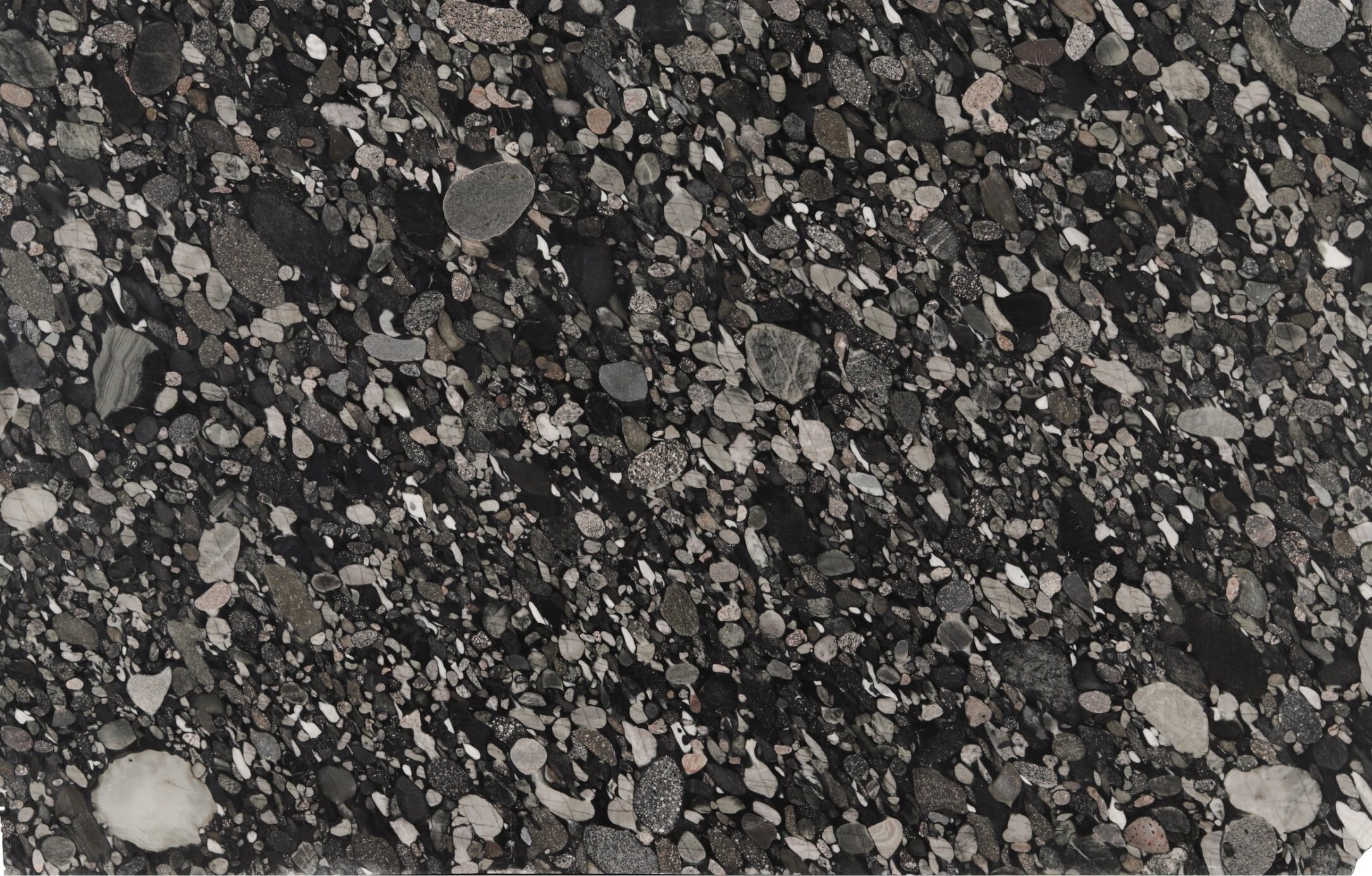
- Black Marinace: also from Brazil, and a conglomerate rather than a speckled or veined stone. Rounded pebbles in gray, white, brown and black, typically set in a black base, so every slab is its own picture.
- Volga Blue and Labrador Antique: part of the black family even though the names don't say it. Both have a glassy look with flashes like fish scales; Volga Blue's flashes look a little bluish, and Labrador Antique runs brown.

One Slab, Two Finishes
Many black granite slabs can be ordered dual-finish: polished on one face, leathered or honed on the other. You stand in front of the same stone, see both finishes, then pick.
Only a slab strong enough on its own gets finished on both faces, and that goes for any stone. The more delicate ones, like Via Lactea and Titanium Gold, have the mesh on the back, so only one face is finished.
Polished shows the deepest color and wipes clean easily. Honed is muted and subtle, and leathered gives a little rustic, farmhouse feel while still looking sharp.
Pro tip: Polished black reads much blacker. Honed or leathered, you get a grayer look, so pick the stone first, then look at it in more than one finish before you decide.
The Steel Grey pair above shows it. Some homeowners rule out polished before they've picked a color, because a wall of windows means glare. For the full breakdown, see our black granite finishes guide.
How to Choose a Black Granite Countertop
Start with how much you want the counter to say: plain, flecked or veined. Then look at your light.
Black absorbs light. In a kitchen with little natural light, a busier stone or a polished finish keeps the room from feeling heavy, and under-cabinet lights make a real difference on any of them.
The two questions I get asked most, side by side:
Steel Grey vs Black Pearl
Steel Grey is a little grayer, with a pebbly, dotted look across the surface. Leathered, that texture gets more pronounced, and the gray plays well with stainless.
Black Pearl is the quieter of the two: darker, with a finer grain. They sit in the same price tier, so it comes down to which look you like; see them side by side.
Absolute Black vs Black Pearl
They're almost identical until you put them next to each other. Absolute Black is typically the flatter of the two, the closest thing to solid black, while Black Pearl usually has a slightly larger grain with a faint gold tint.
Where Absolute Black has fine silver specks, they show on a polished slab, not honed or leathered. Black Pearl is usually the lower-priced of the two.
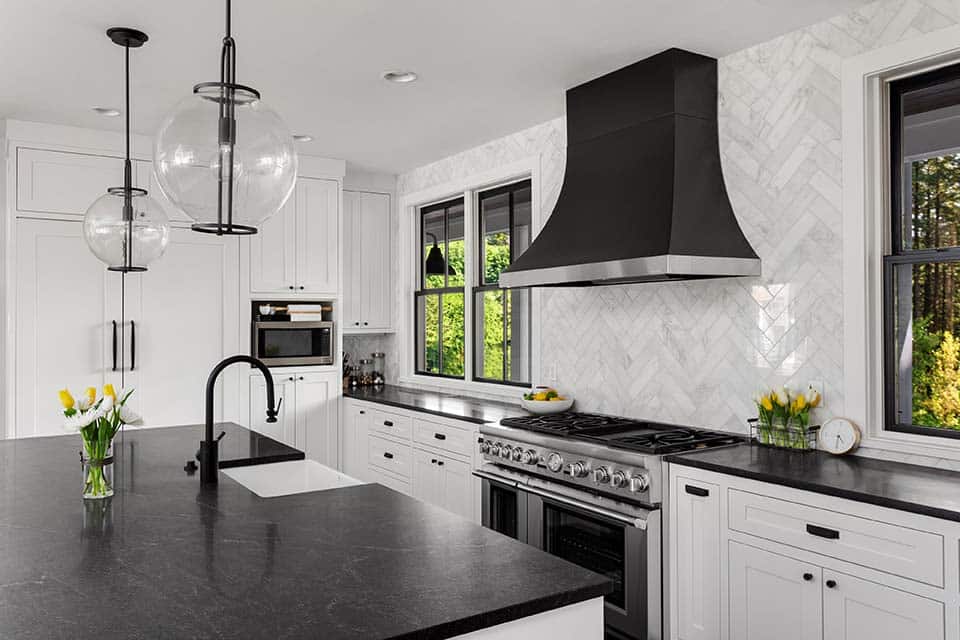
One more thing, and this is personal opinion. Black granite on white cabinets is my favorite combination: the contrast is really nice, and black and white is about as neutral as you can go.
How Much Do Different Black Granite Types Cost?
Price follows the variety. Steel Grey and Black Pearl sit at the lower end of black granite, Silver Grey and Silver Waves a little above them, then Absolute Black and Black Galaxy, with the veined Via Lactea and Titanium Gold at the top. The rest, sourcing, size, complexity, waste, is the same for every material, and we break it all down on our pricing page.
Frequently Asked Questions
Q. What is the most popular black granite?
A. Absolute Black is one of the most popular with our customers. Steel Grey, Silver Grey, Jet Mist and Black Pearl are right there with it.
Q. Are Steel Grey and Silver Grey the same stone?
A. No. Steel Grey comes from India and Silver Grey from Brazil; both read as black on a counter, and Silver Grey turns more gray when honed or leathered.
Q. What is Premium Black granite?
A. It's the name some suppliers give the cleanest Absolute Black. It's typically almost solid black, with very few speckles.
Q. Is Absolute Black real granite?
A. It's black granite, the trade name for several rock types that each have their own makeup. On a countertop it fabricates and performs like the other black granites we work with.
Q. Does black granite stain?
A. I've never seen a black granite stain. Every natural stone has pores, so it could absorb, but on black you wouldn't see it. Black granites are denser than most granites.
Q. Does black granite need to be sealed?
A. Rarely, because it's dense enough that sealer barely soaks in. Use the water test from our granite sealer guide: if water beads up, leave it alone; if it soaks in, it's time to reseal.
Q. Which black granite hides fingerprints best?
A. Steel Grey and Silver Grey, especially leathered. The finish matters more than the stone, and honed Absolute Black shows the most.
Q. Which black granite works outdoors?
A. All of them can go outside, and Steel Grey, Silver Grey and Silver Waves are what we install outside most. Dark stone gets very hot in direct sun, and for veined slabs that carry resin, like Titanium Gold and Via Lactea, leathered is the safer finish.
Q. Are black granite countertops in style?
A. Yes. White stones and quartzites lead today, but black granite keeps selling, in kitchens, laundry rooms, fireplaces and pantries.
Q. What is the prettiest black granite?
A. I love them all. Titanium Gold and Via Lactea are the showpieces, but the prettiest is the one that fits how and where you're using it.
Related Articles
- Black Granite vs Black Quartz vs Black Quartzite: Which Is Best?
- How to Clean Granite Countertops: A Step-by-Step Guide
- Quartzite vs Granite Countertops: A MA Fabricator's Honest Comparison
Visit Our Southborough Showroom
Still figuring out which stone is right for you? Come see us.
Nothing beats standing in front of the actual slabs, comparing colors, patterns, and finishes in person. That's how you make the right decision.
Stop by our countertop store at 43 Turnpike Road (Route 9), Southborough, MA 01772 during business hours. We keep a large inventory in our heated warehouse, so there's always plenty to see.
Already done your homework and know what you want? Email us or give us a call.
Phone: 508-460-7900
Email: info@graniteguyinc.com