Black Soapstone: What a Brazilian Heritage Taught Me
Written by Granite Guy Inc., Southborough, Massachusetts
Updated: March 2026
Black soapstone is the most underrated countertop material in New England. It's heat-proof, never needs sealing, and becomes more beautiful with age. After 30 years of fabricating stone across MetroWest and Greater Boston, I still consider it one of the best choices for a working kitchen.
I grew up in Minas Gerais, Brazil, the region that produces most of the world's finest soapstone. Pedra-sabão, Portuguese for soapstone, isn't a specialty material there. My grandmother cooks with pedra-sabão pots that have lasted decades.
That background gives me a perspective on this material that most fabricators in New England simply don't have.
🪨 What Is Black Soapstone?
Soapstone is a natural metamorphic rock made primarily of talc, which gives it that signature smooth, almost silky feel. Black soapstone gets its charcoal-to-midnight coloring from minerals formed deep within the earth.
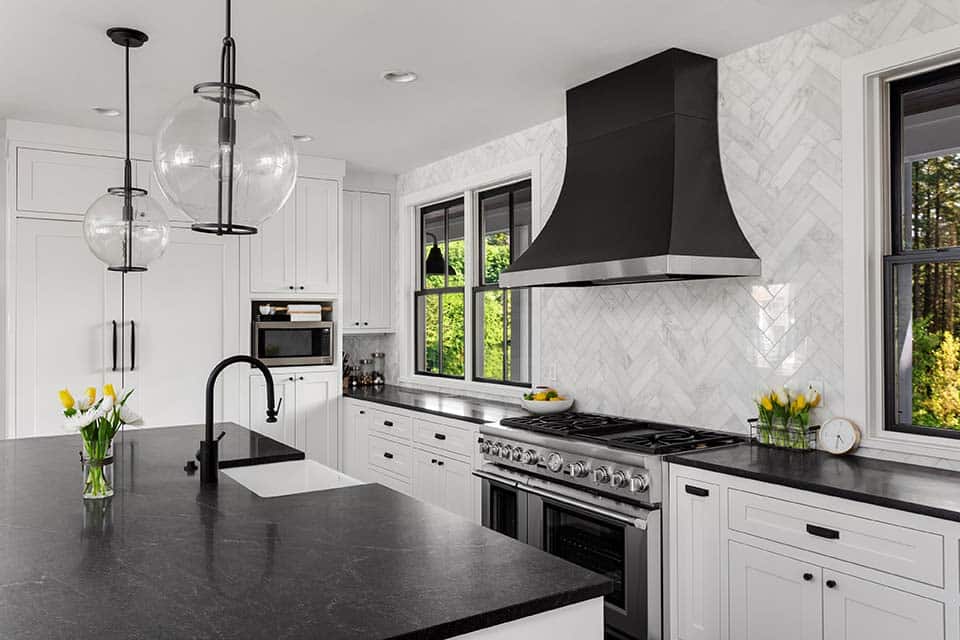
The color ranges from charcoal gray to deep black, often with subtle white or gray veining. Unlike the cold, hard feel of granite, soapstone has a soft, matte finish that feels warm to the touch.
This isn't a delicate showpiece material. It's the same stone used in science labs, commercial bakeries, and historic New England homes for over a century. If it can handle a commercial bakery, it can handle your Sunday dinner.
🔥 Why Black Soapstone Wins in the Kitchen
✦ Heat Resistance That Actually Matters
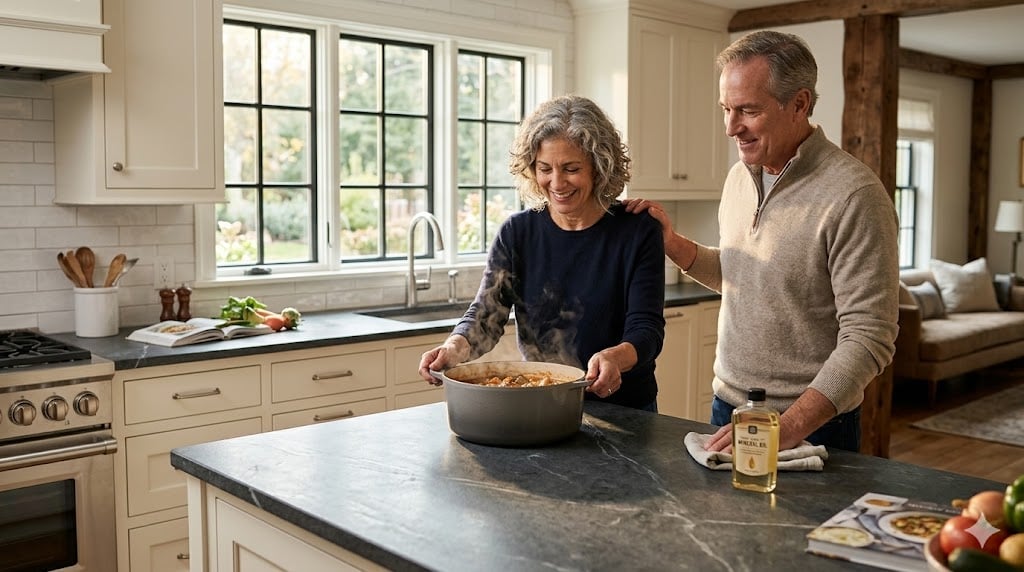
You can set a piping-hot Dutch oven directly on black soapstone without worrying about scorching or thermal shock. Try that with quartz and you risk permanent damage.
This changes how you work in the kitchen. No more scrambling for trivets when you're in the middle of cooking.
The heat resistance comes from soapstone's mineral composition. It's the same reason chemistry labs have used soapstone surfaces for decades to handle Bunsen burners and hot beakers.
✦ Zero Porosity: No Sealing, Ever
Black soapstone is naturally non-porous. Liquids like red wine, lemon juice, and cooking oil stay on the surface rather than soaking in.
While granite requires periodic sealing to stay stain-resistant, soapstone never needs it.
I've had clients who previously owned granite tell me they love not having to think about sealing schedules anymore. With soapstone, maintenance becomes almost invisible.
✦ Self-Healing Surface
Scratches happen with any natural stone. The difference with black soapstone is that you can sand them out yourself in minutes with fine-grit sandpaper and a little mineral oil.
No need to call in a professional. You have total control over maintenance.
✦ Antibacterial and Chemical-Resistant
Because it's non-porous, bacteria have nowhere to hide. A simple wipe-down with soap and water keeps your soapstone sanitary.
Unlike marble, black soapstone won't etch from acidic substances. Squeeze lemons, chop tomatoes, prep vinegar-based marinades directly on the surface without worry.
🌙 The Aging Process: Gray to Midnight
Fresh-cut black soapstone is naturally gray. As it's exposed to touch and cooking oils, it darkens over time.
You can accelerate this by applying food-grade mineral oil to bring out those deep black tones immediately. Or you can let it age naturally over months and years.
Some homeowners love watching their countertops evolve. The stone literally tells the story of your kitchen.
Others prefer a consistent appearance from day one. Either approach works.
I walk every client through sample stones at various stages of aging so they understand exactly what they're getting before we install.
⚠️ The Softness Question
Let's be honest: soapstone is softer than granite. But soft doesn't mean fragile.
Think of it like a hardwood floor. It wears beautifully and develops a patina over time. Soapstone's density and mineral structure make it incredibly resilient in actual kitchen use.
It won't chip the way granite can along edges. It won't crack from thermal shock like quartz. The historic soapstone countertops still in use throughout New England, some over 100 years old, are the best proof of that durability.
🇧🇷 The Brazilian Connection
Most black soapstone comes from Brazil, where it's known as pedra-sabão. Brazilian quarries have been extracting high-quality soapstone for centuries.
Growing up in Minas Gerais, I saw this stone used for everything: cookware, wood-burning stoves, outdoor counters, sculptures.
It wasn't a luxury material. It was everyday life. That's part of what makes it so practical.
My direct relationships with Brazilian quarries mean I can source soapstone with a level of knowledge most New England fabricators don't have. I know which quarries produce the densest stone, which veining patterns hold up best, and what to look for in a quality slab.
🏠 Beyond the Kitchen
Because black soapstone handles moisture and heat so well, we install it throughout the home.
✦ Integrated Sinks
Seamless, farmhouse-style sinks carved from the same slab as the countertop. They handle boiling water directly and look exceptional in a traditional or modern kitchen.
✦ Fireplace Surrounds
Soapstone absorbs and radiates heat, making it a historically ideal material for hearths. Many New England homes originally had soapstone fireplaces. We restore that tradition regularly.
✦ Bathrooms
Chemical resistance makes soapstone immune to hair dyes, makeup, and harsh cleaners that would ruin marble. The non-porous surface handles humidity without issue, and the warm feel is exceptional for bathroom flooring and vanity tops.
🆚 How Black Soapstone Compares
✦ vs. Granite
Granite is harder but requires sealing and can chip along edges. Black soapstone is worry-free regarding stains and heat, and its softer surface means scratches are repairable at home.
✦ vs. Quartz
Quartz is engineered and can melt or discolor under heat. Soapstone is 100% natural and heat-proof.
Quartz requires no sealing but can't handle direct flame or very high temperatures.
✦ vs. Marble
Marble etches and stains from acidic foods and cleaners. Black soapstone gives you that classic dark elegance without the maintenance concerns. For clients who love dark stone but want simplicity, soapstone consistently wins.
💰 The Most Asked Question: How Much Per Square Foot?
About 95% of countertops fit between $70–130 per square foot installed. Exceptions like Blue Bahia granite, Azul Macaúbas and Cristallo quartzites, and Calacatta and Statuario Italian marble families are always more expensive.
But it's not just about material. Here's what else affects your price:
- Sourcing: We work with all suppliers to find the best value. In-house inventory is more cost effective. We have remnants for smaller projects.
- Project size: Bigger projects cost more than smaller ones.
- Complexity: Waterfall edges, mitered edges, and integrated sinks add cost.
- Waste: Intricate shapes mean less efficient cuts and more waste.
✦ The Only Real Rule: Supply and Demand
Pricing depends on what's desirable right now. Trendy means higher price. Out of fashion means lower price.
The rare blues are expensive because they're naturally rare. Italian marbles are expensive because of high demand and limited supply.
✦ So How Do You Budget?
Don't shop by material name. Shop by color and look. Come to our warehouse in Southborough, see, touch, and feel your options, and choose what fits your budget.
🏠 Simple Care Guide
✦ Daily
Wipe down with warm water and mild dish soap. Dry with a soft cloth to prevent water spots. That's it for daily care.
✦ Monthly (Optional)
Apply food-grade mineral oil if you prefer the darker, high-contrast look. Skip this if you want the stone to age naturally at its own pace.
✦ As Needed
Sand out scratches with 120 to 400-grit sandpaper, then apply mineral oil. No professional needed. Most homeowners can handle this in under ten minutes.
✦ What to Avoid
Abrasive cleaners or scouring pads will dull the surface. Harsh chemical cleaners are unnecessary and add no benefit.
No annual sealing. No specialty products. No professional maintenance visits.
❓ Frequently Asked Questions
Q. Does black soapstone scratch easily?
A. It can scratch more readily than granite, but this is manageable. Minor scratches blend into the patina over time, and deeper scratches sand out in minutes at home.
Q. How much do black soapstone countertops cost?
A. Black soapstone typically runs $70–130 per square foot installed, comparable to mid-grade granite or entry-level quartzite. Because it never requires sealing, long-term maintenance costs are essentially zero.
Q. Will soapstone stain?
A. No. Black soapstone is non-porous, so liquids cannot penetrate the surface. Spills wipe away cleanly.
Q. Do I need to oil my soapstone countertops?
A. Oiling is optional. Mineral oil brings out the deepest black tones. Let it age naturally or oil regularly, either approach works.
Q. Where does black soapstone come from?
A. Most black soapstone comes from Brazil, where it's known as pedra-sabão. Minas Gerais is the primary producing region and has been quarrying high-quality soapstone for centuries.
Q. How long do soapstone countertops last?
A. With proper care, generations. Many historic New England homes still have original soapstone surfaces from 100+ years ago.
Q. Is soapstone good for bathrooms?
A. Yes. Chemical resistance, non-porosity, and warm tactile feel make it excellent for vanity tops, flooring, and shower applications.
Q. Can soapstone be used for a fireplace surround?
A. Yes, and it's ideal. Soapstone absorbs and radiates heat naturally, which is why it's been used in New England hearths for centuries.
Q. Is soapstone high maintenance?
A. The opposite. No sealing, no specialty cleaners, no professional visits. Scratches sand out at home.
Q. How does black soapstone compare to black granite?
A. Black granite is harder and requires sealing. Black soapstone never needs sealing, handles heat directly, and scratches repair at home.
📚 Related Articles
- Soapstone Countertops: The Complete Guide
- Is Marble Right for Your Kitchen? A MA Fabricator's Honest Answer
- Can Quartzite Handle Heat? A MA Fabricator's Honest Guide
🏠 Visit Our Southborough Showroom
Black soapstone is a material you really need to feel in person. The texture, the weight, the way it changes with age. None of that comes through in photos.
Stop by our countertop store at 43 Turnpike Road (Route 9), Southborough, MA 01772 during business hours. We keep soapstone slabs at various stages of aging so you can see exactly what you're choosing.
Already done your homework and know what you want? Email us or give us a call.
📞 508-460-7900
📧 info@graniteguyinc.com