Granite Sealer Guide: How to Seal Granite Countertops
Written by Granite Guy Inc., Southborough, Massachusetts
Updated: February 2026
To seal granite countertops: clean the surface thoroughly, let it dry overnight, spray on a penetrating sealer, spread evenly with a cloth, wait 10-15 minutes, then wipe off all excess before it dries. Let it cure for 24 hours before use. That's it.
But here's what most guides don't tell you: many granite countertops barely need any sealer.
Some granites are so dense they barely absorb anything. Others come resin-treated from the factory with built-in protection. Before you grab a bottle of sealer, you need to know if your specific granite actually requires it.
After 30 years fabricating and installing granite across Greater Boston and MetroWest, I've seen every sealing mistake imaginable.
Homeowners who seal religiously every month when their stone doesn't need it. Others who never seal porous granite and end up with permanent oil stains around the stove.
What I'm sharing here is exactly what I tell clients in my Southborough showroom. Real advice from over 10,000 installations, not generic internet recommendations.
🧪 Does Your Granite Actually Need Sealing?
Before buying anything, understand this: granite varies dramatically in porosity. Some varieties are nearly bulletproof. Others absorb liquids faster than you'd expect.
Twenty years ago, homeowners knew nothing about natural stone and just trusted whatever the fabricator said. Now there's endless information online, but most of it is generic advice that doesn't apply to your specific stone.
Let me be direct: if your granite is dense or came resin-treated from the factory, adding more sealer is wasted money.
💧 The Water Test: Your First Step
Here's the simplest way to know if your granite needs sealing. Pour a small puddle of water on your countertop, about the size of a quarter, and watch what happens.
💧 Water Test Results:
Beads up and sits there: Already sealed or naturally dense. You're good.
Darkens within 5 minutes: Porous granite. Plan on 2-3 coats.
Darkens after 10-15 minutes: Medium porosity. One coat is usually enough.
Still sitting after 30 minutes: No sealing needed. Test again in 6-12 months.
For a complete picture, test with both water AND oil. Some granites resist water but absorb oil readily.
Place drops of each a few inches apart and check after 15 minutes.
🗣️ Ask Your Fabricator
A skilled fabricator can tell you instantly whether your granite needs sealing just by looking at it. After thousands of slabs, I identify porosity by visual texture.
Clay-ish, matte surfaces usually mean the stone is porous. Crystalline, glassy surfaces are typically dense.
If your fabricator shrugs and says "I don't know," that's a red flag. Any reputable fabricator should understand their materials.
💰 The Real Cost of Sealing vs. Not Sealing
💵 Cost Comparison:
DIY Sealing: $25-30 for quality sealer (covers most kitchens multiple times)
Professional Sealing: $300-500 depending on square footage
Not Sealing Porous Granite: $3,000-15,000+ to replace stained countertops
Quality fabricators include sealing education with installation. We show clients how to maintain their investment rather than leaving them to figure it out alone.
🪨 Granite Types That Rarely Need Sealing
Many popular granite varieties are so dense they're virtually impervious to staining. Here are stones I've worked with for decades that almost never need sealing:
From Brazil:
- Ubatuba (dark green, extremely dense)
- Absolute Black (nearly indestructible)
- The Delicatus family (high crystal and mica content)
From India:
- Black Galaxy (tight crystalline structure)
- Tan Brown (dense, minimal porosity)
From Finland:
- Blue Pearl (incredibly dense)
- Emerald Pearl (naturally resistant)
From Canada:
- Labrador Antique (dense, crystalline)
From Norway:
- Blue Pearl (one of the densest granites available)
General pattern: Darker granites with visible crystalline structures tend to be less porous. But always test. There are exceptions.
🔴 Granite Types That Always Need Sealing
These granites are more porous and need regular attention:
From India:
- Kashmir White (very absorbent)
- River White (light-colored, porous)
- Silver Cloud (that clay-ish texture)
From Brazil:
- Santa Cecilia Light (often needs multiple coats)
- Giallo Ornamental (surprisingly porous)
- Giallo Veneziano (needs 2-3 applications to fully saturate)
From Canada:
- Caledonia (I've seen water change its color within minutes)
American Granites:
- Many lighter-colored domestic granites need more frequent sealing
🏭 Understanding Modern Stone Processing
Most people don't realize how much stone processing has evolved. I've talked directly to quarry owners in Brazil who explained how they literally soak slabs in pools of resin.
This resin fills pores and acts as a built-in super sealer. Exotic granites like Typhoon Bordeaux and Sienna Bordeaux rely heavily on this treatment because they naturally come out of the ground full of small pits.
The resin creates a smooth, sealed surface.
How to spot factory treatment: Check the backside and edges of your slab. Shiny coating or little drips running down the edges means it's resin-treated. Many slabs also have fiberglass mesh backing.
Modern processing often seals both top AND bottom. Older inventory sometimes only got sealed on top, which caused moisture to wick up through the bottom, especially around sink cutouts.
⚠️ Etching vs. Staining: A Critical Distinction
People constantly confuse these. They're completely different problems.
Staining is absorption. Liquids enter pores and leave discoloration. Sealer prevents this.
Etching is a chemical reaction. Acids contact alkaline stone and create dull, rough marks. Sealer can't stop chemistry.
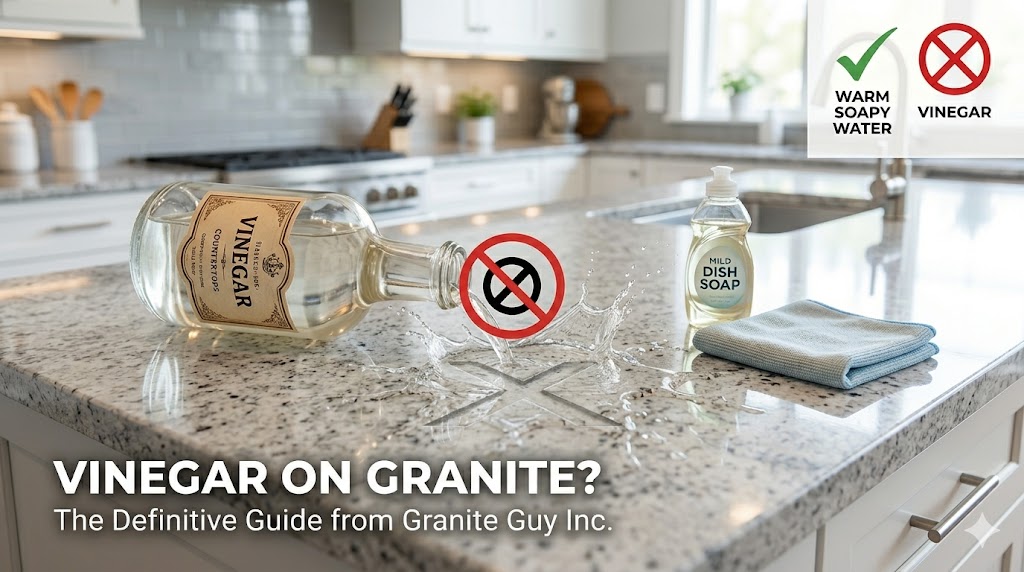
Here's the good news about granite: most granite doesn't etch. Unlike marble, granite is silica-based (quartz and feldspar), not calcium-based. Acids won't damage it the way they damage marble.
⚠️ Warning: If your "granite" is etching from lemon juice, it might be mislabeled. Some stones sold as granite are actually gabbro, diorite, or other materials with different compositions. True granite resists acids.
🛠️ Step-by-Step: How to Seal Granite Countertops
Once you know sealing is needed, here's my process after thousands of applications:
1️⃣ Step 1: Clean Thoroughly and Let Dry
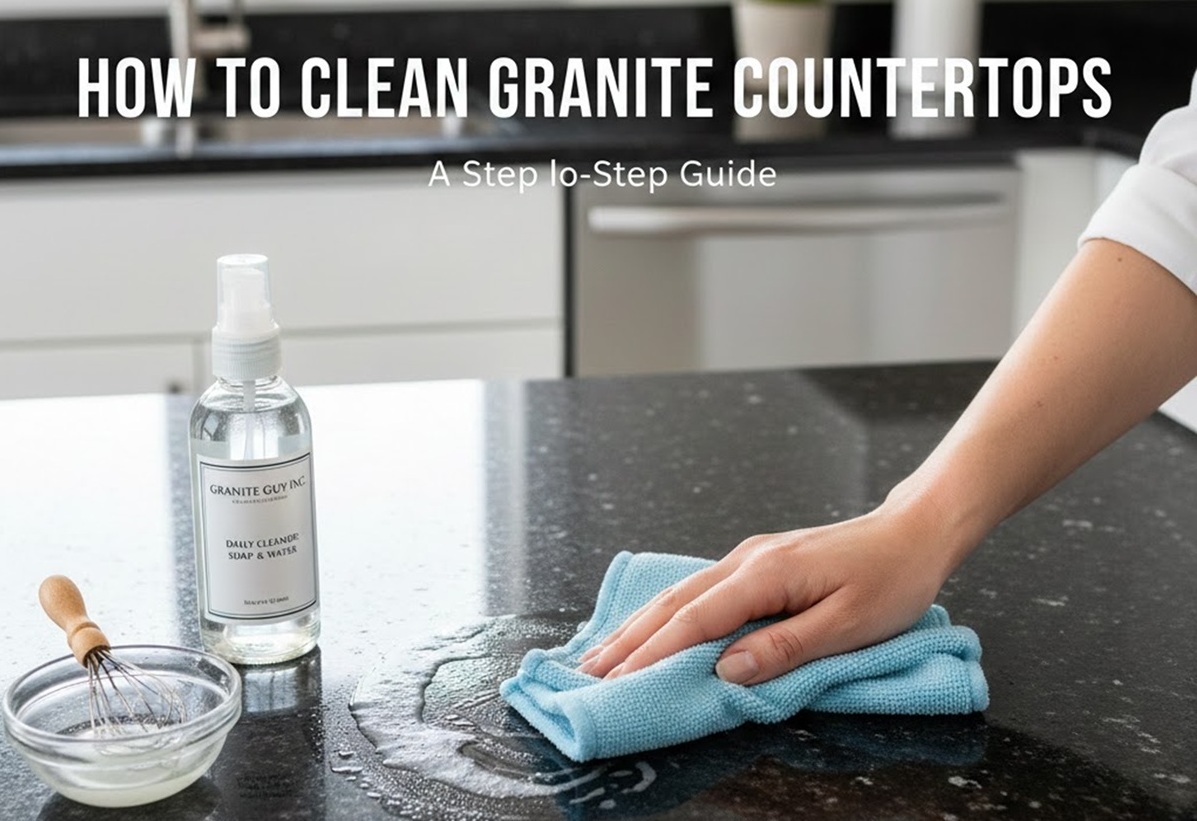
Remove everything from the countertop. Clean with mild soap or a stone-safe cleaner. Avoid anything acidic.
Critical: Let the granite dry completely. Overnight is best. Moisture trapped in the stone prevents sealer from penetrating properly.
2️⃣ Step 2: Apply the Sealer
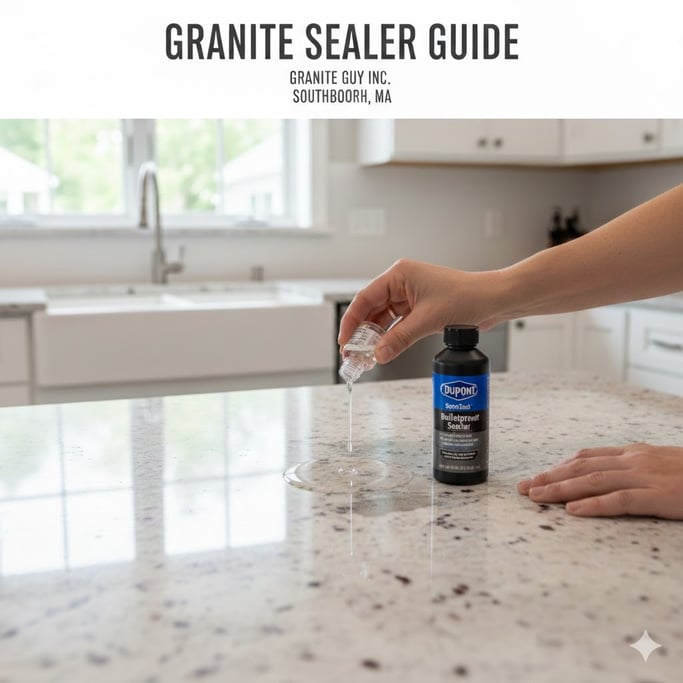
I prefer spray sealers because they penetrate quickly and spread evenly. Spray it on, then use a clean paper towel or microfiber cloth to spread across the surface. Paint rollers work for larger areas.
Watch the absorption. Within less than a minute, you should see sealer soaking in. If it's not absorbing quickly, your stone probably doesn't need much.
3️⃣ Step 3: Wait, Then Wipe (Critical!)
Let the sealer sit for about 10-15 minutes. Follow the manufacturer's instructions, but most penetrating sealers follow this timeline.
Here's where people mess up: Wipe off ALL excess BEFORE it dries completely. Dried sealer residue creates a hazy film that's extremely difficult to remove.
💡 Pro Tip: If you get haze from sealer buildup, mineral spirits on a clean cloth usually removes it.
Remember: sealer only works when it penetrates and fills pores. Whatever sits on the surface is useless and creates problems.
4️⃣ Step 4: Multiple Coats for Porous Granite
For highly porous stones like River White or Giallo Ornamental, apply 2-3 coats in a row. Apply first coat, wait 10 minutes, wipe, repeat.
You'll know you're done when the sealer sits on the surface instead of soaking in. That means the pores are filled.
⚠️ Important: More sealer doesn't mean more protection. Too much just creates buildup. Apply enough to saturate the pores, wipe off the rest, and you're done.
5️⃣ Step 5: Let It Cure
Don't use the countertop for 24 hours. No food prep, no cleaning, nothing sitting on the surface. The sealer needs time to cure and bond within the stone's pores.
🔪 Don't Forget the Edges and Cutouts
Factory sealing doesn't protect cut edges. Sink cutouts, edge profiles, custom cuts — all expose raw stone that wasn't treated at the factory.
When we cut granite during fabrication, we expose untreated areas that can absorb moisture. I've observed moisture creating problems around sink cutouts that appear to travel through stone, working like a wick.
Always ask your fabricator: Do you seal all the cut edges before installation? At our shop, we seal every cut surface. Not all fabricators do.
After installation, pay special attention to sealing around the sink cutout yourself. This area gets the most water exposure and needs the most protection.
🧴 Choosing the Right Granite Sealer
Good news: today's sealers are all pretty effective. You don't need expensive products to get quality protection.
✦ Water-Based vs. Solvent-Based
I recommend water-based sealers for most homeowners. They're easier to work with and much less smelly. Solvent-based sealers penetrate deeper but require better ventilation.
✦ Enhancing vs. Non-Enhancing
Enhancing sealers darken and enrich your stone's color, making patterns more dramatic.
Non-enhancing sealers keep the natural look. What you see before sealing is what you get after.
Read the label carefully. If you want your light granite to stay bright, don't accidentally grab an enhancer.
✦ Products I Trust
🛒 Recommended Sealers:
511 Impregnator Sealer: Blue jug at Home Depot. Solid, reliable, affordable. ~$25-30.
DuPont StoneTech BulletProof: Excellent quality. ~$40 on Amazon.
Tenax Proseal: Professional-grade with excellent penetration.
"Nanotechnology" sealers? Mostly marketing hype. A good penetrating sealer does the job without the premium price.
💎 Premium Protection for High-End Installations
For ultra-luxury granite installations, there are options beyond traditional sealing:
Epoxy Coatings: About $40-50 per square foot. Makes sense when you're investing in rare exotic granite.
HydroShield Treatment: Our partners at Artistic Tile in Natick offer this specialized treatment for around $20 per square foot.
Protective Film: Like a screen protector for your countertop. Invisible barrier that takes the abuse instead of your stone.
For most granite installations, standard penetrating sealers work perfectly. Save the premium treatments for exotic stones where the investment justifies it.
📅 How Often Should You Reseal?
Forget "seal every 6 months" advice. It depends entirely on your specific granite and how you use it.
✦ Factors That Affect Frequency
Granite type: Kashmir White needs more frequent sealing than Black Galaxy.
Use patterns: Heavy-use kitchen counters need more attention than a guest bathroom vanity.
Cleaning products: Harsh cleaners strip sealer faster. Stick with pH-neutral stone cleaners.
✦ The Water Test Is Your Best Guide
Instead of following a rigid schedule, watch how water behaves on your counters. If it beads up, you're sealed. If it soaks in and darkens the stone, time to reseal.
After a while, you'll recognize this intuitively from everyday use without formal testing.
🧽 Daily Care That Extends Sealer Life
Do This:
- Wipe spills promptly, especially oils
- Use warm water with mild dish soap for daily cleaning
- Use pH-neutral stone cleaners for deeper cleaning
- Dry the surface after cleaning
- Use cutting boards and trivets
Don't Do This:
- Avoid bleach and ammonia-based cleaners (won't damage granite but will degrade sealer)
- Skip "all-purpose" cleaners unless they specify safe for natural stone
- Don't let standing water sit, especially around the sink
- Never use abrasive scrubbers or powdered cleansers
✅ What to Expect from a Quality Fabricator
A good fabricator treats sealing as part of their service, not an afterthought:
They know their materials and can assess your granite's porosity immediately.
They seal cut edges during fabrication, before installation.
They educate you on proper maintenance without trying to sell overpriced products.
They're honest about what's needed and what isn't.
Beware of corner-cutting operations — garage setups, remnant dealers, operators who mislabel materials. If they don't know the difference between granite and quartzite, they probably can't advise on sealing either.
📋 The Bottom Line
After 30 years in this business, here's what I want every granite owner to understand:
- Not all granite needs sealing. Test before assuming.
- Modern processing changed everything. Many countertops come pre-sealed with resin.
- Sealing is simple when done right. Clean, spray, spread, wait, wipe, cure.
- The water test is your guide. Test once or twice yearly.
- A knowledgeable fabricator is invaluable. Find one who knows their materials.
❓ Common Questions About Granite Sealing
Q. My granite is 5 years old and has never been sealed. Is it ruined?
A. Probably not. Do the water test immediately. If it darkens quickly, seal it now. Existing stains may be permanent, but proper sealing prevents future damage.
Q. Can I use the sealer from the hardware store?
A. Absolutely. The 511 Impregnator at Home Depot works great. You don't need expensive specialty products.
Q. How do I know if my stone is granite or something else?
A. Try the lemon test on an inconspicuous spot. If it bubbles or etches the surface, it's marble or a calcium-based stone. If nothing happens, it's granite or quartzite.
Q. Do I need to seal quartzite?
A. Depends on the variety. Some quartzites like Taj Mahal are so dense they rarely need it. Others like White Macaubas absolutely do. The water test is your best guide.
Q. Will sealing change how my granite looks?
A. Non-enhancing sealers won't change the appearance. Enhancing sealers will darken and enrich the color. Read the label.
Q. What if I accidentally got sealer on my cabinets?
A. Wipe it off immediately with a damp cloth. If it's dried, try mineral spirits on a cloth, but test in an inconspicuous area first.
Q. How do I remove sealer haze from over-application?
A. Try buffing with a clean, dry cloth first. If that doesn't work, use mineral spirits. For severe buildup, professional restoration may be needed.
Q. Should I seal before or after installation?
A. We seal cut edges during fabrication. For the top surface, seal after installation once the countertop is fully set and dry.
Q. Do you offer sealing services?
A. We include sealing education with every installation and show clients how to maintain their investment. For ongoing sealing services, we partner with Artistic Tile in Natick — they offer professional sealing and restoration.
📚 Related Articles
- Granite vs. Quartz: Which Is Better for Your Kitchen?
- White Granite Countertops: Colors, Care & What to Expect
- How to Seal Marble Countertops
- Quartzite Countertops: Complete Guide
🏠 Visit Our Southborough Showroom
Still figuring out which granite is right for you? Come see us. Nothing beats standing in front of the actual slabs, comparing colors, patterns, and finishes in person.
Stop by our countertop store at 43 Turnpike Road (Route 9), Southborough, MA 01772 during business hours. We keep a large inventory in our heated warehouse, so there's always plenty to see.
Already done your homework and know what you want? Email us or give us a call.
📞 508-460-7900
📧 info@graniteguyinc.com