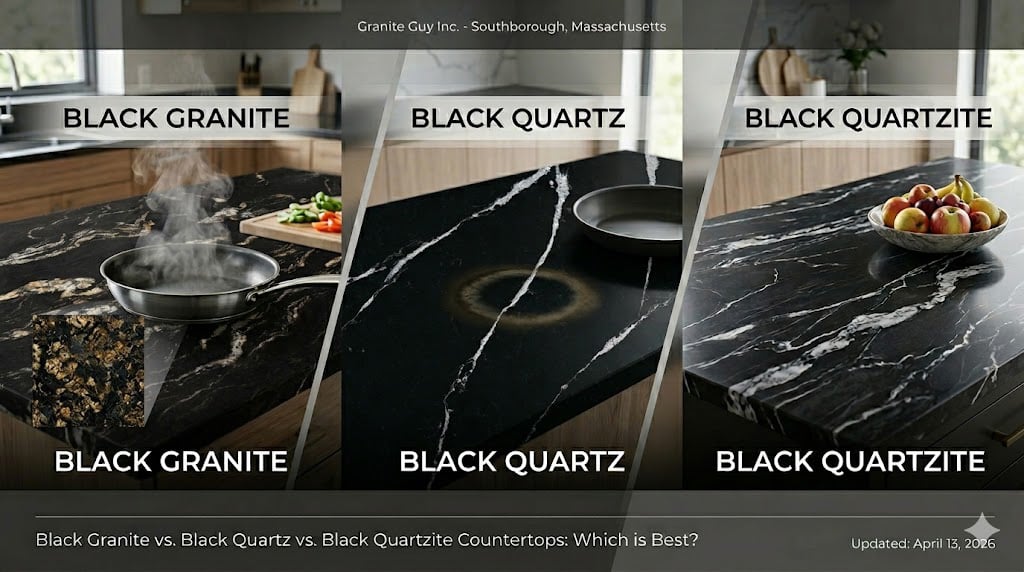
Black Granite vs Black Quartz vs Black Quartzite: Which Is Best?
Written by Granite Guy Inc., Southborough, Massachusetts
Updated: April 13, 2026
Black granite, black quartz, and black quartzite all make good countertops, but they perform very differently in a working kitchen. After 30 years and 10,000+ installations across Massachusetts, I have a clear winner for most homeowners.
💎 The Quick Answer: Black granite wins for most kitchens. It handles heat better than quartz, requires about as little maintenance as quartzite, and typically costs less than both.
We install all three at our shop in Southborough. Here's the honest comparison for Greater Boston and MetroWest homeowners.
⚡ Black Granite vs Black Quartz vs Quartzite: Head to Head
Here's how the three materials compare on the things that actually matter in a working kitchen.
🖤 Black Granite
Heat resistance: Excellent — set hot pans directly on it
Sealing: Rarely needed, especially for black varieties
Appearance: Natural depth, unique slabs, rich sheen that can't be replicated
Scratch resistance: Very good
Price range: Lower to mid ($55–120/sq ft installed)
Best for: Most kitchens and bathrooms
🖤 Black Quartz
Heat resistance: Poor — resins scorch and can crack under high heat
Sealing: Never needed — non-porous by design
Appearance: Consistent, uniform look — engineered veining available but lacks the depth and sheen of natural stone
Scratch resistance: Good
Price range: Mid to high
Best for: Low-maintenance priority
🖤 Black Quartzite
Heat resistance: Excellent — formed under intense heat and pressure
Sealing: Periodic sealing needed depending on stone density
Appearance: Natural depth, dramatic veining — closest look to marble without the maintenance
Scratch resistance: Very good
Price range: Mid to high
Best for: Premium visual drama, marble-like appearance
Read on for the full breakdown of each category.
🔥 Heat Resistance
This is where the conversation gets simple.
Black granite forms under extreme heat deep underground. You can set a hot pan directly on it. No scorching, no cracking, no discoloration.
Black quartzite is a metamorphic rock that also formed under intense heat and pressure. It handles hot pans the same way granite does.
Black quartz is engineered from crushed quartz mixed with polymer resins. Those resins are the problem. A hot pan can scorch the surface, leaving a permanent mark.
Extreme heat can also cause cracking. Every manufacturer warns about this in their care instructions.
If you cook a lot and want to set pots and pans down without thinking about it, granite and quartzite are the clear winners. This matters in busy New England kitchens where you're juggling holiday dinners and weeknight chaos.
🧹 Maintenance and Sealing
Black granite is one of the lowest-maintenance natural stones you can own. Many premium black varieties are so dense they rarely need sealing. A periodic water test tells you when it's time. Daily care is just warm water and a soft cloth.
Here's what most websites get wrong: they'll tell you granite needs sealing every 3-6 months. That's not accurate for black granite. The stone is so dense that sealer barely penetrates. Most black granites rarely need sealing at all.
Black quartz needs zero sealing. It's non-porous by design. Daily cleaning is warm water and a soft cloth. On paper, this is the lowest-maintenance option.
Black quartzite has similar maintenance needs to black granite. It requires periodic sealing depending on the specific stone's density and porosity.
💡 Pro Tip: The maintenance gap between black quartz and black granite is much smaller than most people think. Black granite is nearly as hands-off as quartz, and you get the benefits of natural stone.
🎨 Depth and Appearance
This is where natural stone separates itself from engineered material, and it's the reason most people choose granite or quartzite after seeing all three in person.
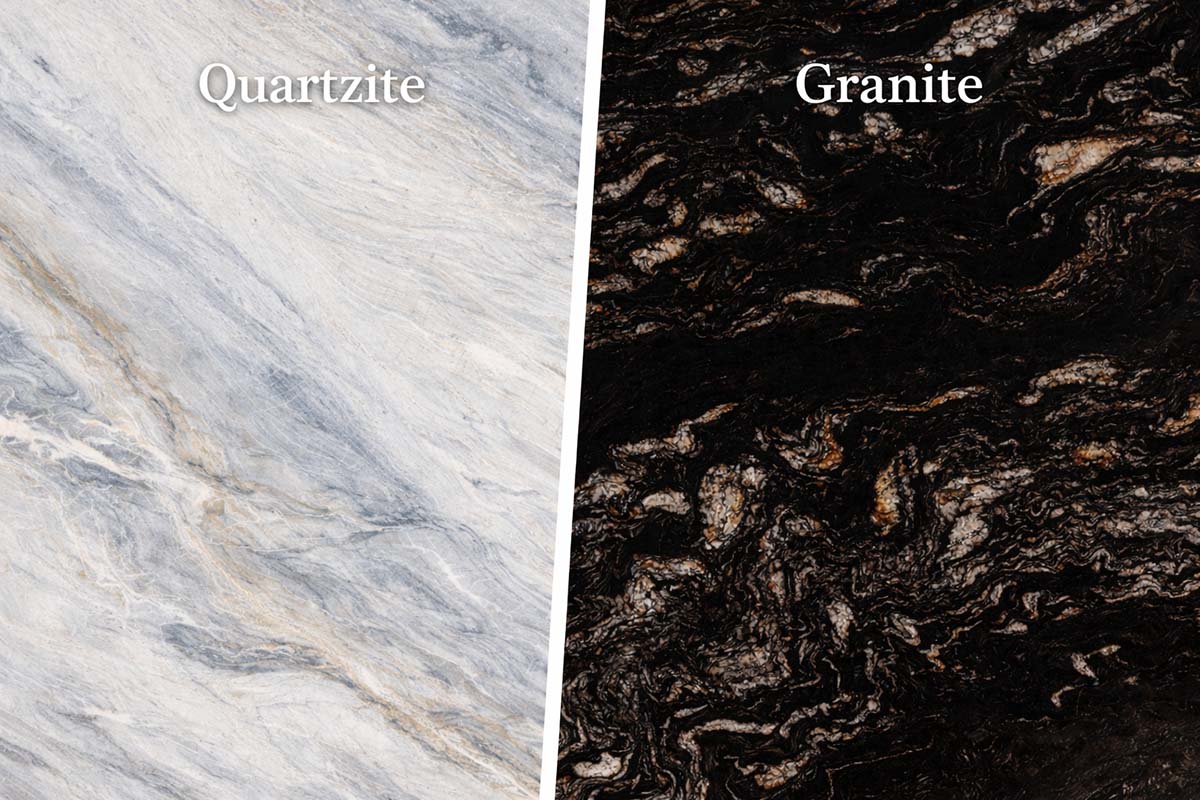
Black granite has real depth. Light interacts with the mineral layers in a way that creates dimension and character. Every slab is unique. The look is rich, natural, and impossible to replicate.
Black quartzite has the same kind of natural depth, often with more dramatic veining and movement. If you want the boldest, most dramatic black surface available, quartzite delivers.
Black quartz looks flat by comparison. The surface is uniform and consistent, which some people prefer. But side by side with natural stone, the difference is immediate and obvious. Natural stone also has a deeper, richer sheen that quartz can't replicate because quartz is made with resins and glue.
Come visit our showroom and stand in front of a polished black granite slab next to a black quartz sample. The depth and sheen difference will make your decision for you.
💪 Durability
All three materials are tough. None of them will fall apart in a normal kitchen.
Black granite resists scratches, chips, and everyday wear extremely well. It's one of the hardest natural stones available for countertops. With normal use, it lasts a lifetime.
Black quartzite is very hard and scores higher on the Mohs hardness scale than some granites. Chip resistance depends on the specific stone and the fabricator's skill. It's similar to black granite in terms of durability.
Black quartz is highly durable against scratches and chips. The resin binding gives it some flexibility, making it slightly more chip-resistant at edges. But it can't handle heat, which is a real durability factor in a working Massachusetts kitchen.
For overall kitchen durability including heat, granite and quartzite come out ahead.
💰 Price Comparison
Black granite is typically the most affordable of the three. Most varieties fall in the lower-to-middle range of the $55-120/sq ft installed spectrum. Common options like Steel Grey and Black Pearl are consistently priced well.
Black quartz falls in the mid range. You're paying for the engineering, the consistency, and the zero-sealing convenience.
Black quartzite is generally the most expensive, especially for dramatic, heavily veined varieties. Sourcing can also be less predictable, which affects availability and price.
Black granite gives you natural stone beauty at a price that often comes in below engineered quartz. We work with all suppliers, so we can source any of these materials at competitive pricing. That's a hard combination to beat for Massachusetts homeowners watching their renovation budget.
❌ What About Black Marble?
I'll be direct: skip black marble for a kitchen countertop.
Marble is a calcium-based stone. Acidic liquids like lemon juice, vinegar, and wine etch the surface on contact. It scratches more easily than granite or quartzite. And in black, every single mark shows.
Black marble is gorgeous in bathrooms, fireplace surrounds, and furniture tops. Even honed or leathered finishes can hide imperfections initially, but over time you'll see the wear and etching accumulate.
If you love the look of black marble veining, look at Via Lactea granite or a dramatic black quartzite instead. You get similar visual drama without the constant maintenance concerns. Our types of black granite guide covers varieties with marble-like veining.
🖤 What About Black Soapstone?
Worth a mention. Black soapstone is a completely different material with its own loyal following in New England. It's naturally non-porous, so it never needs sealing. The color deepens over time as it develops a patina, which some homeowners love.
The tradeoff is softness. Soapstone scratches more easily than granite, quartzite, or quartz. For a busy kitchen with heavy daily use, granite or quartzite holds up better. For a kitchen where you want a material with character and history, soapstone is worth considering.
💬 My Recommendation
For most homeowners, black granite is the best choice for a black countertop. It gives you natural depth, excellent heat resistance, minimal maintenance, the best value, and more variety to choose from.
If budget isn't a concern and you want maximum visual drama, black quartzite is a premium upgrade worth considering.
If you need absolute zero maintenance and can live without natural stone depth, black quartz is a solid option.
Black marble is beautiful but requires more maintenance than the others, so it's better suited for bathrooms and low-traffic areas than busy kitchens.
The best way to decide is to see all the materials side by side. We stock granite, quartz, quartzite, and marble in our Southborough warehouse. Stop by to compare them under real lighting and make a confident call.
❓ Frequently Asked Questions
Q. Can I put hot pans on black quartz?
A. Not recommended. The resins can scorch and leave permanent marks. Extreme heat can also cause cracking. Use trivets. Granite and quartzite handle heat without issue.
Q. Is black quartz easier to maintain than black granite?
A. Slightly. Quartz never needs sealing. But most black granites rarely need it either. The daily cleaning routine is identical.
Q. Does black quartzite stain?
A. It can if not sealed properly. The sealing frequency depends on your specific stone's density. Ask us when you come in and we'll tell you exactly what your slab needs.
Q. Which black countertop material is cheapest?
A. Black granite, especially common varieties like Steel Grey and Black Pearl. It often comes in below quartz pricing.
Q. Which looks most like marble?
A. Via Lactea granite and certain black quartzites offer dramatic veining similar to marble, without the maintenance problems.
Q. Can I mix materials in my kitchen?
A. Absolutely. Some homeowners use granite on the perimeter and a different material on the island. We handle mixed-material projects regularly across Greater Boston and MetroWest.
Q. How long do these materials last?
A. All three last decades with proper care. Granite and quartzite can easily outlast the kitchen itself. Quartz has a similar lifespan under normal use.
📚 Related Articles
- Black Granite Countertops: Pros, Cons & What to Expect
- Types of Black Granite Countertops: Most Popular Varieties Compared
- Black Granite Finishes: Polished vs Leathered vs Honed
🏠 Visit Our Southborough Showroom
Still figuring out which stone is right for you? Come see us. Nothing beats standing in front of the actual slabs, comparing colors, patterns, and finishes in person. That's how you make the right decision.
Stop by our countertop store at 43 Turnpike Road (Route 9), Southborough, MA 01772 during business hours. We keep a large inventory in our heated warehouse, so there's always plenty to see.
Already done your homework and know what you want? Email us or give us a call.
📞 508-460-7900
📧 info@graniteguyinc.com
Learn about our process and pricing