Can Quartzite Handle Heat? Yes. Here's What Else You Need to Know.
Written by Granite Guy Inc., Southborough, Massachusetts
Updated: October 12, 2026
Yes, you can put hot pans on quartzite. We have never seen heat damage a true quartzite top.
The quick answer: A hot pan off the stove won't hurt true quartzite. A trivet isn't necessary for the stone, and it never hurts. Resin fill and sealer are the only parts extreme heat could affect in theory, and we have never seen that happen either.
If you're choosing quartzite countertops for a Massachusetts home and you cook hard, this is what we tell customers in our Southborough showroom.
Can You Put Hot Pans on Quartzite?
Yes. We have never seen a quartzite top crack, stain, etch or burn from heat, on any job we've done across MetroWest and Greater Boston.
That answer is about true quartzite, stones like Cristallo and Taj Mahal. The word quartzite is used loosely in the industry, so see the actual slab with someone who can tell you what it is.
We can't show you a photo of heat damage on quartzite, because we have never had one to photograph.
Is Quartzite Heat Resistant?
In everything we've seen on real jobs, yes. You will read online that quartzite forms deep in the earth under heat and pressure, and that explanation matches what we have seen.
It isn't proof on its own, though. Heat underground and a cast iron pan on a counter are different things, so I lean on what our jobs show, not on geology.
I won't give you a temperature number either. The figures you'll find online run anywhere from 300 to 1,000 degrees for the same stone, and none of them carries a source. For the basics of the stone itself, see what is quartzite.
Do You Need a Trivet on Quartzite?
Not for the stone. A trivet isn't necessary on true quartzite, and it never hurts.
Use one if it's handy, and don't worry if you set a pan down without one. When the counter fills up on Thanksgiving, set the roasting pan wherever there's room. In normal daily kitchen use, there is nothing to worry about.
Resin, Mesh and Sealer: What Heat Reaches First
Resin and sealer are what heat reaches first, not the stone. Some slabs carry a resin coating or fill, and most exotic stones, quartzite included, have fiberglass mesh on the back.
Mesh isn't special to quartzite; we see it on marble, granite and soapstone too. It's also why I don't call every quartzite slab 100 percent natural.
In theory, extreme heat could discolor or burn resin. We have never seen it happen.
Sealer is the same story. Extreme heat could damage almost anything, sealer included, but a pan off your stove is everyday cooking, not extreme heat.
Sealer's real job is stains. Some quartzites with a whiter background, White Macaubas for one, tend to be more porous than others, and our sealing guide walks through the water test that tells you when to reseal.
Can Quartzite Crack From Heat?
We have never seen one crack from heat. When a stone top does crack, the cause is structural, and the risk sits in two places: natural veins and the narrow strips around cutouts.
Quartzite's one real weak point is a natural vein, a crack from nature. A vein is a weak point, not a guarantee of a crack.
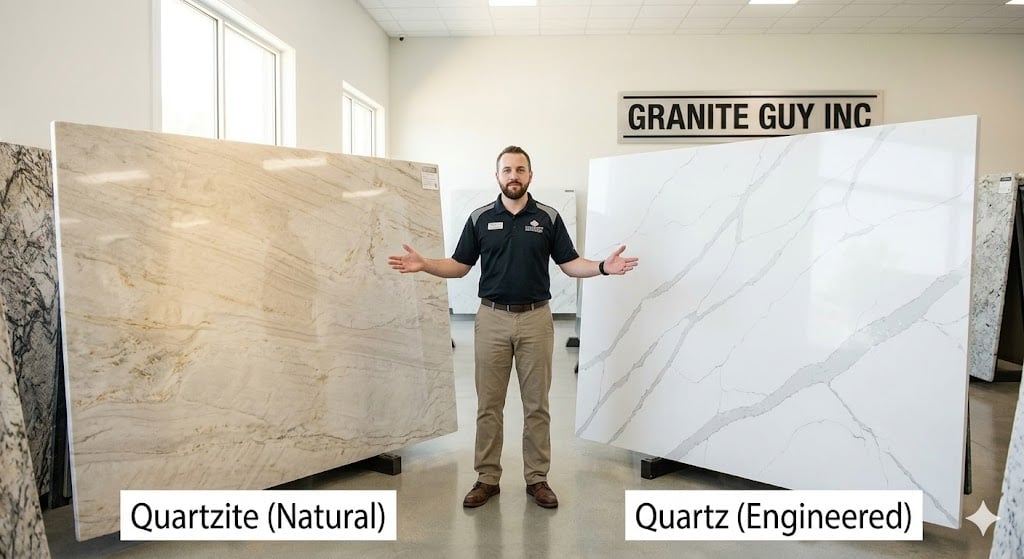
In our experience, quartzite is a stable stone. Quartz can carry internal stress, and we have seen a crack start at a corner on its own; quartzite doesn't have that problem. For the full side-by-side, see quartz vs quartzite.
Cooktops, Sinks and the Strips Around Them
A sink or cooktop cutout leaves narrow strips of stone to carry the weight. That's true of any stone, and the cutout size comes from the sink or cooktop maker's specs, not from the material.
On a standard 24-inch cabinet with a standard sink, only a few inches of stone are left behind the opening. A cooktop is deeper than a sink, so it leaves even less.
Here's what we do about it. We back-cut around every sink and cooktop and reinforce the strips with rods and epoxy.
Where we can, we place the seam at the center of the sink or cooktop. It takes the stress off the narrow strips, and a seam there is shorter and less noticeable.
The risky time for a top is before it's installed: transport, handling, carrying it in and setting it on the cabinets. Once it is set and glued down, it is fully supported.
For some cooktops, we only start the opening at the shop and finish it after the top is set and glued. It's messier and dustier, and I'd rather clean a little mess than take the risk during transport and installation.
Still picking a sink? Our undermount sink guide covers how that choice shapes the cutout.
What If You See a Mark Where a Pot Sat?
We have never seen a dull or hazy ring on quartzite where a pot sat, and we have never had to fix one.
If you see something on your top you can't explain, give us a call before trying to fix it yourself. For everyday care, see how to clean quartzite countertops.
How Much Do Quartzite Countertops Cost?
Quartzite pricing comes down mostly to which variety you choose. Cristallo and Blue Macaubas are naturally rare and run well above the rest. The rest, sourcing, size, complexity, waste, is the same for every material, and we break it all down on our pricing page.
Is Quartzite Right for a Busy Cook?
Choose quartzite if:
- You set hot pans down without thinking about it
- You want natural stone and don't mind checking the seal with a few drops of water
- You're happy to pick your actual slab in person
Consider something else if:
- You never want to think about sealing: quartz and porcelain don't need it
- You want the same look slab to slab: quartz and porcelain are made to a spec
My Recommendation
Cook the way you cook. I've been fabricating and installing countertops in Massachusetts since 1995, with 10,000+ projects completed, and on true quartzite a hot pan isn't the thing to worry about.
What matters more is picking a true quartzite and having the cutouts done right. Browse our quartzite slabs in stock, then come see them in person.
Frequently Asked Questions
Q. Can you put hot pans on quartzite?
A. Yes. We have never seen heat damage a true quartzite top.
Q. Is quartzite heat resistant?
A. Yes, in everything we've seen on our jobs. We don't give a temperature figure, because the numbers online have no source.
Q. Does quartzite crack from heat?
A. We have never seen it happen. Cracks come from structure, such as a natural vein or a narrow strip at a cutout, not from a hot pan.
Q. Do I need a trivet on quartzite?
A. Not for the stone. A trivet never hurts, so use one if it's handy.
Q. Can heat damage the sealer or resin?
A. In theory, extreme heat could. We have never seen it happen in normal kitchen use.
Q. Is every quartzite slab 100% natural?
A. No. Many slabs carry resin fill or fiberglass mesh on the back.
Q. Can quartzite go around a cooktop?
A. Yes. We back-cut and reinforce the strips around every cooktop and sink cutout with rods and epoxy.
Q. What temperature can quartzite take?
A. We don't give a number. We go by what our jobs show, not by a figure nobody can source.
Related Articles
- Quartzite vs Granite Countertops: A MA Fabricator's Honest Comparison
- What Is Leathered Quartzite? A Pro's Guide to Textured Stone
- Quartzite Countertop Pricing Guide: The Real Cost for MA Homeowners
Visit Our Southborough Showroom
Still figuring out which stone is right for you? Come see us.
Nothing beats standing in front of the actual slabs, comparing colors, patterns, and finishes in person. That's how you make the right decision.
Stop by our countertop store at 43 Turnpike Road (Route 9), Southborough, MA 01772 during business hours. We keep a large inventory in our heated warehouse, so there's always plenty to see.
Already done your homework and know what you want? Email us or give us a call.
Phone: 508-460-7900
Email: info@graniteguyinc.com