Marble vs. Quartz Countertops: A 30-Year Fabricator's Honest Guide

Written by Granite Guy Inc., Southborough, Massachusetts
Updated: April 2026
After over 30 years in the stone industry, I've watched the same conversation play out thousands of times.
A homeowner walks in, falls in love with marble, and then talks themselves out of it.
"My friend said never get marble."
"I read online it stains."
"Someone told me it's too soft."
💎 The Quick Answer: Both are excellent countertops, but they are built for different kitchens. Marble wins on heat resistance, repairability, and uniqueness . Quartz wins on stain resistance and low maintenance. Your lifestyle, not marketing, should make the decision.
Here's what I tell them: Yes, marble is softer than granite, quartz, or quartzite. That part is true.
But softer doesn't mean delicate. It's still a rock, one that's been used in kitchens and buildings for thousands of years.
What most people don't realize? Quartz was literally invented to mimic marble for people who were too scared to get the real thing.
Let me give you the honest breakdown.
🔥 Heat Resistance
💧 Stain Resistance
☀️ UV & Outdoor Use
🧹 Maintenance
🔨 Repairability
🎨 Appearance
💰 Price (Installed, Massachusetts)
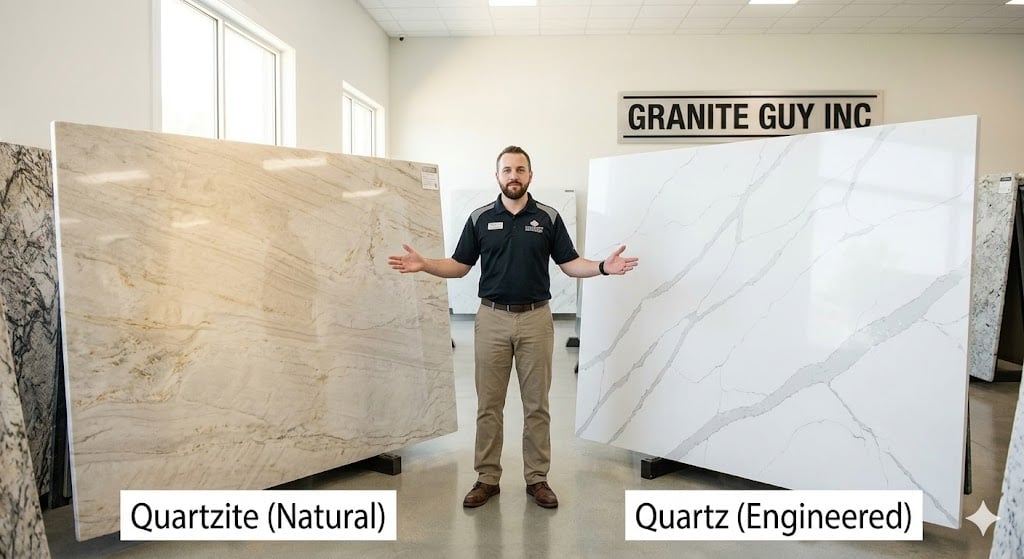
🪨 Marble vs. Quartz: Natural Stone vs. Engineered Surface
Marble is a metamorphic rock. It forms when limestone transforms under intense heat and pressure over millions of years.
The veining comes from mineral impurities. Iron oxides create golds and reds, while carbon gives you grays and blacks. Every slab is genuinely one-of-a-kind.
Quartz countertops are engineered surfaces. Manufacturers combine crushed natural quartz crystals (about 90-95%) with polymer resins and pigments in a controlled factory setting.
Because it's manufactured, the patterns are consistent. The sample you see in a showroom is exactly what your kitchen will look like.
The irony? Quartz manufacturers saw a niche: everyone wanted that beautiful white marble look, but they were afraid of it. So they created a product that doesn't etch, doesn't stain, and looks almost like marble.
For a while, quartz was much more affordable too, but those prices have climbed significantly over the years.
Here's something to consider: Marble has been used in kitchens and buildings for over 2,000 years. Quartz countertops have only been popular in American kitchens for about two decades.
Marble has proven itself. Quartz? Let's wait and see.
In MetroWest and Greater Boston, I see both materials requested constantly. Marble tends to dominate in older historic homes where character matters. Quartz is popular in newer construction and condo renovations where low maintenance is the priority.
🎨 Appearance: The Look You Can't Fake
✦ Marble: Depth You Can See Into
There's a reason marble has been the choice for sculptors, architects, and designers for millennia.
You don't just look at marble, you look into it. The crystalline structure creates a depth and luminosity that catches light differently throughout the day.
The veining is random and organic because it's natural. No two slabs are ever the same.
✦ Quartz: Consistency and Control
Quartz has come a long way. High-end quartz can mimic marble beautifully, and some premium lines get surprisingly close.
But side-by-side with natural marble, most people can tell the difference. Quartz tends to look more uniform, which is actually a selling point if you want a clean, modern aesthetic.
If you're doing a large kitchen with multiple slabs or marble kitchen islands, quartz makes color matching easier.
With marble, we use digital layout software to photograph your exact slabs and show you a layout before we cut. You'll see exactly where the veins will flow at the seams before anything is touched.
💪 Durability: Let's Clear Up the Myths
This is where the biggest misconceptions live.
✦ Marble: "It's Soft" (But It's Still a Rock)
When people say marble is "soft," they're comparing it to granite or quartzite on the Mohs hardness scale.
Yes, marble is softer than those materials. But let's be clear: it's still a rock. It's not going to crumble under normal kitchen use.
What "softer" actually means in practical terms:
Scratching: Marble scratches more easily than granite or quartz. If you drag a ceramic plate across it or cut directly on the surface, you may see marks over time.
Etching: This is the real concern. Acidic substances like lemon juice, tomato sauce, vinegar, and wine cause a chemical reaction that dulls the polished surface.
This happens instantly on contact. It's not a stain; it's a change in the finish.
Staining: With proper sealing, stains aren't a huge issue. The etching is what catches people off guard.
The verdict: If you're a perfectionist who can't stand any marks, marble might drive you crazy.
But if you appreciate a kitchen that develops character over time, like a well-worn leather jacket or an antique farmhouse table, you'll love how marble ages.
✦ Quartz: The Heat Problem Nobody Mentions
Quartz gets marketed as "bulletproof" and "maintenance-free." And for the most part, it is.
But it has one serious weakness that most articles gloss over: heat.
Remember that 5-10% resin binding the quartz together? Resin doesn't handle heat well. Place a hot pan directly on quartz, and you can scorch or damage the resin, leaving a permanent mark.
Manufacturers say quartz handles temperatures up to about 300°F, but I wouldn't take any chances.
Here's what I'm seeing in 2026: Quartz heat damage has become a real repair business.
I know restoration specialists who are getting constant calls for quartz burns. Before, their work was mainly natural stone, bringing the shine back to marble. Now a significant portion of their calls are quartz burn repairs.
It's not just hot pans either.
I had a client over the holidays with a kitchen we installed five years ago. They put a heating mat on their quartz countertop during a Christmas party. The countertop cracked.
We're replacing it this week. This is becoming more common across MetroWest: air fryers, instant pots, and holiday cooking setups landing directly on quartz surfaces.
The verdict: Quartz is low-maintenance and stain-resistant, but trivets are non-negotiable for hot cookware. Keep heating mats and air fryers away from direct contact with the surface.
☀️ The UV Factor: Something Most People Don't Consider
Here's something that rarely comes up in marble vs quartz discussions: sunlight.
Marble handles UV exposure just fine. You can use it outdoors, near windows, wherever you want.
Quartz? The UV light damages the resin over time, causing the surface to change color or fade.
This is why quartz isn't recommended for outdoor kitchens or areas with significant direct sunlight.
If you have a kitchen with big south-facing windows and your countertops will be bathed in sun all day, this matters more than most people realize.
A lot of the open-concept kitchens we install across Greater Boston and MetroWest have exactly this setup: large windows, great natural light, and quartz that slowly yellows over the years.
🔥 Heat Resistance: A Clear Winner
This one's straightforward.
Marble: Naturally heat-resistant. You can place a hot pan directly on marble without worry. Bakers love marble because it stays naturally cool, perfect for rolling out dough.
Quartz: Will scorch or crack under high heat. Always use trivets. No exceptions.
If you're a serious cook who's constantly moving hot pots and pans around, marble has the edge here.
💧 Stain Resistance: Quartz Takes This Round
Quartz is non-porous. Liquids sit on the surface rather than absorbing into it.
You don't need to seal quartz, and it resists wine, oil, coffee, and juice extremely well. Wipe up spills and you're done.
Marble is porous and needs periodic sealing. How often depends on use. Some people seal annually, others go longer.
The good news is sealing is simple: pour it on, let it soak, wipe it off. If water stops beading on the surface, it's time to reseal.
⚠️ The Mislabeling Problem: What Showrooms Won't Tell You
Here's something that frustrates me as a fabricator: not everything labeled "quartzite" is actually quartzite.
When quartzite and Brazilian marble both became popular around the same time, some suppliers started mislabeling softer marbles as "quartzite" or "soft quartzite."
I've heard salespeople tell customers things like, "It's a marble-quartzite hybrid, just a couple million years younger than true quartzite. If it had stayed in the ground longer, it would've become quartzite."
That's not how geology works.
✦ Materials Commonly Mislabeled as Quartzite
Super White: This was a big one. Very popular, often sold as quartzite, but it etches like marble because it is marble.
Fantasy Brown: Technically a dolomitic marble. Harder than Italian Carrara but will still etch from acids.
Shadow Storm: Beautiful stone, but it's marble. It etches almost as much as traditional marble.
Avalanche: Another Brazilian marble that got the quartzite label.
The test: If a salesperson calls something "soft quartzite," put a drop of lemon juice on a sample and wait a few minutes. If it leaves a dull spot, it's marble, not quartzite. True quartzite won't etch from acid.
This matters because if you buy Shadow Storm thinking it's quartzite, you'll be surprised when lemon juice leaves marks. If you buy it knowing it's marble and you're okay with that, you'll be happy with your choice.
I've had customers come in from all over Greater Boston and MetroWest who were sold one of these stones as quartzite at another showroom. The acid test doesn't lie. Always ask your fabricator to confirm the material before you fall in love with it.
Brazilian Marble: The Secret Most Homeowners Don't Know
Speaking of Brazilian stone, here's something most articles won't tell you.
Not all marble is created equal.
The classic Italian marbles everyone knows, Carrara, Calacatta, Statuario, all come from the same region in Italy and behave similarly. They're beautiful, but they're relatively soft and porous.
If you're deciding between Calacatta vs Carrara marble, the main differences are veining boldness and price, not durability.
Many Brazilian marbles are actually harder and more durable than their Italian counterparts.
Why? Higher quartz content and lower calcium content in the stone. This makes them more scratch-resistant and less absorbent.
I've been one of the biggest sellers of Brazilian marble for years.
Stones like White Pegasus, Mont Blanc, Bacchus, Olympus White, Calacatta Sublime, and Calacatta Barini give you that elegant marble look with better durability than European marble. They're typically more affordable than Italian Calacatta too.
In our Southborough showroom, Brazilian marble has become one of the most requested materials from customers across MetroWest and Greater Boston. Especially for kitchens where durability matters but the marble look is non-negotiable.
A note on finishes: If you go with marble, Brazilian or Italian, consider a honed or polished marble finish based on your lifestyle. Honed (matte) hides scratches and etching much better than polished (glossy).
You still get the beauty of marble, but the wear blends in rather than standing out.
💰 Why Stone Pricing Isn't One-Size-Fits-All
How much is it per square foot? That's the most asked question we get. Here's why it's not a simple answer.
For marble countertop pricing in Massachusetts, total installed costs typically range from $65–$150 per square foot. Quartz runs in a similar range: $65–$150 installed. Pricing on both materials depends heavily on the specific slab, complexity, and project size.
Why does pricing vary so much?
- Sourcing: We work with all suppliers to find the best value. Stock material from our Southborough yard offers the best pricing. Special orders cost more.
- Complexity: Curves, waterfalls, and integrated sinks require more fabrication time.
- Waste: Every project is like a puzzle. Intricate shapes mean less efficient cuts and higher material cost.
The best way to get accurate pricing is to visit our Southborough showroom with your drawings or dimensions. We'll walk you through both materials side by side and give you real numbers for your actual project.
🧹 Maintenance: Day-to-Day Reality
✦ Quartz
- No sealing required, ever
- Clean with mild soap and warm water
- Avoid abrasive scrubbers that can dull the surface
- Always use trivets for hot items
- Keep away from prolonged direct sunlight
✦ Marble
- Seal periodically (reseal when water stops beading)
- For how to clean marble countertops: use a pH-neutral stone cleaner, not vinegar or citrus-based products
- Wipe up acidic spills promptly (though etching happens instantly)
- Trivets recommended but not critical
- Can be used outdoors and in sunny areas
For how to seal marble countertops, the process is simple: apply a quality impregnating sealer, let it soak for 15-20 minutes, then wipe off the excess. Most homeowners can do this themselves in under an hour.
✅ Which One Belongs in Your Kitchen?
After three decades of helping homeowners make this decision, I've learned it comes down to lifestyle.
I ask clients a few simple questions: How do you use your kitchen? Do you cook a lot? How do you feel about your kitchen developing character over time?
Then I explain the trade-offs and let them decide.
✦ Choose Marble If:
- You want a one-of-a-kind natural masterpiece
- You're an avid baker (marble stays naturally cool for dough)
- You're okay with the stone showing signs of life over the years
- You want superior heat resistance
- You might use stone outdoors or in sunny areas
- You appreciate that real marble has a depth engineered products can't match
- You want a surface that can actually be restored (if marble scratches, we can polish it out; if quartz burns, the damage is often permanent)
✦ Choose Quartz If:
- You want a "set it and forget it" surface
- You prefer a clean, consistent modern look
- You have a busy household and don't want to worry about etching
- You want a bulletproof surface against stains, but you're willing to be careful with hot pans
- Your counters won't be exposed to significant UV light
Both are excellent long-term investments. There's no wrong answer, just the right answer for how you actually live.
❓ Frequently Asked Questions
Q. What is the main difference between marble and quartz countertops?
A. Marble is natural stone with unique veining. Quartz is engineered from crushed quartz and resin. Marble needs more care but handles heat. Quartz is low-maintenance but can't take heat.
Q. Can I put hot pans directly on quartz?
A. No. The resin binders fail around 300°F. Always use trivets. This is the number one cause of quartz damage we see.
Q. What's the deal with "soft quartzite"?
A. Be cautious. It's often marble mislabeled as quartzite. Do an acid test: lemon juice will dull marble but won't affect true quartzite. Learn more about quartz vs quartzite.
Q. How do I know if my marble needs resealing?
A. Sprinkle water on the surface. If it beads up, you're good. If it absorbs and darkens the stone, time to reseal.
Q. Which is better for baking: marble or quartz?
A. Marble. It stays naturally cool, perfect for rolling out dough. Bakers have preferred marble for generations.
Q. Does marble stain easily?
A. With proper sealing, staining isn't the main concern. Etching from acidic substances is more common. Sealing helps with stains; nothing prevents etching except wiping up acids quickly.
Q. Can quartz go outdoors?
A. No. UV light damages the resin over time, causing discoloration. Marble is the better choice for outdoor kitchens or areas with significant sun exposure.
Q. How long do marble and quartz countertops last?
A. Both can last decades with proper care. Marble has a longer track record (thousands of years in buildings). Quartz is newer, but quality installations should last 20+ years.
📚 Related Articles
- Marble Countertop Pricing in Massachusetts: $65–$150/sq. ft. Installed
- Is Carrara Marble Right for You? A MA Fabricator's Honest Take
- How to Clean Marble Countertops
🏠 Visit Our Southborough Showroom
Still figuring out which stone is right for you? Come see us. Nothing beats standing in front of the actual slabs, comparing marble and quartz side by side in person. That's how you make the right decision.
Stop by our countertop store at 43 Turnpike Road (Route 9), Southborough, MA 01772. We keep a large inventory in our heated warehouse, serving MetroWest and Greater Boston, so there's always plenty to see.
Already done your homework and know what you want? Email us or give us a call.
📞 508-460-7900
📧 info@graniteguyinc.com