Skip to content
All posts

Quartzite Kitchen Countertops | 30-Year MA Fabricator's Guide

Quartzite Kitchen Countertops | 30-Year MA Fabricator's Guide

Written by Granite Guy Inc., Southborough, Massachusetts
Published: January 2026

Quartzite is the material clients choose when they want marble's elegance but need granite's durability. After 30 years of fabricating countertops across MetroWest and Greater Boston, I can tell you quartzite delivers on both.

The reality: Quartzite is one of the hardest natural stones you can put in a kitchen. It handles heat, resists scratches, and holds up to busy Massachusetts family life without the etching issues that come with marble. For New England homes that value quality and longevity, it's a natural fit.


📑 Quick Navigation


🔍 First Things First: Quartzite Is NOT Quartz

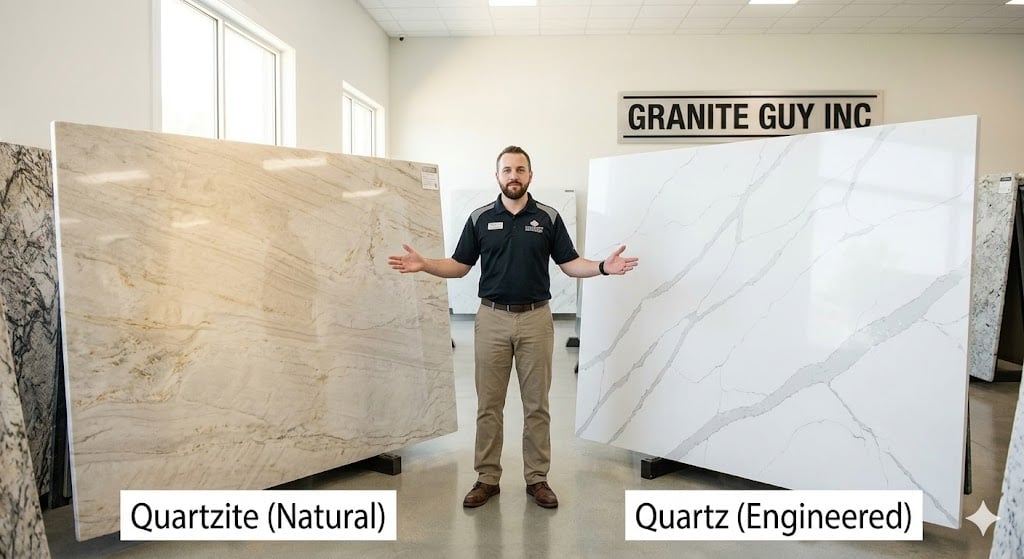
This is the most common confusion I see in my showroom. I can't tell you how many times clients use the names interchangeably, but they're completely different materials. Let me clear this up.

✦ Quartzite: Natural Stone

Quartzite is 100% natural stone. It starts as sandstone, then gets transformed by extreme heat and pressure deep in the earth over millions of years.

The result is a dense, incredibly hard metamorphic rock with flowing veins and natural beauty. Every slab is unique. No two quartzite countertops look exactly alike.

✦ Quartz: Engineered Surface

Quartz countertops are manufactured products. They're made by combining roughly 90% crushed quartz crystals with polymer resins and pigments in a factory.

The result is a uniform, non-porous surface. Quartz is consistent and low-maintenance, but it can't handle high heat and may yellow in direct sunlight over time.

✦ Why This Matters for Your Kitchen

If you set a hot pan on quartz, you could damage it. Quartz resins can scorch around 300°F.

Quartzite handles heat beautifully. You can set a hot pan directly on it without worry. For Massachusetts kitchens that get heavy use, that's a significant difference.

For a complete breakdown, read our guide: Quartz vs Quartzite: What's Better for Countertops?


✨ Why Quartzite Works So Well in Kitchens

I love showing quartzite to clients. Once they understand what it is, they see why it's become so popular in Massachusetts homes. From historic Colonials in Wellesley to new construction in Hopkinton, quartzite fits right in.

🪨 Exceptional Hardness

Quartzite rates around 7-8 on the Mohs hardness scale. For context, granite is around 6-7, and marble is only 3-4.

This means quartzite resists scratches better than almost any other countertop material. You can prep food directly on it without worry, though I still recommend cutting boards to protect your knives.

🔥 Superior Heat Resistance

Unlike quartz, quartzite handles heat without issue. You can set a hot pot or pan directly on the surface.

Will I still tell you to use trivets? Yes, it's good practice. But quartzite won't scorch or discolor from heat the way engineered materials can.

🖼️ Natural Beauty Like Marble

Quartzite offers the flowing veins and elegant movement that clients love about marble. The difference is performance.

Marble etches when acidic substances touch it. Lemon juice, wine, tomato sauce will leave dull marks. Quartzite doesn't have this problem because it's silica-based, not calcium-based like marble.

If you love the marble aesthetic but need a harder-working surface, quartzite is often the answer.

🌞 UV Resistance

Quartzite won't fade or yellow in sunlight. This makes it perfect for kitchens with large windows or skylights, which are popular in many Greater Boston homes.

Engineered quartz can discolor over time when exposed to UV light. That's why you can't use quartz for outdoor kitchens, but quartzite handles sun exposure beautifully.

💎 Each Slab Is Unique

Every quartzite slab has its own character. The veining, coloring, and movement are one-of-a-kind.

This is either a pro or a con depending on your perspective. If you want something no one else has, quartzite delivers.


⚠️ What You Need to Know

I believe in being honest about materials. Quartzite is excellent, but it's not perfect for everyone.

✦ Sealing Is Required

Quartzite is natural stone with some porosity. It needs to be sealed to prevent staining.

How often? It depends on the specific stone and how heavily you use your kitchen. Use the water test to know when it's time to reseal.

💡 Pro Tip: Drop water on the surface. If it beads up, you're sealed. If it soaks in and darkens the stone, it's time to reseal.

This isn't difficult maintenance, but it is maintenance. If you want zero upkeep, engineered quartz might be a better fit.

✦ Variation Between Slabs

That unique veining I mentioned? It also means the sample you see might not match the actual slab perfectly.

This is why I always tell clients to choose your specific slabs in person at our Southborough showroom. I've seen too many people disappointed because they picked from a small sample. What you see in a 4x4 inch piece won't capture the full movement of a 10-foot slab.

✦ Some "Quartzites" Aren't Actually Quartzite

Here's something most fabricators won't tell you: not everything labeled quartzite is true quartzite. I've seen plenty of softer stones get mislabeled at other shops.

True quartzite won't etch from acids. If you're unsure, ask for an acid test. A drop of lemon juice on true quartzite won't react.

If it etches, you're looking at a softer stone like dolomite or marble, regardless of what the label says. At our showroom, we know our materials and we'll tell you exactly what you're getting.

✦ Price Point

Quartzite generally costs more than granite or engineered quartz. The material is rarer, and it requires skilled fabrication due to its hardness.

Is it worth the premium? For many Greater Boston and MetroWest homeowners, absolutely. You're getting natural beauty with exceptional durability, and it adds real value to Massachusetts homes.


💰 Why Stone Pricing Isn't One-Size-Fits-All

Quartzite typically ranges from $80-150 per square foot installed. This covers about 95% of available options.

✦ Exceptions

Rare blue quartzites like Azul Macaúbas and ultra-rare translucent varieties like the Cristallo family command premium pricing.

✦ Why Pricing Varies

  • Sourcing: We work with all suppliers in the industry to find the best value for your project. If you choose anything from our in-house inventory, it's a set price per square foot no matter the size of the job. If we need to special order material, the pricing may change. In this industry, you can only order whole slabs at a time.
  • Complexity: Customization like waterfalls and integrated sinks require more fabrication time.
  • Waste: Every project is like a puzzle. How efficiently we can fit your pieces on the slab affects the final cost. Intricate shapes mean less efficient cuts.

That's why visiting our showroom is the best way to decide. You'll see our materials in person in our indoor heated warehouse, compare finishes, and get expert guidance to make the right choice.


🎨 Popular Quartzite Varieties for Kitchens

These are the quartzites I install most often across MetroWest and Greater Boston. Each has its own personality.

✦ Taj Mahal

The most popular quartzite we install across MetroWest. Taj Mahal features a creamy beige background with subtle golden veining.

It's warm, elegant, and works in almost any kitchen design. I've installed Taj Mahal in everything from modern Natick kitchens to traditional Sherborn farmhouses.

For everything you need to know about this specific stone, read our Taj Mahal Quartzite Guide.

✦ White Macaubas

Clean and contemporary. White Macaubas has a soft white to light gray background with fine linear veining.

It gives you the Carrara marble look with quartzite performance. This is my recommendation for clients who want that classic white kitchen but need durability.

✦ Sea Pearl

A refined Brazilian quartzite with a soft gray-green base and gentle veining in white, cream, and light gray.

The movement is calm and sophisticated. Sea Pearl is perfect for clients who want elegance with a natural, organic feel.

✦ Cristallo

A translucent quartzite known for its icy white background and delicate veining. Some varieties are almost see-through.

Cristallo comes in different color variations including pinkish, light bluish, golden, and white versions. Patterns range from busier to more subtle veining. Cristallo is a statement stone, often backlit in bars or islands to create dramatic effects. Premium pricing, but truly one-of-a-kind.

✦ Azul Macaubas

The showstopper. Azul Macaubas is a rare Brazilian quartzite with vibrant blue tones layered with gray and white.

This is not a subtle choice. It's for clients who want their kitchen to make a statement. Pricing reflects its rarity.


🔧 Finish Options: Polished vs Honed vs Leathered

The finish you choose changes everything about how your quartzite looks and lives. Here's what I tell clients.

✦ Polished

High-gloss, reflective finish that shows off the stone's depth and color. Polished quartzite sparkles in the light and photographs beautifully.

Best for: Formal kitchens, clients who want maximum visual impact.

Consider: Shows fingerprints and water spots more readily.

✦ Honed

Smooth matte finish without the shine. Honed quartzite has a more understated, contemporary feel.

Best for: Modern kitchens, clients who prefer a softer look.

Consider: Hides water spots and minor scratches better than polished.

✦ Leathered

Textured finish with a soft sheen. The surface has a subtle bumpy feel that shows the stone's natural character.

Best for: Clients who want something unique, busy kitchens where fingerprints are a concern.

Consider: The texture can make cleaning slightly more involved.

✦ My Recommendation

For most kitchen applications, I suggest honed or leathered finishes. They hide everyday wear better and feel less formal for a working kitchen.

Polished is beautiful, but it shows everything.

If you're meticulous about wiping down surfaces, go for it. If you have kids or use your kitchen heavily, consider the alternatives.


🏠 Care and Maintenance

Quartzite is easier to maintain than most people think. Here's what I tell every client after we install.

✦ Daily Cleaning

Use a mild dish soap and warm water. Wipe with a soft cloth. That's it.

Avoid abrasive cleaners or anything acidic. While quartzite won't etch like marble, there's no reason to stress the sealant.

✦ Sealing Schedule

Plan to reseal periodically. How often depends on your specific stone and usage.

Use the water test to know when it's time to reseal.

✦ Spill Management

Wipe up spills reasonably quickly. Quartzite is more forgiving than marble, but letting liquids sit for extended periods isn't ideal for any natural stone.

✦ Hot Pans

Yes, you can set hot pans on quartzite. It handles heat better than almost any other countertop material.

I still recommend trivets when possible. Not because the stone needs them, but because it's good habit.

✦ Cutting

Use cutting boards. Not to protect the quartzite, but to protect your knives. Quartzite is hard enough to dull blades.


🤔 Is Quartzite Right for Your Kitchen?

After thousands of installations across Massachusetts, I've noticed patterns in who loves their quartzite kitchens.

✅ Choose Quartzite If:

  • You want natural stone beauty without marble's maintenance concerns
  • You cook with high heat and want to set down hot pans
  • You appreciate that every slab is unique
  • You're willing to seal periodically
  • You want UV resistance for a sunny kitchen
  • You're building a high-end kitchen where quality matters

🔄 Consider Alternatives If:

  • You want zero maintenance (consider engineered quartz)
  • You need a perfectly uniform, consistent look (consider quartz)
  • Budget is your primary concern (consider granite)
  • You don't want to commit to sealing (consider quartz or porcelain)

✦ The Best of Both Worlds

Some clients do what I often recommend with marble: quartzite island, quartz perimeters.

The island becomes your showpiece. The perimeter counters around the sink and stove get a durable, low-maintenance engineered surface.

You get the beauty where it matters most and practicality where you need it. This is a popular approach in busy Massachusetts households with kids.


Quartzite has become incredibly popular across MetroWest and Greater Boston over the past five years. I'm installing more quartzite now than ever before.

The trend toward warmer tones is driving a lot of it. Ten years ago, everyone wanted stark white and cool grays.

Now Massachusetts homeowners want warmth. Taj Mahal quartzite fits this perfectly.

I'm also seeing more leathered finishes. Clients want texture and character.

They're moving away from the ultra-polished, showroom-perfect look toward something that feels more natural and lived-in. That makes sense for New England homes.

For New England specifically, quartzite makes sense. Our homes value quality and longevity.

A quartzite countertop will look as good in 20 years as it does today. That fits the New England mentality of buying quality once.

Many of the whole-house projects I work on with high-end architects include quartzite somewhere. It's become a standard premium choice for luxury kitchens throughout the region.


❓ Frequently Asked Questions

Q. Is quartzite the same as quartz?
A. No. Quartzite is 100% natural stone quarried from the earth. Quartz is an engineered surface made from crushed quartz and resin in a factory.

Q. Does quartzite need to be sealed?
A. Yes. Quartzite is natural stone with some porosity. Plan to seal periodically based on the water bead test.

Q. Can I put hot pans on quartzite?
A. Yes. Quartzite handles heat extremely well. Unlike engineered quartz, it won't scorch from hot cookware.

Q. Will quartzite etch like marble?
A. True quartzite won't etch from acids because it's silica-based, not calcium-based. Some mislabeled softer stones may etch.

Q. How hard is quartzite compared to granite?
A. Quartzite is harder. It rates 7-8 on the Mohs scale versus granite's 6-7. It's one of the hardest countertop materials available.

Q. How much do quartzite countertops cost?
A. Most quartzite falls between $80-150 per square foot installed. Rare colors like blue quartzites cost more.

Q. What's the best finish for a kitchen?
A. I recommend honed or leathered for most kitchens. They hide everyday wear better than polished.

Q. Can quartzite be used outdoors?
A. Yes. Quartzite is UV-resistant and won't fade in sunlight, making it excellent for outdoor kitchens.

Q. How do I know if my quartzite is real?
A. True quartzite won't react to acid. A drop of lemon juice on real quartzite won't etch. If it does, you have a softer stone.

Q. How often do I need to reseal quartzite?
A. It varies by stone and usage. Use the water test: if water soaks in instead of beading, it's time to reseal.


   Marble Kitchen Countertops in MA

🏠 Visit Our Showroom

Still figuring out which stone is right for you? Come see us.

Nothing beats standing in front of the actual slabs, comparing colors, patterns, and finishes in person. That's how you make the right decision.

Stop by our countertop store at 43 Turnpike Road (Route 9), Southborough, MA 01772 during business hours.

We keep a large inventory in our heated warehouse, so there's always plenty to see.

Already done your homework and know what you want? Email us or give us a call.

📞 508-460-7900
📧 info@graniteguyinc.com

Learn about our process and pricing