Written by Granite Guy Inc., Southborough, Massachusetts
Updated: September 15, 2026
Carrara marble countertops will etch, and most homeowners who understand that still choose them. Etching is not damage. It is the natural aging that gives marble its character, and a honed finish hides it almost completely.
Carrara is the most available and most affordable of the white Italian marbles. It etches from acidic foods, and no sealer prevents that. Honed finishes hide etching; polished finishes show it. Choose it knowing what it is, and you will like how it ages.
Every customer who walks into my facility stops in front of the marble. Then they ask the hard questions: will it stain, will it etch, is it high maintenance.
The honest answer is yes to most of that. Here is everything you need to decide whether Carrara is right for your kitchen.
🪨 What Carrara Marble Countertops Actually Are
Carrara marble is a metamorphic rock quarried from the Apuan Alps in Tuscany, Italy. These are the same mountains that supplied stone for the Pantheon and for Michelangelo's David.
If it does not come from that region, it is not true Carrara.
✦ The Look
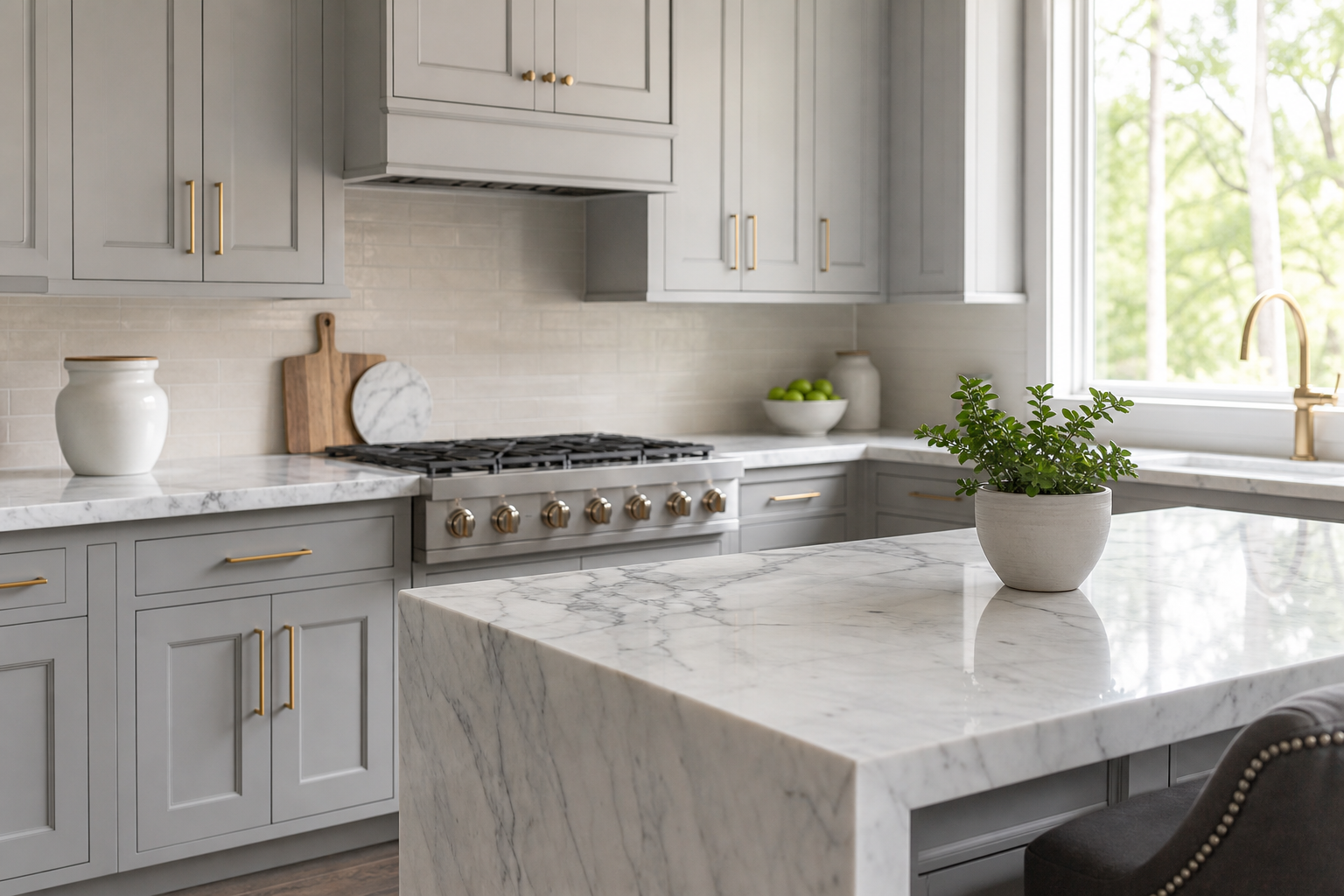
Carrara typically shows soft, feathery gray veining over a background that commonly ranges from white to a distinct blue-gray. It usually reads quieter than its dramatic cousins, Calacatta and Statuario.
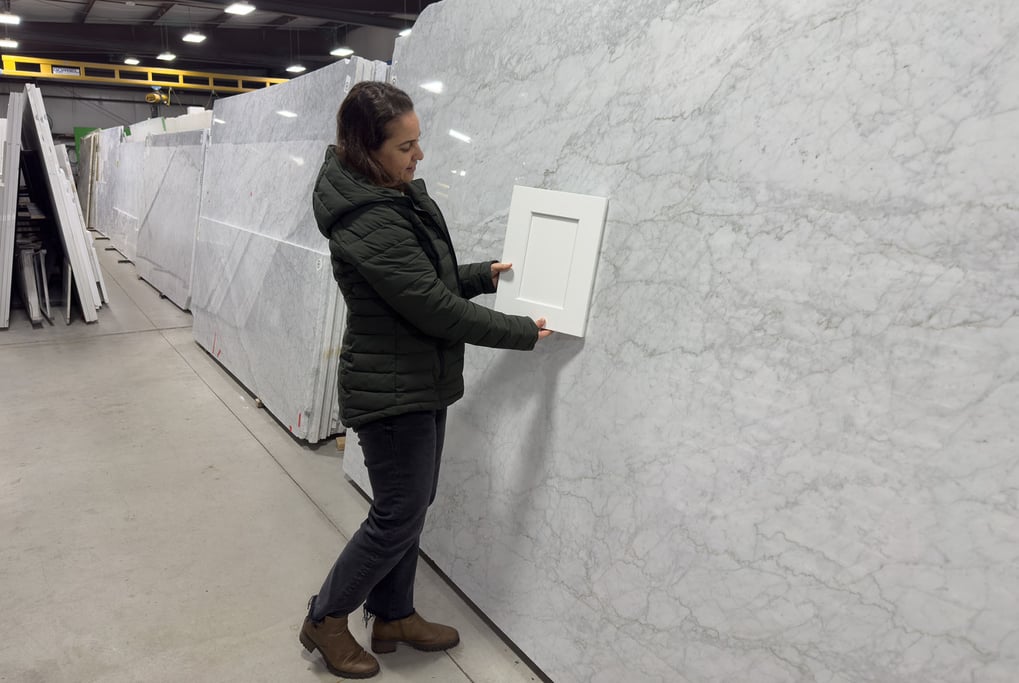
That said, no two slabs match. Photographs flatten the differences, so come see the actual slab before you commit.
✦ Why It Matters
When a homeowner pictures "marble countertops," they are usually picturing Carrara. It has been the default choice in fine kitchens for centuries.
I have worked with some of my builder clients for almost twenty years. A lot of the homes they build are designed by Patrick Ahearn, a respected New England architect, and Carrara is his signature. That endurance is not an accident.
🎯 Is Carrara Right for You?
Before anything else, let's work out whether Carrara suits how you actually live.
✦ Choose Carrara If
You want real marble, not an engineered look-alike. You appreciate patina, the slow aging that gives the surface character.
You are an empty nester, or your children are past the juice-box stage. You bake often, and you want a cool surface for pastry work.
✦ Consider Alternatives If
You have young kids who will spill acidic drinks and forget to wipe them up. You want a surface you never think about.
Marks will bother you. Your kitchen sees heavy daily food prep. If any of that sounds like your house, quartz countertops may serve you better.
❓ Will Carrara Marble Stain or Etch?
This is the question I get most, and the two words get mixed up constantly.
Staining is liquid soaking into the stone. Sealing prevents it.
Etching is a dull mark where something acidic touched the surface. Lemon, vinegar, wine, even hard water will do it. No sealer stops etching, because it is a chemical reaction rather than absorption.
Most of what gets called a stain on Carrara is actually an etch mark.
✦ Why I Recommend Honed
A honed surface is matte, and it hides etching. That is the main reason, and most homeowners prefer the look anyway once they see both side by side.
As the patina develops, it adds depth rather than damage. And if you ever need a repair, honed marble refinishes easily.
🌡️ How New England Conditions Affect Carrara
Here is something a national guide will not tell you.
✦ Hard Water
Many MetroWest towns have hard water, including Natick, Wellesley, Needham, Sudbury, Wayland, and Concord.
Calcium deposits actually blend into Carrara better than they would on dark granite. Calcium on calcium.
Parts of Worcester County also deal with elevated iron and manganese, which can leave yellow-brown spotting on light surfaces. If you are on a private well in Wayland or Sudbury, we see more mineral spotting, and a softener helps.
✦ Temperature and Humidity
Temperature swings are fine. Marble handles our climate without trouble.
Humidity does not change how often you need to seal, whatever some sources claim.
✨ Honed or Polished Carrara?
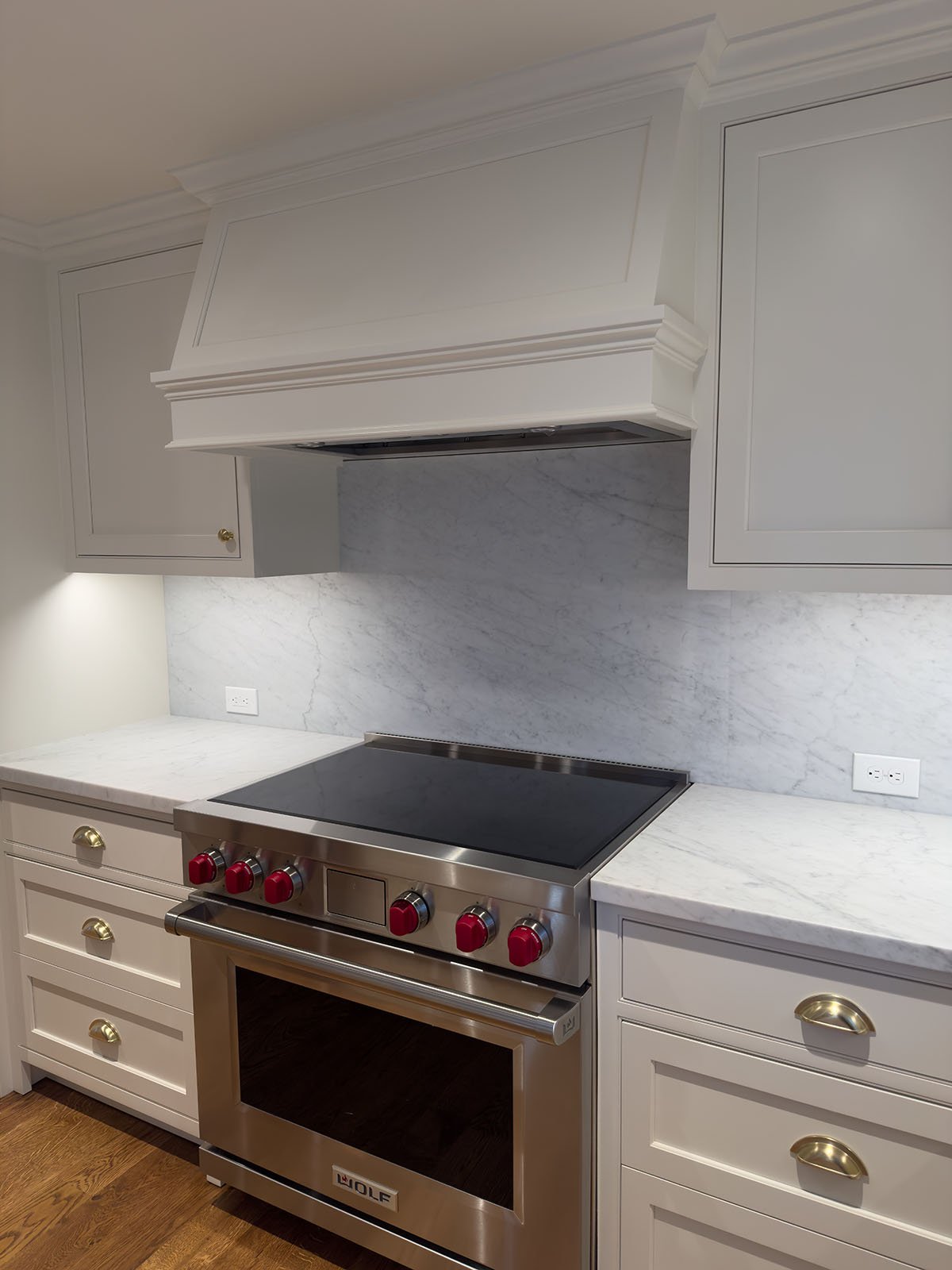
For Massachusetts kitchens I recommend honed almost every time.
✦ Polished
Glossy and reflective, and it shows every etch mark clearly. It photographs beautifully and lives harder.
✦ Honed
Matte, already softly worn, so etching blends in instead of standing out. Easier to live with day to day.
The full breakdown is in our honed vs. polished marble guide.
🗣️ What My Customers Say After Five Years
I check in with customers long after installation. Here is what they actually tell me.
✦ The Stubborn Polished Choice
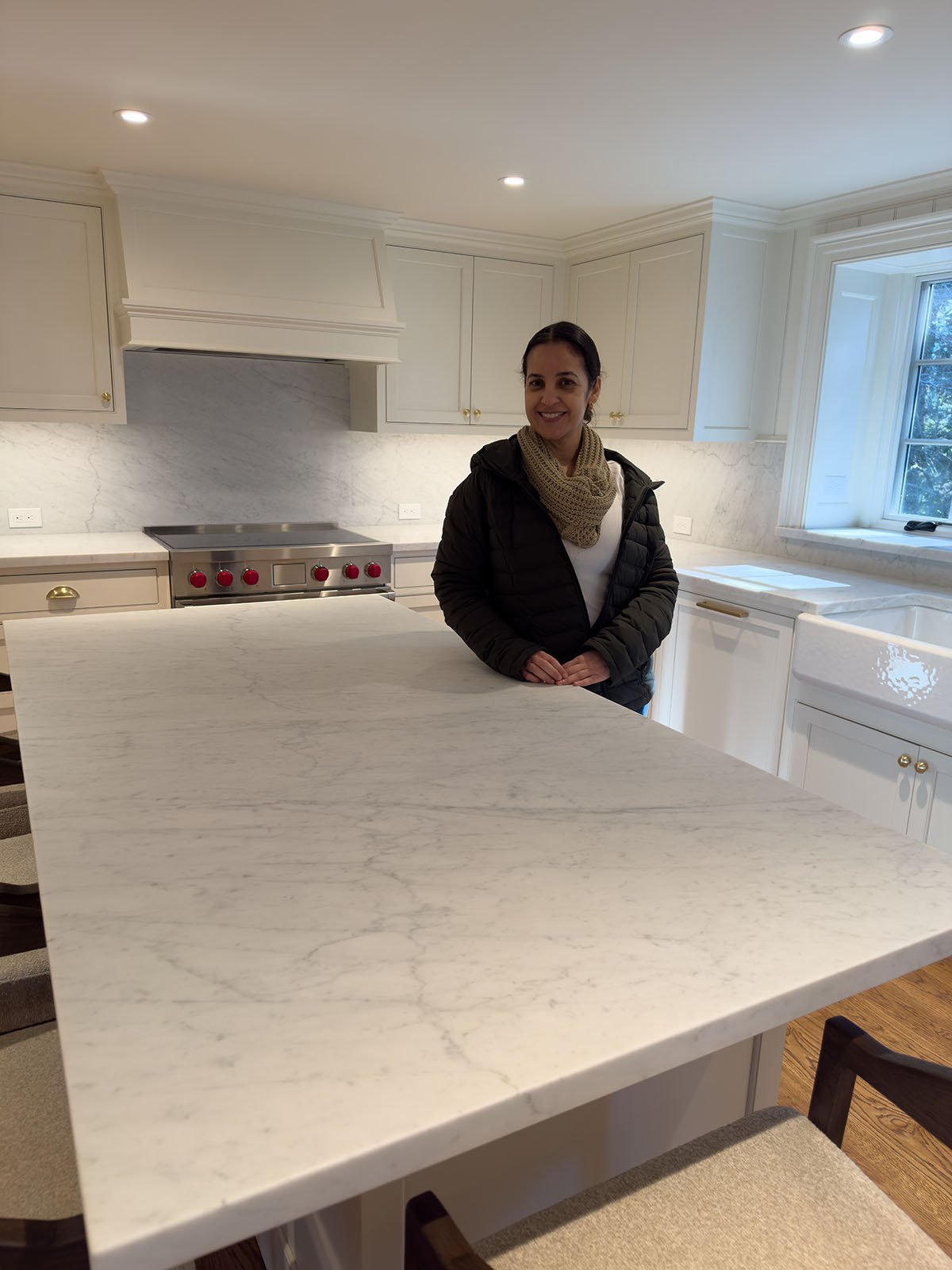
A Wellesley homeowner insisted on polished Carrara despite my recommendation. She had a big kitchen and wanted the gloss.
Five years later she called. The etch marks were driving her crazy. Honing the whole kitchen was doable, so we did it. She called back months later to say she wished she had listened the first time.
✦ The Wellesley Hills Remodel
This happens more than you would guess. Someone buys a house, tears the kitchen out completely to make it their own, and then puts back almost exactly the same Carrara.
It says something about how right the material is for these homes.
✦ The Baker's Perspective
A Concord baker uses her island daily for bread and pastry. The cool surface is ideal for dough.
She treats the etch marks like seasoning on a cast iron pan. Character, not damage.
✦ The Pattern I See
Homeowners who understand Carrara before they buy it like it more over time, not less. The ones who expected perfection are the ones who struggle.
I would rather lose a sale today than take a call six months from now from someone who feels misled. That honesty has earned me more marble work than any pitch could.
⚖️ Carrara vs. Calacatta vs. Statuario
Customers ask constantly, so here is the short version.
✦ Carrara
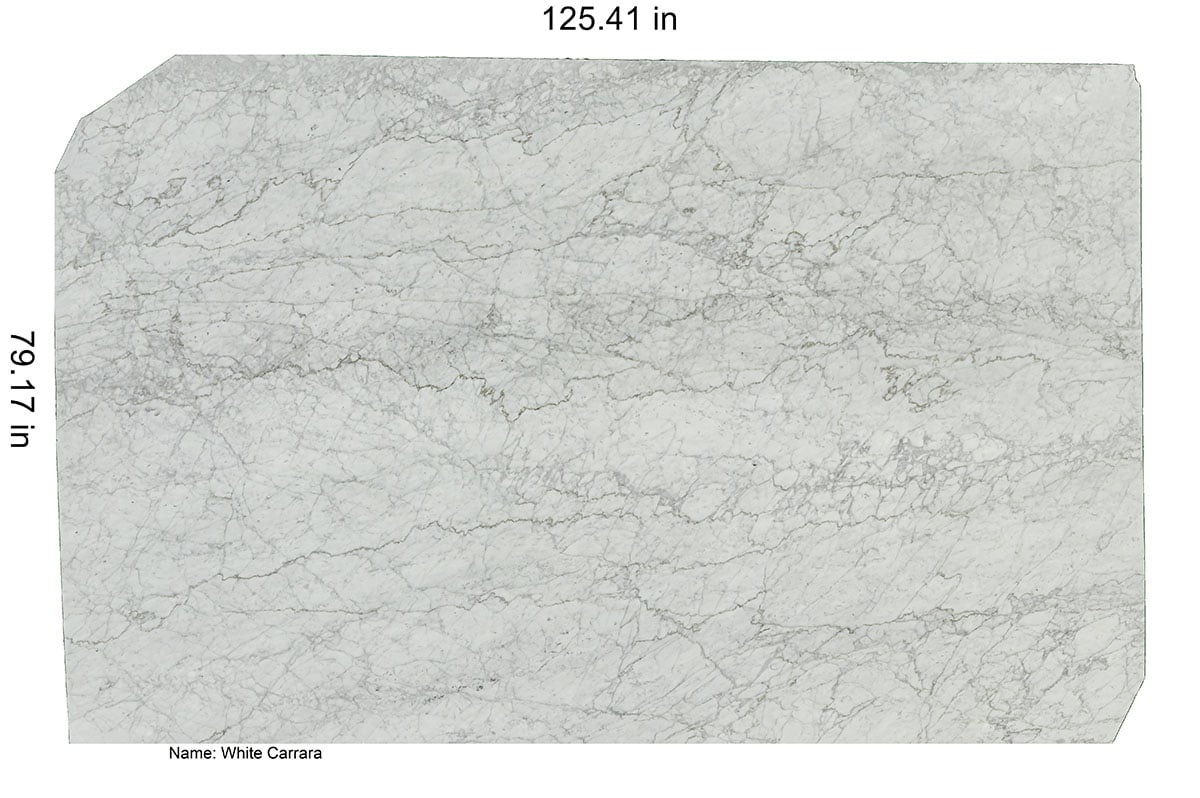
White to gray-blue background with soft, consistent veining. The most available and most affordable of the three.
✦ Calacatta
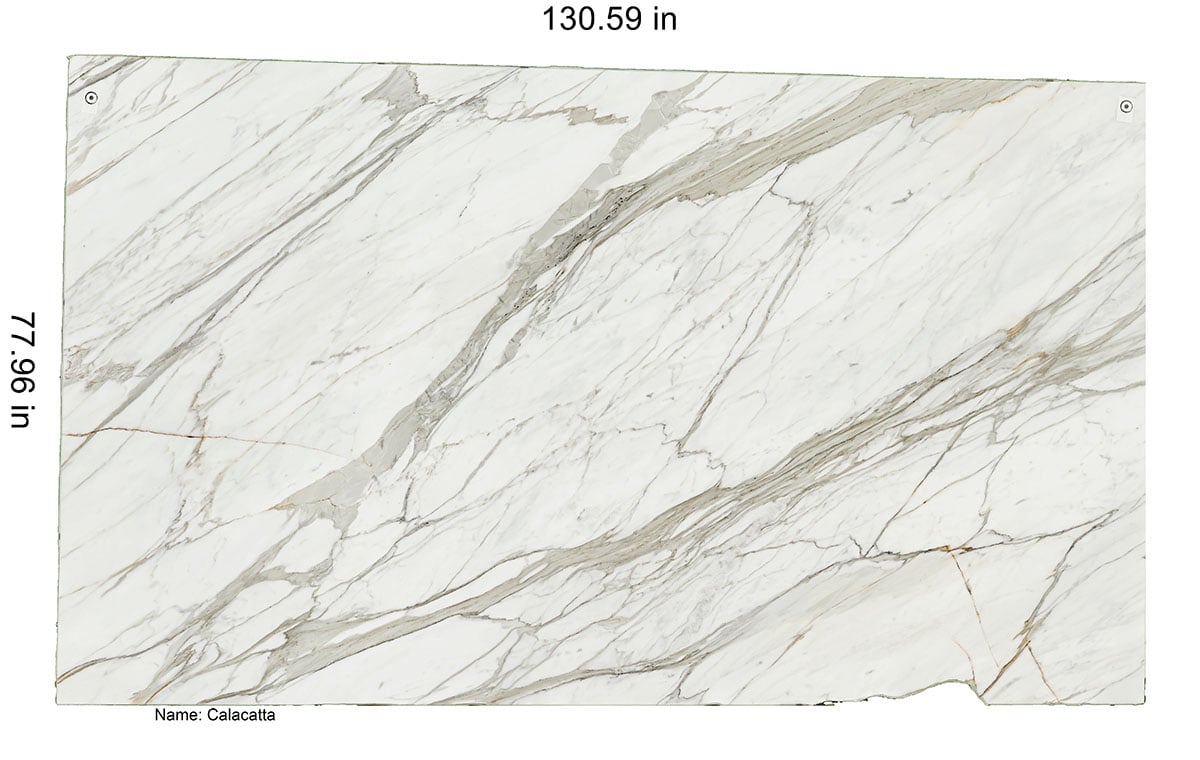
Whiter background with bolder veining. Considerably rarer, and priced accordingly.
✦ Statuario
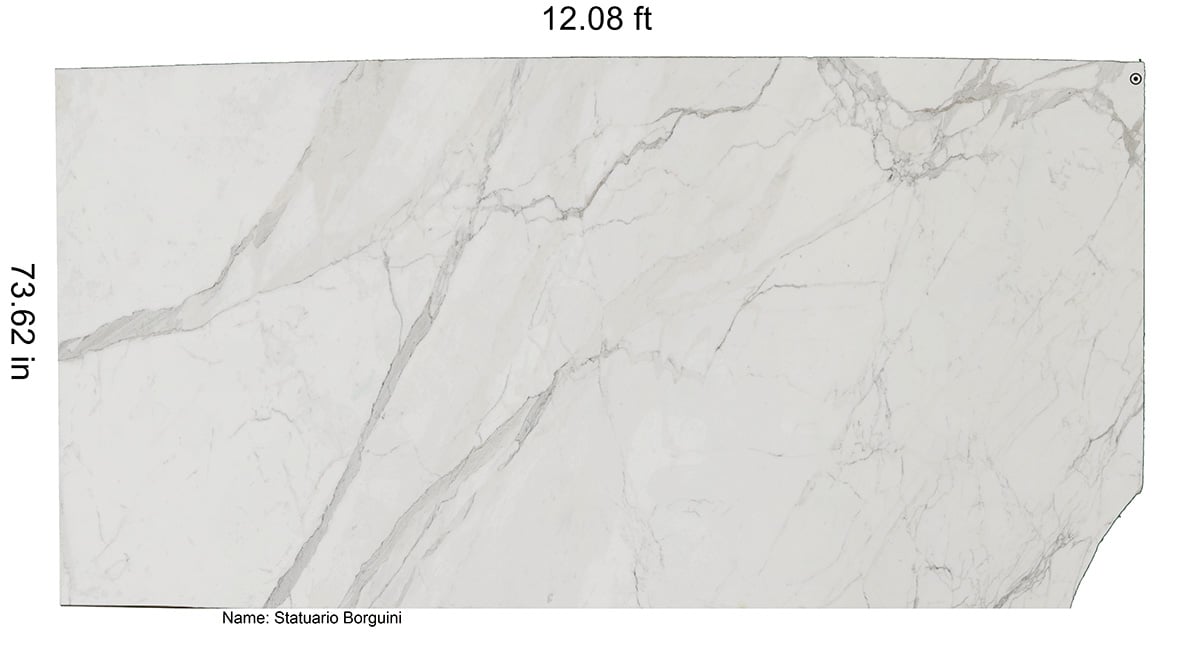
The brightest white with striking gray veining. The rarest of the three.
All three perform the same. The difference is appearance and price. Our Calacatta vs. Carrara guide goes deeper, and if you are weighing marble against an engineered look-alike, our Carrara marble vs quartz comparison covers that trade-off.
🎨 Grades, Slab Selection, and Cabinet Pairing
Not all Carrara is alike, and the names on the label are less reliable than what you see in front of you.
✦ Grades
You will hear CD, C, Extra, Gioia, Venatino, and Statuarietto. These describe how white the background is and how the veining looks, not how strong the stone is. Our Carrara marble grades guide breaks down all six.
✦ Background Color
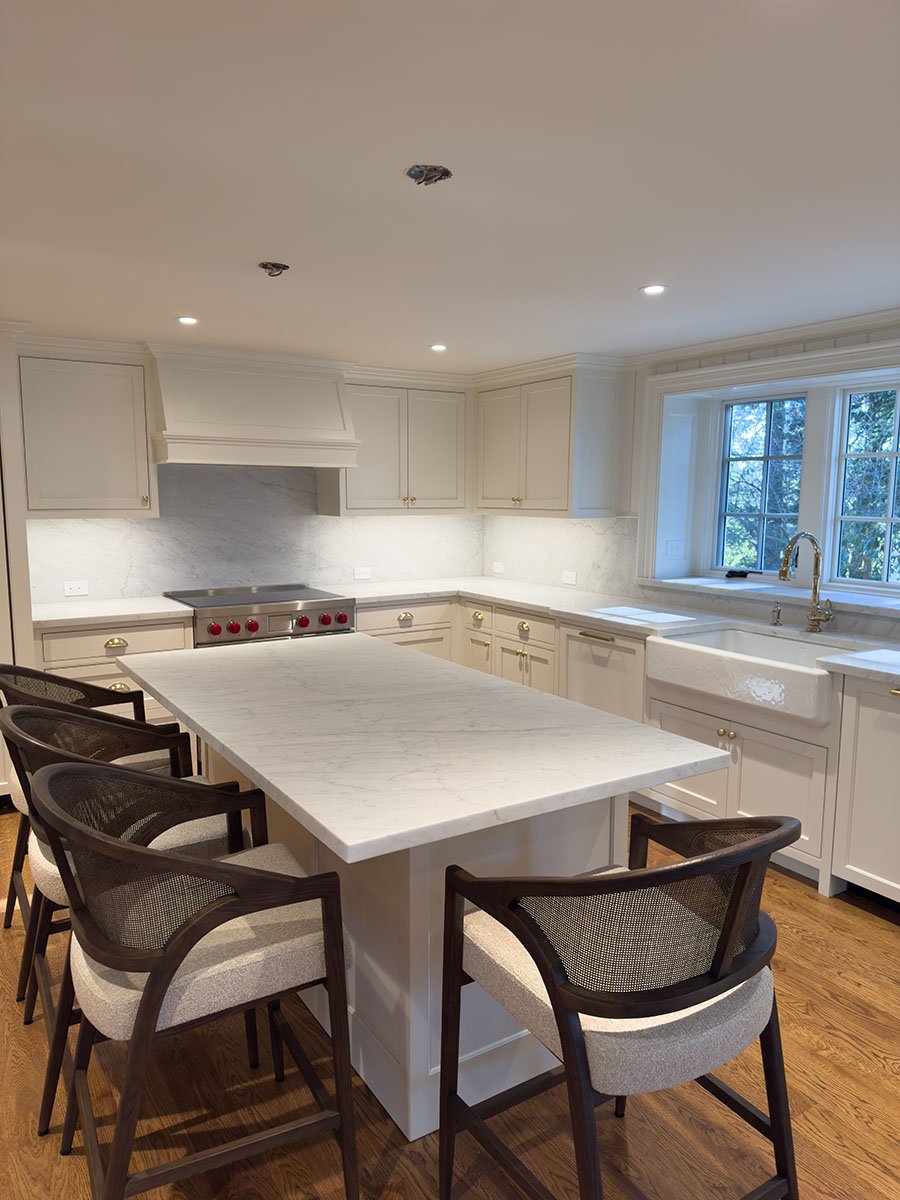
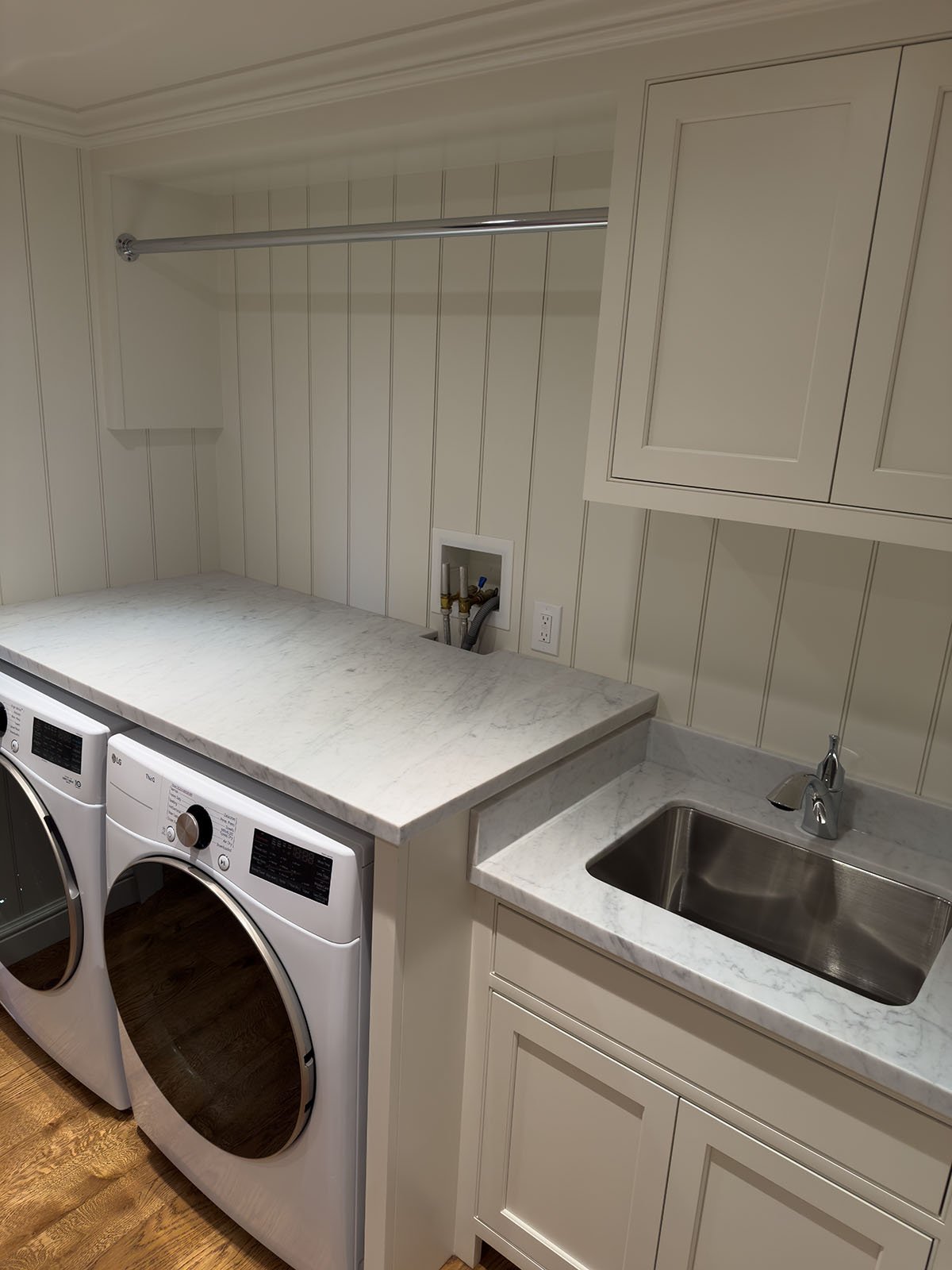
Backgrounds commonly range from bright white to blue-gray, and neither is better. Warmer whites pair well with cream cabinets, cooler gray-blues with pure white cabinetry.
Most Carrara runs cool, but some blocks have a creamy warmth. If your cabinets are warm-toned, ask us to find one. They exist. Our guide to what color cabinets go with Carrara marble covers the pairings in detail.
✦ Veining and Book Matching
Some slabs have tight, consistent veining, others dramatic variation. For countertops, consistency usually flows better across a workspace.
If your project needs multiple slabs, ask about book matching. Consecutive slabs from the same block let the veining mirror across a seam, which matters on large islands.
✦ What to Watch For
Natural fissures are normal and do not affect integrity. Cracks, chips, and large pits are a different matter.
📐 Thickness and Edge Profiles
✦ Thickness
In New England, three centimeters is the most common countertop thickness. It gives better structural support and allows more elaborate edges.
Two centimeters is common for vanities, fireplaces, thresholds, niches, and shower walls.
Here is the part worth knowing: some of the most beautiful Carrara only comes in two centimeters. The whitest backgrounds, the cleanest veining. If you want that slab on a kitchen counter, we build it up with a mitered edge so it reads thicker.
✦ Edge Profiles
An eased edge is slightly rounded and by far the most popular. An ogee suits classic New England architecture. A mitered edge creates a thick, modern look and is what waterfall islands need.
Mitered edges on marble take the right equipment and the right hands. We do them regularly.
🔧 Can Carrara Be Repaired?
More easily than harder stones, which surprises most homeowners.
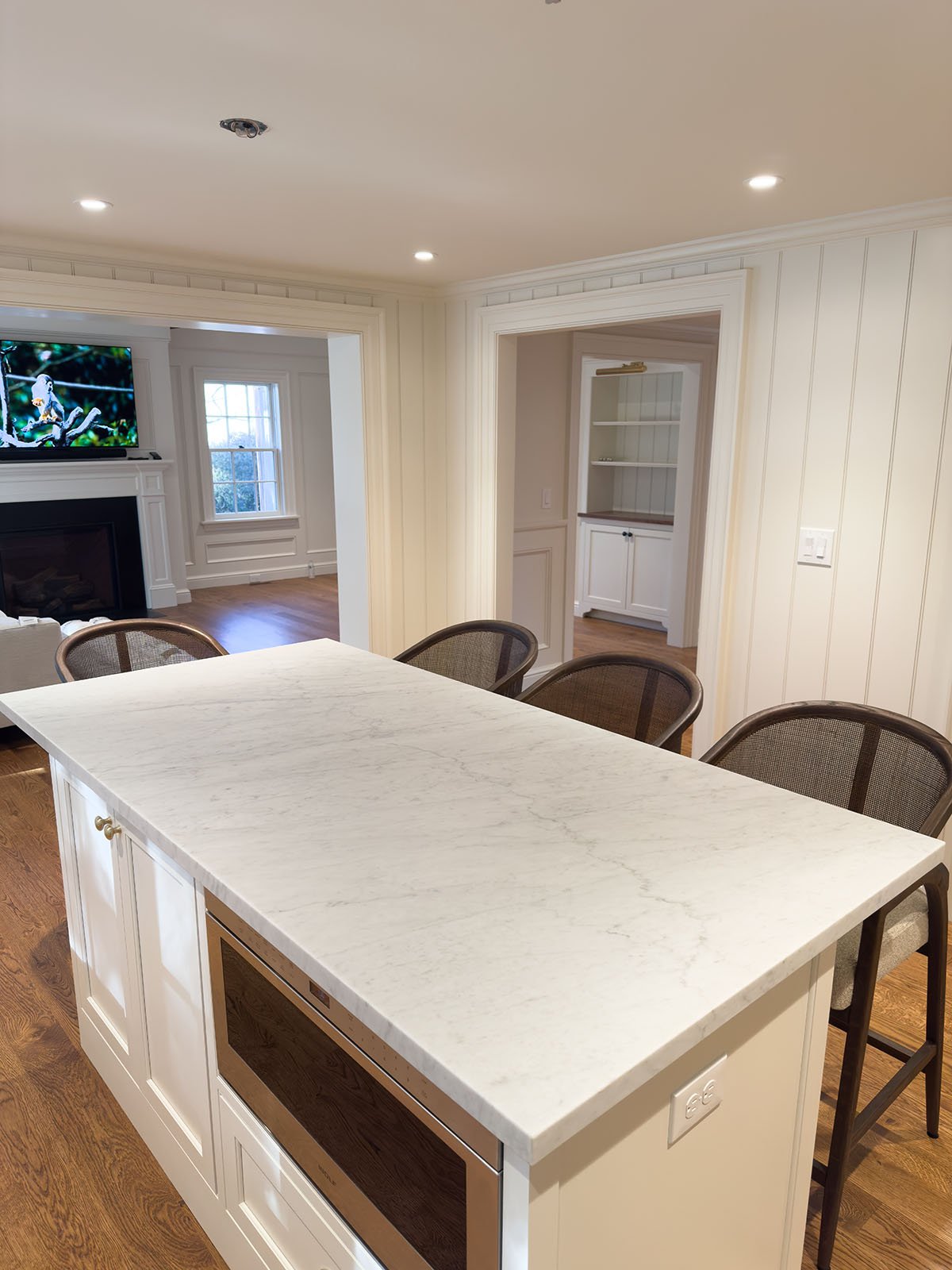
Scratches, etching, and dull spots can be refinished in your home. A professional hones out the surface damage and restores the finish without removing the countertop.
The trade-off is straightforward. Carrara shows wear sooner but is easier to restore. Granite resists wear longer and is harder to fix when something does happen.
🗻 Vermont Danby: The New England Alternative
If you want marble with local roots, look at Vermont Danby. It is quarried a few hours north of Boston.
Danby is typically denser and more durable than most Italian marbles, and the look is different: cloudier, subtler veining rather than Carrara's linear gray lines.
It costs more than Carrara. You are paying for durability and New England provenance. Our Vermont Danby marble guide covers the variations.
💰 Why Stone Pricing Isn't One-Size-Fits-All
How much is it per square foot? That's the most asked question, and it is not that simple. Let me explain why.
Total installed pricing typically ranges from $55 to $150 per square foot. Some rare materials fall outside that range.
✦ Sourcing
Two suppliers can charge different prices for the same slab. Anything from our in-house inventory is a set price per square foot regardless of job size.
If we special order for your job, pricing changes, because in this industry you buy whole slabs at a time.
✦ Project Size
Larger jobs spread setup and templating across more square footage, which usually works in your favor.
✦ Complexity
Waterfalls, integrated sinks, and elaborate edge work take more fabrication time.
✦ Waste
Every project is a puzzle. How efficiently your pieces fit on the slab affects the final number, and intricate shapes cut less efficiently.
✦ Long Story Short
Carrara delivers real value against other white marbles. We work with all suppliers and can source what you need.
Our Carrara marble countertops cost guide breaks the numbers down by tier, and our pricing and quotes page explains how we put a number together.
💡 Caring for Carrara
Do:
- Wipe spills quickly with mild soap and water
- Use trivets under hot pans
- Keep a cutting board handy for prep
- Reseal when water stops beading and starts soaking in
Don't:
- Cut directly on the surface
- Use abrasive scrubbers or harsh chemicals
- Leave citrus, wine, or tomatoes sitting
- Fear the patina
On sealing, skip the calendar. Pour a little water on the surface and let it sit. If the spot darkens, it absorbed, and it is time to seal. That test works on any natural stone.
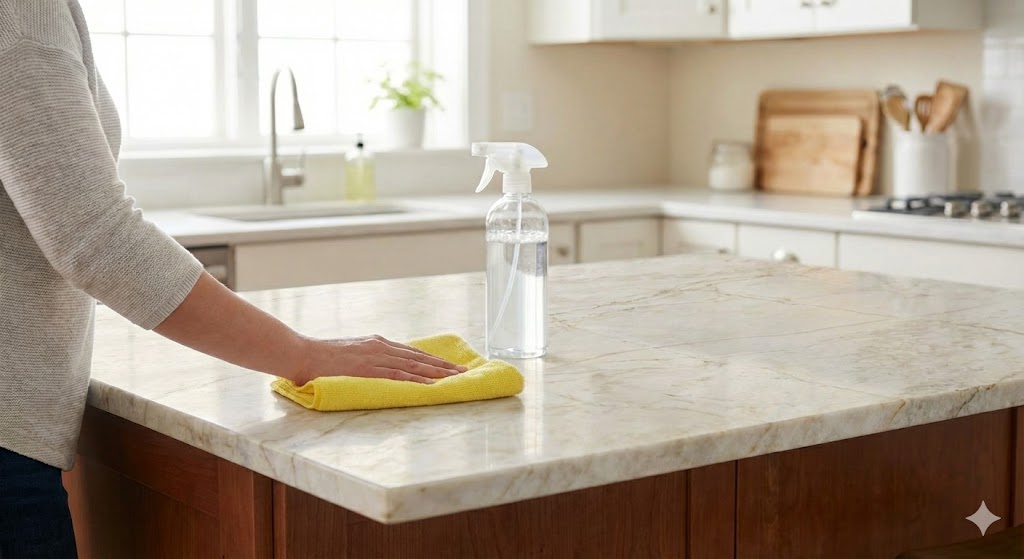
Our guide to cleaning marble countertops covers the rest.
❓ Frequently Asked Questions
Q. Will one lemon ruin my Carrara countertop?
A. A quick touch will not leave a visible mark. Leave a cut lemon sitting and it etches. Honed hides it better.
Q. Is Carrara more expensive than granite?
A. They overlap. Both have affordable and premium ends, and pricing depends on which slabs you compare.
Q. How long does Carrara marble last?
A. A lifetime. What changes over the decades is appearance, not structural integrity.
Q. Can I put hot pans on Carrara?
A. It resists heat and will not scorch, but I still recommend trivets. Sudden temperature swings stress any natural stone.
Q. Does Carrara need to be sealed?
A. Yes. Use the water test rather than a schedule, and remember sealing prevents staining, not etching.
Q. Is there such a thing as Carrara granite?
A. No, Carrara is only ever marble. For a similar look with more durability, look at quartzite countertops such as Taj Mahal.
Q. Where can I buy Carrara slabs in Massachusetts?
A. Distributors have showrooms, but working directly with a fabricator gets you guidance on the actual slab. Come see ours in Southborough.
Q. What goes with Carrara marble?
A. Almost everything: white or cream cabinets, gray or navy for contrast, warm wood, and brass hardware.
Q. Do Carrara countertops increase home value?
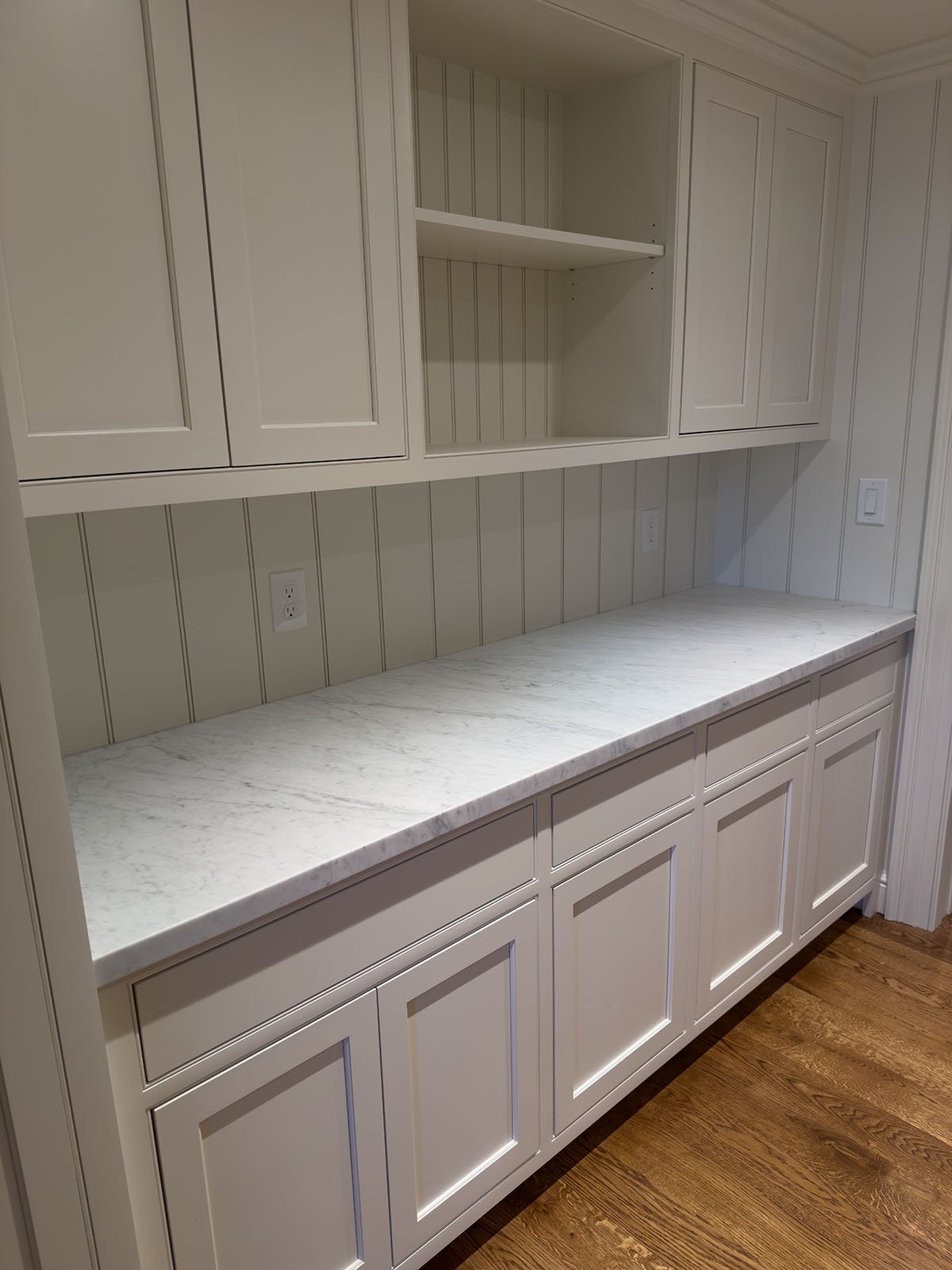
A. Quality countertops add real value regardless of neighborhood. Buyers notice the difference between a fabricated slab and a laminate.
Q. Is Carrara marble outdated?
A. No. It has been the default white marble in fine kitchens for centuries, and it still is. Our is Carrara marble outdated guide looks at what designers are actually specifying in 2026.
📚 Related Articles
🏠 Visit Our Southborough Showroom
Still deciding whether Carrara is right for you? Come see us. Nothing beats standing in front of the actual slabs and comparing finishes in person.
Stop by our countertop store at 43 Turnpike Road (Route 9), Southborough, MA 01772 during business hours. We keep a large inventory in our heated warehouse, so there is always plenty to see.
Already done your homework and know what you want? Email us or give us a call.
📞 508-460-7900
📧 info@graniteguyinc.com