Calacatta vs. Carrara Marble: Which Stone Is Right for You?
Written by Granite Guy Inc., Southborough, Massachusetts
Published: February 10, 2026
Both Calacatta and Carrara marble come from the same mountains in Italy. They're both white marbles with gray veining. And from across the room, you might not know the difference.
But put them side by side? Completely different stones. After 30 years of fabricating both across MetroWest and Greater Boston, I can spot the difference instantly — and so will you once you know what to look for.
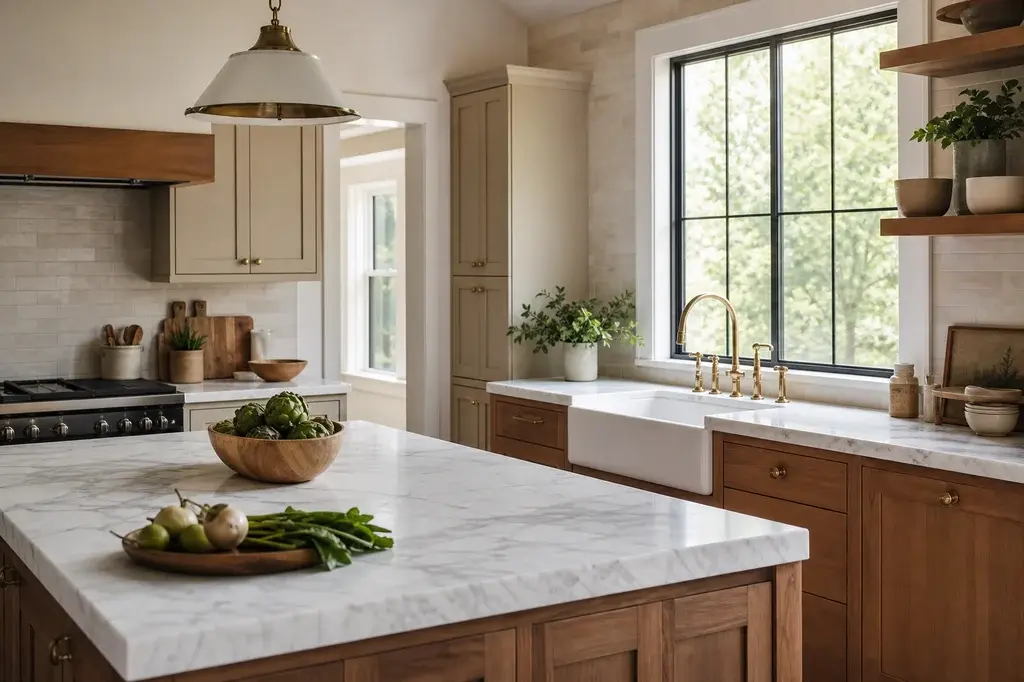
So why choose marble over other materials? For many homeowners, it comes down to one thing: nothing else looks like real Italian marble. The depth, the movement, the way light plays across the surface — it's timeless in a way that engineered materials can't replicate. Our marble countertops page covers the slabs in stock and how a job runs.
Jump to:
⚡ The Quick Version
Carrara has a gray-white background with soft, feathery veining distributed evenly across the slab. It's elegant and understated. Runs $70–150 per square foot installed.
Calacatta has a bright white background with bold, dramatic veining. It commands attention. Runs $150–300+ per square foot installed.
Both come from Tuscany. Both need the same care. The difference is aesthetics and budget.
Now let me show you exactly what separates them.
🎨 Visual Differences: What You'll Actually See
⚪ Background Color
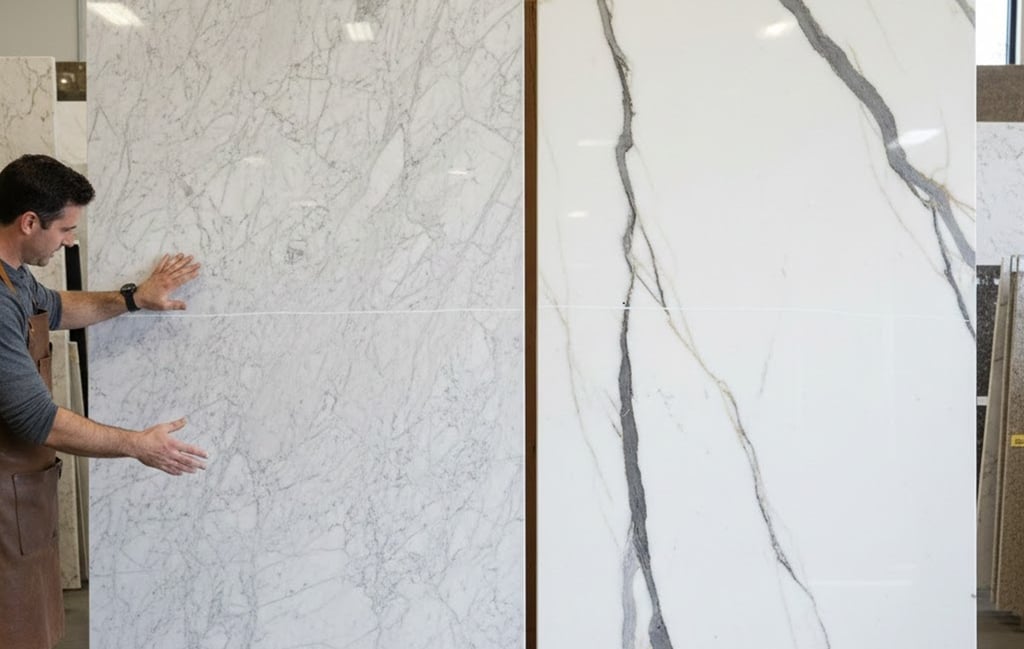
Carrara has a gray-white or blue-gray background. It's softer, more muted. Think elegant and understated — the marble equivalent of a whisper.
Calacatta has a bright, pure white background. Crisp and clean. It doesn't blend in — it takes over the room.
〰️ Veining Patterns
Carrara features fine, feathery veining spread evenly throughout the slab. The delicate lines create a consistent pattern. No single vein dominates.
Calacatta is the opposite. The bright white background dominates, interrupted by fewer but dramatically bold veins. Big, pronounced, impossible to ignore.
👁️ The Showroom Test
Here's how I explain it to clients: Stand ten feet back from both slabs. Carrara looks like a soft gray-white stone with texture. Calacatta looks like a white canvas with bold brushstrokes painted across it.
One whispers. One shouts.
🌍 Origin: Same Region, Different Quarries
Both marbles come from the Carrara region of Tuscany, Italy — the same mountains that supplied Michelangelo. This area has been producing marble for over 2,000 years.
Carrara marble comes from quarries throughout the region. It's more abundant and has been the workhorse marble for centuries.
Calacatta marble comes from specific quarries higher in the Apuan Alps. These deposits are rarer, which is why Calacatta costs significantly more.
Same mountains. Different elevations. Very different price tags.
💰 Marble Countertop Pricing Massachusetts: Let's Get Specific
This is where the decision gets real for most homeowners.
Carrara marble typically runs $70 to $150 per square foot installed. The range depends on background color and veining. Cleaner, whiter backgrounds with subtle veining are rarer and cost more. Grayer backgrounds with busier patterns are more common and more affordable.
Calacatta marble starts around $150 per square foot and can reach $300+ for premium slabs. But here's why pricing gets complicated: "Calacatta" isn't one stone.
Why Calacatta Pricing Is All Over the Map
"Calacatta" encompasses dozens of different Italian marbles from various quarries. Each looks completely different:
Common varieties: Calacatta Gold, Calacatta Borghini, Calacatta Vagli, Calacatta Michelangelo, Calacatta Oro
Bold and dramatic: Calacatta Macchia Vecchia, Calacatta Viola, Calacatta Paonazzo
Rare varieties: Calacatta Cervaiole, Calacatta Altissimo, Calacatta Fantastico
Each quarry produces limited quantities. Some varieties aren't available for months or years. That's why I can't give you a phone quote — the specific slab you choose determines the price.
A Note on Calacatta Gold
This is the variety most people picture when they hear "Calacatta." Bright white background with warm golden-brown veining. It's one of the more available types, which makes it less expensive than rare varieties like Borghini or Cervaiole. If you want the classic Calacatta look without the absolute top-tier price, Calacatta Gold is often where I steer clients.
🏔️ Understanding Carrara Varieties
Carrara isn't one stone either. It's a family of marbles with real differences in quality and price.
Classic varieties: Bianco Carrara (most common), Carrara Gioia (cleaner, more refined), Carrara Venatino (linear veining)
Premium varieties: Carrara White, Carrara Select, Carrara Extra, Statuarietto
Entry-level Bianco Carrara starts around $70 per square foot. Premium varieties like Carrara Extra or Statuarietto can reach $150+ — overlapping with lower-end Calacatta territory.
🏛️ What About Statuario?
If you're researching Calacatta and Carrara, you've probably seen Statuario mentioned. It's the third Italian white marble people ask about.
Statuario sits between Carrara and Calacatta. Bright white background like Calacatta, but the veining is more linear and directional — running in parallel patterns rather than scattered organically.
Price: $120 to $200+ per square foot installed.
The honest truth: Many slabs get labeled interchangeably between Statuario and Calacatta depending on the supplier. The quarries are close together, and there's no governing body checking labels. I've seen the same stone called Statuario at one yard and Calacatta at another.
💡 My advice: Forget the name, choose the slab. Come see them in person and pick the one that works for your space and budget.
✅ When to Choose Carrara
Full kitchen countertops. When you're covering 50+ square feet, Carrara makes financial sense without sacrificing beauty. A full Carrara kitchen might run $4,000–7,500 for the stone. The same kitchen in Calacatta? $10,000–20,000+.
Marble bathroom countertops and surrounds. Carrara's subtle elegance works perfectly in bathrooms without overwhelming the space.
Traditional or transitional homes. The softer veining complements classic New England architecture beautifully — it feels appropriate rather than flashy.
When you want marble, not a statement. Carrara enhances a space. It doesn't demand to be the center of attention.
✅ When to Choose Calacatta
Marble kitchen islands. If your island is the centerpiece of your kitchen, Calacatta delivers maximum impact where it matters most.
Waterfall edges. The bold veining creates stunning visual flow when the marble cascades down the sides. The right marble edge profile makes all the difference here — mitered edges for waterfall installations show off the stone's full thickness.
Marble fireplace surrounds. A floor-to-ceiling Calacatta fireplace becomes the focal point of your entire home.
Bookmatched installations. The dramatic veining creates incredible symmetry when consecutive slabs are mirrored.
📍 What I'm Seeing in Massachusetts
In the high-end homes I work on across MetroWest and Greater Boston, I see both marbles regularly — often in the same kitchen.
🏠 Real project: Last month I installed Calacatta Gold on a waterfall island in Wellesley. The homeowner paired it with Carrara on the perimeter counters. The island became the showpiece, the perimeter stayed elegant but understated, and she saved about $8,000 compared to doing Calacatta throughout.
Calacatta shows up in statement applications: marble kitchen islands, floor-to-ceiling fireplace surrounds, and primary bathroom feature walls.
Carrara dominates for full kitchen installations, secondary bathrooms, and projects where clients want marble throughout without a six-figure stone budget.
🔧 Durability and Maintenance
Here's what most articles won't tell you: they're virtually identical in terms of care.
Both are marble kitchen countertops that require a bit of care. Both rate 3 on the Mohs hardness scale. Both will etch from acidic substances like lemon juice, wine, and tomato sauce.
Both need a high-quality sealer. If you're wondering how to seal marble countertops, we recommend a professional-grade impregnating sealer applied every 6-12 months. It won't prevent etching (that's a chemical reaction with acids), but it will prevent staining from oils and liquids.
The only practical difference? Etching shows more on Calacatta's bright white background. Carrara's gray tones help camouflage minor etching and wear.
Honed vs polished marble: If low maintenance is your priority, consider honed finishes for either stone. The matte surface hides imperfections better than polished, though some clients love the high-gloss drama of a polished Calacatta slab.
For daily cleaning, check out our guide on how to clean marble countertops — the short version is pH-neutral soap and water, nothing acidic.
⚖️ Marble vs Quartz Countertops: A Quick Comparison
Many clients come in asking about marble vs quartz countertops. It's a fair question — quartz manufacturers have gotten very good at mimicking the Calacatta and Carrara look.
Choose marble if: You want the real thing. Natural depth, unique veining, the prestige of authentic Italian stone. You're okay with some maintenance and understand that patina develops over time.
Choose quartz if: You want the look without the worry. No sealing, no etching, consistent appearance. You're okay with a manufactured product that won't develop the same character as natural stone.
The honest difference: Stand in front of a real Calacatta slab, then look at the best quartz imitation. You'll see it. The depth isn't there. The veining looks printed rather than grown. Some people don't care — and that's fine. But if you're reading an article this detailed about Italian marble, you probably do.
If you want the marble aesthetic with more durability than marble but still natural stone, consider quartzite — it's harder than both marble and quartz.
🤔 My Recommendation
Choose Carrara if: You want authentic Italian marble across significant square footage, or you prefer understated elegance that doesn't compete with other design elements.
Choose Calacatta if: You want a showstopper, you're doing a single statement piece, or budget isn't your primary concern.
Consider both: Calacatta on the island, Carrara on the perimeter. You get the drama where it matters and stay within budget on the rest.
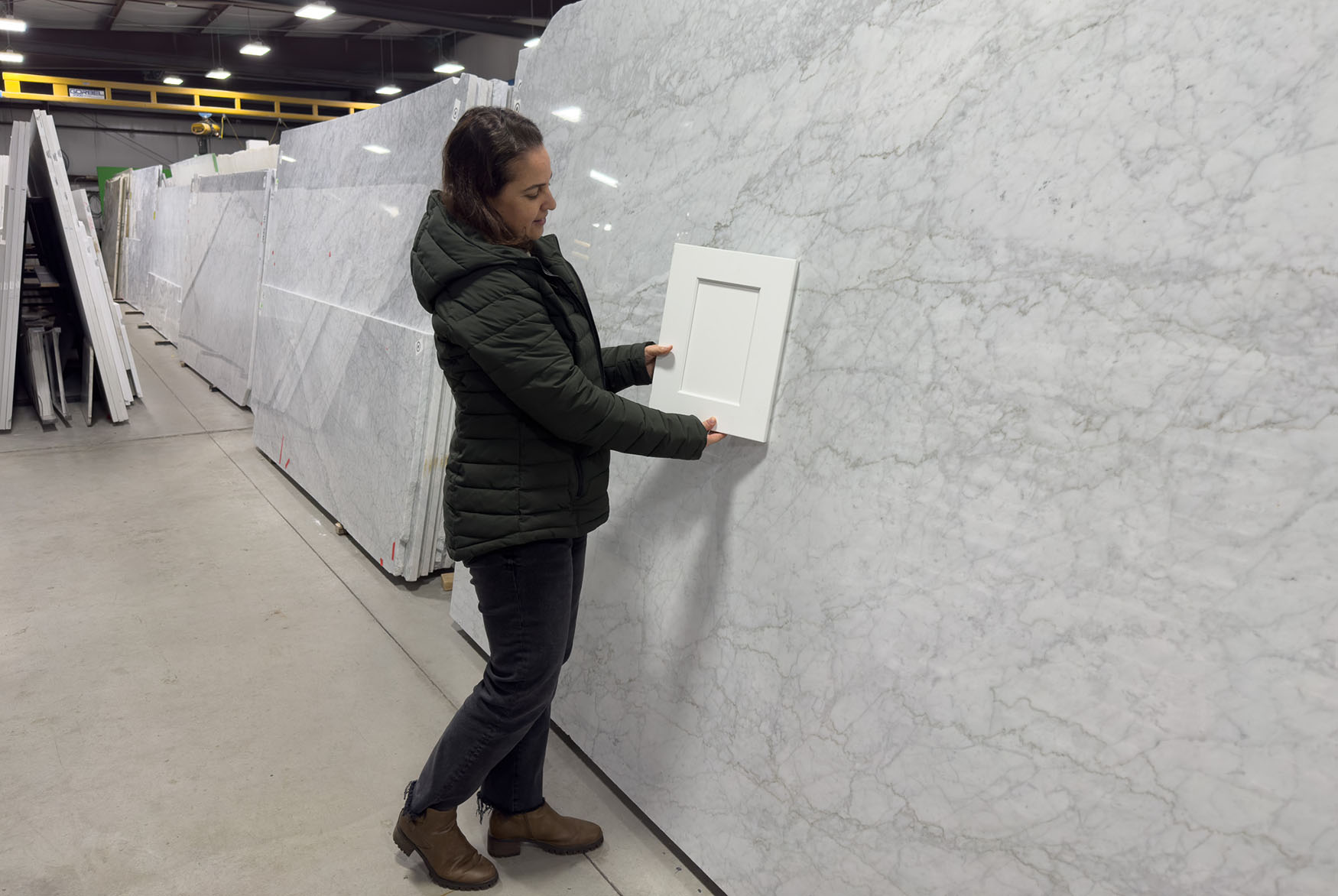
Still not sure? Come see them side by side. Photos don't capture how light plays across the surface, or how the veining depth changes as you move around the slab. This is a decision you need to make in person.
❓ Frequently Asked Questions
Q. Can I mix Carrara and Calacatta in the same kitchen?
A. Absolutely — it's one of my favorite approaches. Calacatta on the island, Carrara on perimeter counters. You get the statement piece where it matters most without blowing your entire budget.
Q. Is Calacatta worth the extra cost?
A. For statement pieces where the stone is the focal point, yes. For full kitchen coverage across 60+ square feet, Carrara delivers similar elegance at a fraction of the price. It depends on how you're using it.
Q. How do I know if I'm getting real Calacatta?
A. Work with a reputable fabricator who sources directly from Italian quarries. We can identify authentic Italian marble by appearance and stone characteristics. If someone's offering "Calacatta" at suspiciously low prices, ask questions.
Q. Which marble is more durable?
A. Neither — they're identical. Both rate 3 on the Mohs scale, both etch from acids, both need sealing. The only difference is that etching shows more on Calacatta's bright white background.
Q. Why can't you give me a price over the phone?
A. Because "Calacatta" and "Carrara" each cover dozens of different stones at different price points. Calacatta Gold costs half what Calacatta Borghini costs. The only way to price your project accurately is to select your actual slab.
📚 Related Articles
- Quartzite Countertops — if you want the marble look with more durability
🏠 See Both Marbles in Person
At Granite Guy Inc., we stock both Carrara and Calacatta varieties in our Southborough showroom. Come see full slabs side by side, compare the veining up close, and find the marble that fits your project and budget.
Granite Guy Inc.
43 Turnpike Road (Route 9)
Southborough, MA 01772