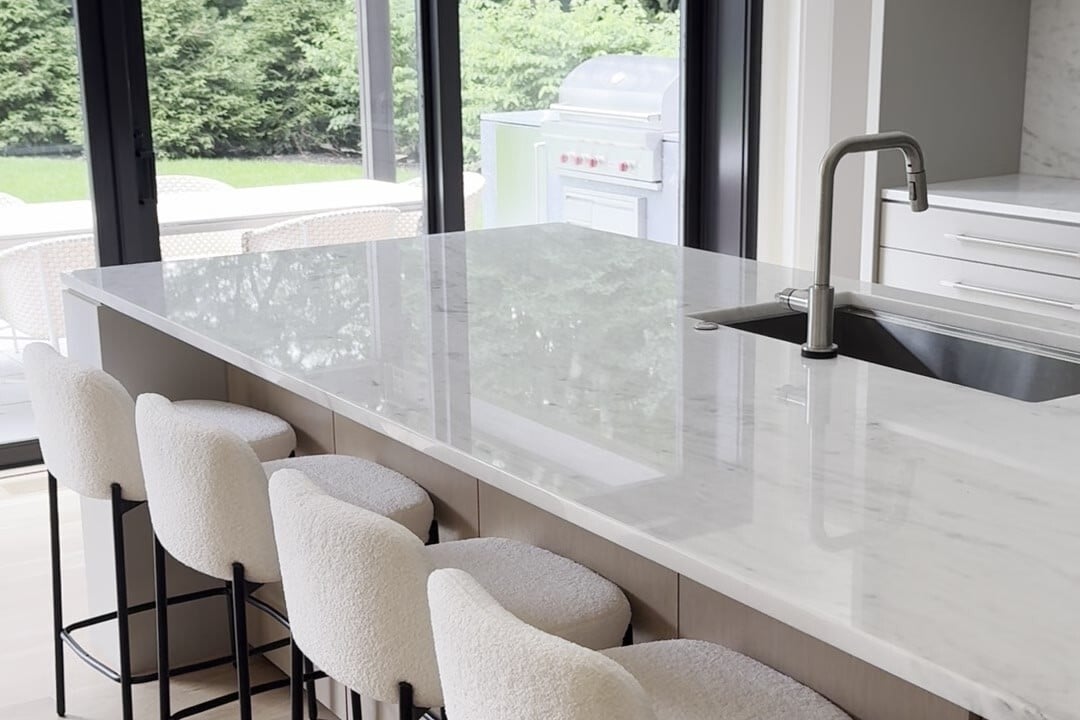
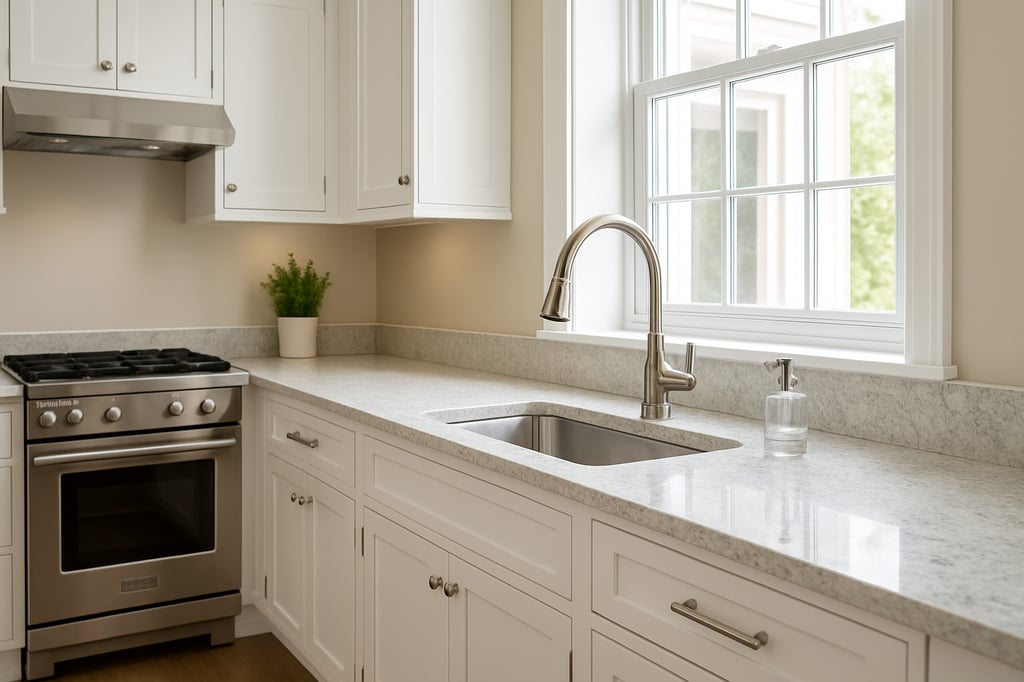
Written by Granite Guy Inc., Southborough, Massachusetts
Last updated: January 2026
4-inch backsplashes remain one of the smartest choices for modern kitchens, despite what you might read online. When homeowners search for information about whether this classic option still makes sense, they're often confused by conflicting advice.
As someone who has installed thousands of stone countertops and backsplashes throughout Greater Boston and MetroWest since 1995, I can give you an honest answer based on real experience. 4-inch backsplashes are not only relevant but often the best choice for many homeowners.
📐 What Is a 4-Inch Backsplash?
A 4-inch backsplash is a protective strip of stone, tile, or other material that extends up the wall from your countertop. Despite the name, these backsplashes are often customized to exact measurements.
Sometimes they're shorter (2-3 inches) or taller (5-6 inches), depending on the design. When clients plan to add tile above, I often recommend a shorter stone backsplash, around 2-3 inches, to leave more breathing room for the tile in that limited wall space.
Here's something many homeowners don't realize: the backsplash is a completely separate piece from the countertop. We fabricate it separately and install it independently using 100% silicone. This means you can choose to skip the backsplash entirely, go with tile instead, or select any height that works for your space.
🕰️ Is a 4-Inch Backsplash Outdated in 2025?
Absolutely not. When clients ask me this directly, I tell them: "Absolutely, it's still fashionable."
In New England, homeowners tend to prefer subtler, more understated design elements. While full-height stone backsplashes are gaining popularity (especially in high-end renovations), many clients find them too modern or overwhelming for traditional New England home styles.
Even in million-dollar homes in Wellesley or Weston, we regularly install 4-inch backsplashes because the homeowners prefer the proportions and classic look. It's not about budget, it's about style preference.
A 4-inch backsplash provides excellent protection exactly where you need it most, the area directly behind your countertops where spills and splashes actually occur. It also allows homeowners to paint the upper wall in their preferred color, creating more design options than a full stone wall.
Current trends: I've noticed more clients choosing full-height backsplashes in recent years, especially in modern kitchen countertops renovations. But the majority of my installations are still 4-inch. I'm also seeing increased interest in thinner profiles (3/4 inch instead of the standard 1.25 inches) for a more delicate, contemporary appearance.
⚖️ 4-Inch vs Full-Height: The Real Differences
Having installed both approaches thousands of times, here's what you need to know. Our full-height backsplash page covers the slab version start to finish.
A 4-inch backsplash adds about 4 extra square feet of material plus edging costs. Full-height backsplashes often double your material cost, sometimes using just as much material as the entire counter itself.
Installation time matters too. 4-inch backsplashes install the same day as your countertops in a single visit. Full-height requires a two-step process: install counters, remeasure once leveled, fabricate, then return for installation. This adds 1-2 weeks to your project.
The verdict:
- Choose 4-inch when: Budget matters, you prefer traditional styles, you want flexibility with paint colors above, or your stone has busy patterns that might overwhelm in large sections.
- Choose full-height when: Budget allows, you prefer modern aesthetics, you want minimal grout lines, or you have subtle stone patterns that won't overwhelm the space.
🪨 Best Materials for 4-Inch Backsplashes
Since your backsplash will be cut from the same slab as your countertops, any material you choose for your counters can work as a 4-inch backsplash. However, there are practical considerations for each.
Granite: The Classic Choice
Granite offers perfect color matching with countertops, excellent durability, and wide variety of patterns and colors. It can be milled down to 3/4 inch for a more delicate profile.
Just keep in mind that natural stone can have fissures or veining that require careful cutting. It may also need periodic sealing.
4-Inch Quartz Backsplash: The Durable Choice
Quartz brings engineered consistency that makes fabrication easier. It never needs sealing and is extremely durable, the resins make it less prone to chipping than natural stone.
Why quartz excels for backsplashes: If you want a sleek, modern 3/4-inch profile, quartz is your best choice. We can mill it down from the standard 1.25 inches to create a more delicate, contemporary look. This thinner profile is increasingly popular in modern kitchens where clean lines matter.
Quartzite: Stunning but Thick
Quartzite offers stunning natural patterns that rival marble with extreme hardness and durability. However, here's a critical limitation: quartzite is nearly impossible to mill down to thinner profiles.
This has become more problematic recently as sinks get larger and faucet space gets tighter. Having a thick quartzite backsplash behind the faucet can create installation challenges.
Marble: Elegant but Delicate
Marble creates elegant, timeless appearance with subtle colors that work beautifully in New England homes. But marble often comes with reinforcing mesh on the back from the factory.
The marble cannot be milled down. If you remove the mesh by milling, the stone becomes extremely fragile during transportation and installation. Marble is also more porous, requiring more care and frequent sealing.
Soapstone: Natural Character
Soapstone brings beautiful natural gray tones, and it's non-porous and naturally antimicrobial. It develops character over time with mineral oil treatments.
It's softer than granite and can scratch more easily. It also requires periodic mineral oil application for consistent color.
Quick Reference: Can It Be Milled Down?
| Material | Milled to 3/4"? | Sealing Required? |
|---|---|---|
| Quartz | ✅ Yes | None |
| Granite | ✅ Yes | Annual (light) |
| Quartzite | ❌ No | Annual |
| Marble | ❌ No (mesh backing) | Every 6-12 months |
| Soapstone | ✅ Yes | None (oil optional) |
💰 Cost Analysis: What You'll Actually Pay
"Based on my experience installing kitchen countertops Massachusetts residents love, here is the financial reality. Everything in the stone industry is measured by square footage. Every 3 feet of 4-inch backsplash equals approximately 1 square foot of material.
If you are wondering how to save money on countertops, sticking to a 4-inch splash is one of the most effective strategies. For a 12-foot kitchen run, you're only adding 4 square feet of stone.
Standard Costs:
-
For standard 4-inch granite or quartz backsplashes: Expect $200-400 additional cost.
-
Standard profiles, like a simple eased edge countertop finish, are typically the most affordable option.
-
Decorative edges or milling material down to 3/4 inch will add extra costs ($150-300+)."
🔧 Installation Process and Timeline
For 4-inch backsplashes, we handle everything in a single day. We cut the backsplash from the same slab as your countertops, ensuring perfect color and pattern matching.
We install and level your countertops first. Then during the same visit, we clean the wall surface, apply 100% silicone adhesive, and ensure tight fit and proper alignment.
Critical tips for installation day:
- Don't touch for 24 hours. The silicone needs a full day to cure. Anxious homeowners sometimes test the bond too early and compromise the seal.
- Expect small gaps. New England walls are never straight. Gaps between backsplash and wall are normal and will be filled with caulk.
- Painters handle the finish. The gap at the top is typically caulked and painted during your remodel.
🚫 Common Misconceptions Debunked
After 30 years in this business, here are the biggest misunderstandings I encounter.
"The backsplash is part of the countertop." Completely wrong. The backsplash is a separate piece that we fabricate and install independently. You're not required to get a stone backsplash at all.
"I can upgrade to full-height later." This rarely works well. Once we've used your slab for the countertops and 4-inch backsplash, we typically don't have matching material left. Even if we order more of the "same" stone, natural variations mean it won't match perfectly.
"4-inch provides inadequate protection." A 4-inch backsplash protects exactly where splashes and spills actually occur. This height has been standard for decades because it works.
"All 4-inch backsplashes look the same." We customize heights constantly. That "4-inch" might actually be 2-3 inches for tile combinations, or 5-6 inches to reach a window sill.
🎨 The 4-Inch Stone Backsplash with Tile Above
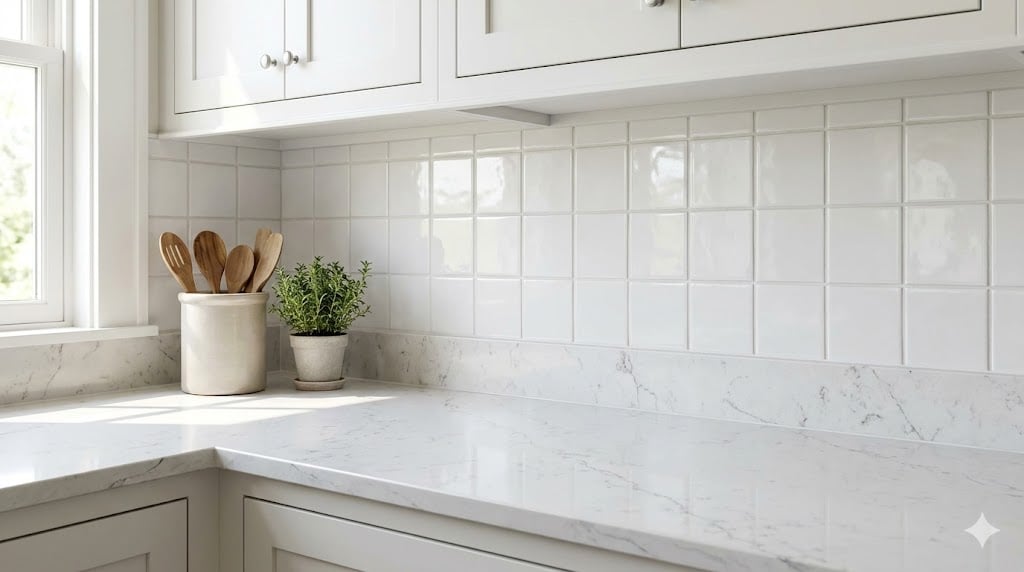
This is one of the most searched combinations, and I need to give you my honest professional opinion, along with practical advice if you love this look.
The typical kitchen has only about 18-19 inches between the countertop and upper cabinets. This limited space is tight for showcasing two different materials. The proportions can feel cramped if not done carefully.
My honest recommendation: For most kitchens, choosing one material from counter to cabinets creates a cleaner, more cohesive look. But I also know some homeowners love the vintage farmhouse aesthetic of stone below with tile above, and I've seen it done beautifully when executed correctly.
How to Make Stone + Tile Work
If you're set on this combination, here's how to do it right:
- Go shorter on the stone. Instead of a full 4 inches, consider a 2-3 inch stone backsplash. This gives your tile more room to breathe in that tight 18-19 inch space and creates better proportions.
- Keep the tile simple. A basic 4x4 or 6x6 square tile works far better than busy subway patterns.
- Match grout to tile color. This minimizes grout lines and reduces visual clutter.
- Consider your stone pattern. If your granite has dramatic veining, pair it with a solid, neutral tile.
- Use caulk, not grout, where tile meets stone. The junction needs flexibility, and caulk provides that while grout will crack.
🏆 The Best Alternative: 4-Inch Stone with Beadboard
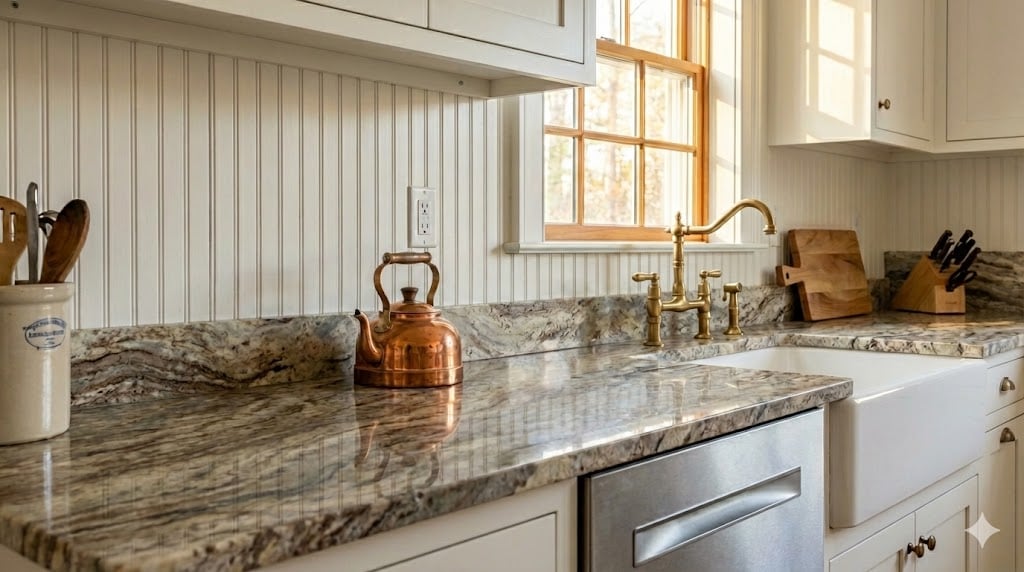
Here's one combination that consistently works beautifully: stone backsplash with wood cladding or beadboard above.
We see this throughout New England, and it's a great option. The stone protects the wood from water damage at the splash zone, creating both functional and aesthetic benefits. The natural warmth of wood above cool stone creates visual interest without the proportion problems of tile.
This pairing suits traditional Cape Cod, Colonial, and farmhouse styles perfectly.
📐 Design Considerations for Different Layouts
Straight runs along walls: 4-inch backsplashes work perfectly here. They're the default choice and rarely create design issues.
Islands: Typically don't need backsplashes unless they include a sink or cooktop. For island sinks, a 4-inch backsplash on the sink side provides splash protection.
Behind the sink with windows: This is where custom heights shine. Instead of standard 4-inch, we'll often extend the backsplash to the window sill, creating a continuous waterproof surface where it matters most.
🧹 Maintenance and Long-Term Care
Good news: 4-inch backsplashes are remarkably low-maintenance. Cleaning is very straightforward.
Daily care: Wipe with a damp cloth and mild dish soap. That's it.
Sealing schedule by material:
- Granite/Quartzite: Light annual sealing (less critical at backsplash height)
- Marble: Every 6-12 months
- Quartz: Never needs sealing
- Soapstone: No sealing, but periodic mineral oil enhances color
Avoid harsh chemicals or abrasive cleaners. The silicone bond creates a watertight seal that rarely needs attention once cured.
⚠️ When NOT to Choose a 4-Inch Backsplash
Be honest with yourself about these scenarios.
If there's any chance you'll want full-height stone in the future, install it now. Matching stone later is nearly impossible.
If your style is distinctly modern or contemporary, full-height stone usually makes a stronger design statement. For true modern designs, full-height is often ideal, particularly when paired with a dramatic waterfall countertop.
If you're an enthusiastic cook who creates significant splatter beyond the 4-inch zone, consider either full-height stone behind the range or full tile coverage.
❓ Frequently Asked Questions
Q. Is a 4-inch backsplash outdated?
A. No. 4-inch backsplashes remain completely fashionable, especially in New England. Even in million-dollar homes, homeowners regularly choose 4-inch because they prefer the classic proportions.
Q. How much does a 4-inch granite backsplash cost?
A. For a typical kitchen, expect approximately $200-400 beyond your countertop pricing. This covers about 4 extra square feet of material plus edge finishing for a 12-foot run.
Q. Can I add tile above a 4-inch granite backsplash?
A. You can, but it requires careful execution. I recommend going shorter on the stone (2-3 inches instead of 4) to give the tile more breathing room. Use simple square tiles (4x4 or 6x6), match grout to tile color, and use caulk where tile meets stone.
Q. Should my backsplash match my countertop?
A. Using matching material creates the most cohesive look and is by far the most popular choice. The backsplash is cut from the same slab, ensuring perfect color and pattern matching.
Q. Can you make a backsplash thinner than the counter?
A. It depends on the material. Quartz and most granites can be milled to 3/4 inch. Quartzite is too hard to mill, and reinforced marbles lose structural integrity if the backing mesh is removed.
Q. Do I need a backsplash with granite countertops?
A. While not absolutely required, a backsplash is highly recommended. It creates a clean transition while protecting your walls from water and spills.
Q. How long does installation take?
A. 4-inch backsplashes install in a single day along with your countertops. Full-height backsplashes require a two-step process that adds 1-2 weeks.
Q. What's better for a backsplash: granite or quartz?
A. Both work beautifully. Quartz never needs sealing and can be milled to a sleek 3/4-inch profile. Granite offers natural beauty and unique patterns. Choose based on your countertop preference.
Q. How do you clean a granite backsplash?
A. Wipe with a damp cloth and mild dish soap. Avoid harsh chemicals. Annual sealing is optional due to minimal exposure.
Q. Is a 4-inch backsplash enough protection?
A. For normal kitchen use, absolutely. The 4-inch height protects exactly where splashes occur. Consider full-height behind ranges if you cook frequently with heavy splatter.
✅ Final Recommendations from 30 Years of Experience
For most homeowners, a 4-inch backsplash matching your kitchen countertop material is an excellent choice. It provides necessary protection, creates a cohesive look, and allows design flexibility with the wall above, all while staying within budget.
For high-end renovations where budget allows and your stone pattern is subtle enough, full-height backsplashes create that seamless, luxury appearance. Just remember: it's a two-step installation that adds timeline and costs.
For traditional New England homes, 4-inch backsplashes often better suit the understated elegance characteristic of our region's architecture.
The one rule I never break: Always install some form of backsplash or wall protection.
📞 Ready to Discuss Your Backsplash Options?
"Every kitchen is unique, and the right backsplash choice depends on your specific space, style preferences, and budget. You might be typing countertop companies near me looking for a quick quote, but stone fabrication requires experience to get the details right—especially with backsplashes.
If you are looking for a trusted countertop fabricator near me, Granite Guy Inc. has served Greater Boston and MetroWest since 1995. We work with granite, quartz, quartzite, marble, soapstone, and porcelain."
- Phone: 508-460-7900
- Location: Southborough, Massachusetts
- Service Area: Greater Boston and MetroWest including Framingham, Natick, Wellesley, Sudbury, Weston, Shrewsbury, and throughout the region