
Waterfall Countertop Cost: $1,500–$5,000+ in Massachusetts
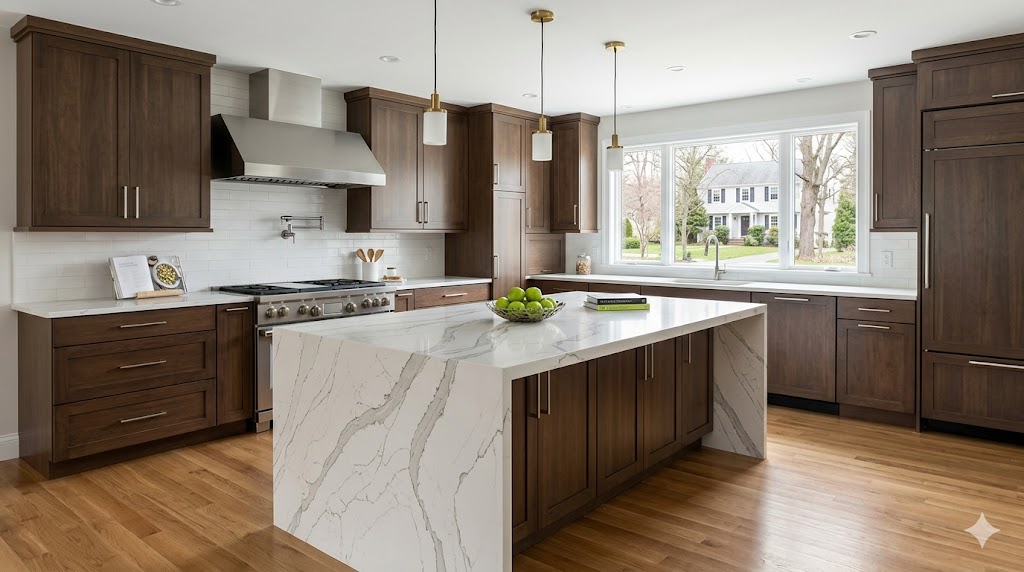
Written by Granite Guy Inc., Southborough, Massachusetts
Updated: March 2026
A single waterfall side adds $1,500 to $2,500 to your countertop project. A double waterfall island runs $3,000 to $5,000 or more — and that number can climb quickly depending on your material, your island size, and who's doing the work.
💎 Quick Answer
Waterfall countertops are beautiful but technically demanding. Most MA homeowners pay $4,000–$6,000 for a standard 3×5 ft island with one waterfall side. The biggest variables are material choice, vein matching complexity, and fabricator experience.
I've done hundreds of waterfall installations across Greater Boston and MetroWest over 30 years. Here's what every Massachusetts homeowner should know before committing.
🪨 What Is a Waterfall Countertop?
A waterfall countertop is when the stone continues from the top of your island or peninsula down the side — all the way to the floor — creating one unbroken surface.
The key is a 45-degree mitered joint where the horizontal top meets the vertical drop. Two pieces are cut at precise angles so the vein or pattern appears to fold over the edge seamlessly.
Done right, it looks like the stone grew that way. Done wrong, it looks like two pieces awkwardly glued together — and that's more common than people realize.
⚠️ Why Most Waterfalls Go Wrong
People see waterfall countertops on Instagram or in a neighbor's kitchen countertops and fall in love. What they don't see is what happens when the wrong fabricator takes the job.
I've been called in to fix botched waterfall installations more times than I'd like to count. Chipped edges. Veins that don't match at the miter. Gaps at the seam. Edges that cracked within months because the material wasn't suited for it — or the cut was made from the wrong part of the slab.
The problem is that a waterfall looks simple. It isn't. It's one of the most technically demanding jobs in stone fabrication, and most of the risk is invisible until after installation day.
⚠️ Red Flag
If a fabricator can't show you a portfolio of completed waterfall projects in your specific material, keep looking. A waterfall is not the place to let someone practice.
🎨 Material Difficulty: Not All Stone Is Equal
This is the part most articles skip — and it's the most important thing to understand before you choose your stone.
Some materials handle a waterfall edge cleanly. Others are punishing. Your material choice affects not just the look, but how well the finished edge holds up over time.
Here's how I think about it after fabricating all of them for 30 years.
✦ Quartz — The Most Forgiving
Quartz is the easiest material for waterfall edges. Consistent patterns make the miter joint predictable and the edge finishes cleanly.
If you're doing your first waterfall or working with a tighter budget, quartz gives you the best chance of a flawless result. Expect $75 to $150 per square foot installed. Still deciding between quartz and natural stone? Read our quartz vs. quartzite comparison.
✦ Granite — Reliable and Unique
Granite cuts well with the right equipment, and every slab is one of a kind. The main consideration is that each slab is different, so vein planning matters more than with quartz.
Heat-resistant and extremely durable. Granite runs $60 to $140 per square foot depending on rarity.
✦ Marble — Beautiful but Demanding
Marble is stunning in a waterfall — especially with bold, flowing veins. But the miter joint has to be precise because any gap or misalignment in the pattern shows immediately.
Regular sealing is required. Marble waterfall countertops range from $85 to $200 per square foot.
✦ Porcelain — The Newest Challenge
Ultra-thin porcelain slabs have become popular for waterfall installations in Boston's luxury condos and high-end kitchens. The contemporary look is striking.
But porcelain is brittle. The miter cut requires specialized waterjet technology, and until recently, most fabricators couldn't handle it. Costs range from $55 to $120 per square foot.
✦ Quartzite — The Most Difficult
Quartzite is one of the hardest natural stones on earth — and that's exactly what makes it so challenging for waterfall edges.
The 45-degree miter cut is unforgiving. If your fabricator doesn't have the right equipment and real experience with hard stone, the edge chips. I've seen beautiful slabs ruined by a fabricator who didn't know what they were getting into.
Done right, the results are extraordinary. Plan on $90 to $200 per square foot.
💡 Bottom Line on Material
Quartz is the most forgiving. Quartzite is the most demanding. The harder the material, the more critical it is that your fabricator has the right equipment and direct experience with that specific stone. Looking for something completely different? Soapstone is a beautiful alternative that handles waterfall edges exceptionally well.
🔬 Vein Matching and Slab Planning
This is where cost complexity lives — and where most homeowners don't know what to ask.
If your stone has bold veining or an exotic pattern, the waterfall effect only works if that pattern flows continuously from the top surface down the vertical side. To achieve this, the fabricator has to cut both pieces from specific parts of the same slab so the vein folds over the edge naturally.
That requires careful digital layout before a single cut is made. We use SlabSmith software to map exactly where each piece comes from on the slab, visualize the vein flow, and confirm the result before anything is cut.
Without that step, you're guessing.
💡 Why This Affects Your Cost
When vein matching is required, more of the slab may go to waste. You might need a larger slab — or even two slabs — to get the right pieces from the right locations. A good fabricator will show you the digital layout and get your approval before cutting anything.
If your material has a consistent or solid pattern — many quartz options fall here — vein matching isn't a concern. The edge looks clean regardless of where the pieces come from.
If your material has dramatic, flowing veins — Calacatta marble, Taj Mahal quartzite, exotic granite — the planning gets complex. But when it's done right, the result is something no other edge profile can match.
💰 The Most Asked Question: How Much Per Square Foot?
How much does a waterfall countertop cost? That's the most asked question. But it's not that simple.
💎 The Range
About 95% of countertops fall between $55–$150 per square foot installed. That range covers most materials and most projects in Massachusetts.
✦ Exceptions
Some rare and exotic stones fall outside this range and are always more expensive.
Rare blues like Blue Bahia granite and Azul Macaúbas quartzite — blue is nature's scarcest color. Translucent stones like the Cristallo quartzite family. High-end Italian marbles like Calacatta and Statuario.
✦ The Only Real Rule: Supply and Demand
Pricing depends on what's desirable right now. Trendy means higher price. Out of fashion means lower price.
The rare blues are expensive because they're naturally scarce. Italian marbles are expensive because of high demand and limited supply. A stone that looks plain might be affordable — and a stone that looks exotic might surprise you on the low end. Fall in love with three or four options and let us run the numbers. You might find one is 20–30% less than the others.
✦ What Else Affects Your Price
- Sourcing: We work with all suppliers to find the best value. In-house inventory is the most cost-effective option. For smaller projects, ask about our remnant inventory — premium stone at discounted pricing.
- Project size: Larger islands, double waterfalls, and unusual dimensions all change the math.
- Complexity: Waterfall edges, mitered joints, and integrated sinks require more fabrication time. A solid-color quartz waterfall is straightforward. A bookmatched quartzite island with a double waterfall is a different job entirely.
- Waste: Every project is a puzzle. How efficiently we fit your pieces on the slab affects the final cost. And for waterfall edges with bold veining, the pieces have to come from a specific part of the slab for the vein to flow correctly — sometimes that means using more material than expected.
✦ So How Do You Budget?
Don't shop by material name. Shop by color and look.
Come to our warehouse in Southborough, see and touch your options in person, and we'll run real numbers on your actual island dimensions — not national averages that have nothing to do with your kitchen.
🔨 The Two-Step Installation Process
Here's something most fabricators won't tell you — and most homeowners never think to ask.
For hard stones like quartzite, and for homes with uneven floors — which is most older Massachusetts homes — a single-day install isn't always the right approach.
We use a two-step installation process when the job demands it. The first step sets the base and confirms everything is level and properly supported. The second step brings in the finished waterfall pieces and executes the final miter joint under controlled conditions.
This eliminates the margin for error that comes from trying to do everything at once with a 600-pound slab.
Most homeowners, when I explain this, visibly relax. It's not faster. But it's right.
We offer professional waterfall countertop installation across Greater Boston and MetroWest — from simple single-side islands to complex double waterfalls in hard stone.
💡 On Timing
Plan for 6 to 8 weeks from material selection to completed installation. Templating, fabrication, and scheduling all take time — and you cannot rush precision stonework.
New England homes present their own specific challenges. Uneven floors, narrow doorways, upper-floor kitchens — waterfall pieces sometimes require windows to be removed or small cranes for upper-floor access. We've handled all of it. The planning happens before installation day, not during it.
🏡 Is a Waterfall Right for Your Kitchen?
Not every kitchen benefits from a waterfall edge. Here's an honest way to think about it.
✦ It Works Well In
Modern, contemporary, and transitional kitchens with clean lines. Open floor plans where the island is the visual anchor of the room. Islands that are at least 3×5 feet — anything smaller and the waterfall feels out of proportion.
It also works beautifully on bar countertops and peninsulas. A wet bar or home bar with a waterfall edge creates the same dramatic effect as an island. We install them regularly in finished basements and entertainment spaces across MetroWest.
✦ It Usually Doesn't Fit In
Traditional or colonial kitchens with ornate molding and raised-panel cabinets. Small kitchens where the proportions feel cramped. Spaces where sharp, modern lines fight the existing design.
✦ Quick Style Test
Look at your cabinet doors. Flat panels with simple hardware? Your kitchen is ready for a waterfall. Raised panels with decorative molding? The waterfall will fight the room.
When you come into our showroom, we'll tell you honestly — even if it means talking you out of it.
🔄 Waterfall vs. Regular Countertop: What's the Actual Difference?
A standard countertop ends at the edge of the cabinet with a finished profile — eased, beveled, or bullnose. It's clean, functional, and works in any kitchen.
A waterfall continues that surface vertically down to the floor. It's a design statement, not just an edge profile. The two aren't really comparable — one is a finish, the other is an architectural feature.
The cost difference reflects that. A standard edge countertop on a 3×5 ft island might run $2,000 to $3,000 installed. Add a waterfall and you're at $4,000 to $6,000 or more. That extra cost buys you the look, the cabinet protection, and the craftsmanship required to execute it correctly.
If you're on the fence, come see both in person. The difference is obvious when you're standing next to them.
⭐ Pros and Cons
What you gain:
- A focal point that anchors your entire kitchen
- Protection for cabinet sides from kicks, spills, and everyday wear
- Real resale value in the Massachusetts market — especially in Newton, Weston, Wellesley, and Needham
- The ability to conceal appliances, outlets, or storage behind the stone
What to consider:
- Adds $1,500 to $5,000+ over a standard edge countertop
- Requires expert fabrication — poor execution is obvious and permanent
- Won't suit every kitchen style
- Cannot be modified after installation
❓ Frequently Asked Questions
Q. How much does a waterfall countertop cost in Massachusetts?
A. A single waterfall side adds $1,500 to $2,500 to your project. A standard 3×5 ft island with one waterfall runs $4,000 to $6,000 total, including material, fabrication, and professional installation.
Q. Which material is easiest for a waterfall edge?
A. Quartz. Consistent patterns make the miter joint predictable and the edge finishes cleanly. It's the most forgiving option for waterfall fabrication.
Q. Which material is the hardest to execute?
A. Quartzite is the most demanding. It's extremely hard, which makes precision cutting critical. One wrong move and the edge chips — and it can't be fixed after the fact.
Q. Does the vein have to match on a waterfall edge?
A. Only if your stone has bold, flowing veins. For solid or consistent-pattern materials, it's not an issue. For dramatic natural stone, vein matching is essential and requires digital layout planning before any cuts are made.
Q. Why does vein matching make a waterfall more expensive?
A. Achieving the right vein flow may require cutting from a specific part of the slab — and that can mean more waste, a larger slab, or additional planning time. A good fabricator will show you the layout before you approve anything.
Q. Can any fabricator do a waterfall?
A. No. Waterfall edges require CNC precision, real experience with mitered joints, and for hard stones like quartzite, waterjet technology. Always ask for a portfolio of completed waterfall projects in your specific material.
Q. What is a two-step waterfall installation?
A. For hard stones and homes with uneven floors, we set the base first and then return to execute the final miter joint. It takes more time but eliminates the margin for error on a 600-pound slab. Not every fabricator does this — but it's the right way.
Q. How long does a waterfall countertop installation take?
A. Plan for 6 to 8 weeks from material selection to final installation. Templating, fabrication, and scheduling all require time. Precision stonework cannot be rushed.
Q. Do waterfall countertops add home value in Massachusetts?
A. Yes. A well-executed waterfall signals quality craftsmanship and typically returns value at resale — particularly in Greater Boston communities where buyers expect high-end kitchen finishes.
Q. What is bookmatching on a waterfall countertop?
A. Bookmatching uses two consecutive slabs from the same block, placed so their patterns mirror each other — like an open book. It creates a breathtaking symmetrical effect on bold-veined stones. It's a premium option that increases both material and fabrication costs.
Q. Are waterfall countertops still in style?
A. Yes — and they've moved past trend into a design classic. What started as a high-end luxury feature is now a mainstream expectation in updated Massachusetts kitchens. A well-executed waterfall doesn't date the way trendy finishes do.
Q. Can you do a waterfall on a bar countertop or peninsula?
A. Absolutely. Waterfalls work just as well on bar tops, wet bars, and peninsulas as they do on kitchen islands. The fabrication process is identical. If you have a bar area in your home, it's worth considering.
📚 Related Articles
- Taj Mahal Quartzite: The Complete Guide
- How to Choose Kitchen Countertops: A Massachusetts Fabricator's Guide
🏠 Visit Our Southborough Showroom
Still figuring out which stone and which edge is right for you? Come see us. Nothing beats standing in front of the actual slabs and talking through your specific island dimensions in person.
Stop by our countertop store at 43 Turnpike Road (Route 9), Southborough, MA 01772. We keep a large inventory in our heated warehouse, so there's always plenty to see — and we'll give you honest advice about whether a waterfall actually fits your kitchen.
Already done your homework and know what you want? Email us or give us a call.
📞 508-460-7900
📧 info@graniteguyinc.com


