Marble Backsplash Ideas: Your Complete Kitchen & Bathroom Guide

Written by Granite Guy Inc., Southborough, Massachusetts
Published: April 2026
A marble backsplash is one of the smartest ways to bring marble into your kitchen or bathroom. You get all the beauty of natural marble in the one spot where durability concerns barely matter.
💎 The Quick Answer:
Backsplashes don't take the abuse that countertops do. No knife cuts, no hot pans, no acidic foods sitting on the surface. For kitchens, go full-height slab or a 4-inch slab strip. For bathrooms, a 4-inch backsplash is the standard. Budget roughly $300–900 for a 4-inch or $1,500–4,000+ for full-height.
After fabricating and installing thousands of marble projects throughout Greater Boston and MetroWest since 1995, I can tell you something most people don't realize: the backsplash is the safest place to use marble in your home.
🪨 Why a Marble Backsplash Is a Smart Choice
Here's what I tell clients who love marble but worry about durability.
Marble countertops take daily abuse: knife cuts, hot pans, lemon juice, wine spills, constant scrubbing. That's where marble's softness and porosity become real concerns.
But a backsplash? It just sits there looking beautiful.
No cutting, no heat, no acidic foods sitting on it. The occasional splash wipes right off. On a vertical surface, marble's durability "weaknesses" become almost irrelevant.
You get those flowing Calacatta veins or the soft Carrara grays, that classic New England look, without stressing about every dinner party.
🏠 Marble Backsplash in the Kitchen: Your Options
After 30 years in this business, I've noticed a clear pattern in how people use marble backsplashes depending on the room. Let me start with kitchens, since that's where most of the questions come from.
✦ Why Full-Height Slab Works Best in Kitchens
In kitchens, that 18-inch space between countertop and upper cabinets is awkward. It's too small for two different materials to look right, so most clients commit fully: either a full-height marble slab throughout or a clean 4-inch strip.
Full-height marble slab behind the entire kitchen makes a dramatic statement, with continuous veining flowing from countertop to wall. When the veining lines up perfectly from counter to backsplash, that's called bookmatching — and it's one of the most striking things we do. It's the most visually powerful option, though it adds significant cost. Our full-height backsplash page covers the stone option in detail.
✦ The Smart Compromise: Full-Height Behind the Stove Only
Here's something very popular that a lot of homeowners don't initially consider.
Instead of doing full-height marble throughout the entire kitchen (expensive) or settling for a 4-inch strip everywhere (less dramatic), many clients do full-height marble only behind the stove, the natural focal point, and a 4-inch slab strip elsewhere.
This approach gives you the visual impact where people actually look. The stove area gets that marble statement piece with veining flowing up the wall. The rest of the kitchen gets a cleaner, more budget-friendly treatment.
It's visually effective and cost-effective.
🛁 Marble Backsplash in the Bathroom
Bathrooms are completely different from kitchens. About 99% of my marble bathroom installations use a 4-inch backsplash or something close to it.
Sometimes we adjust the height slightly for outlets, window sills, or other obstacles. But on average it's three to four inches.
The open wall space above a bathroom vanity makes that 4-inch strip look intentional and clean. It provides the water protection you need without overwhelming the space. For more on the 4-inch option across all materials, check out my 4-inch backsplash guide.
✨ Powder Rooms: Where Marble Backsplash Really Shines
Powder rooms deserve special mention because this is where clients get creative with marble backsplashes.
Powder rooms are the "jewelry box" of the house: small space, big impact, and guests actually see it. So people invest in the details here.
✦ Wall-Mounted Faucets
With wall-mounted faucets, the backsplash needs to be taller anyway to cover the plumbing, usually around 12 inches. Clients often take this opportunity to make it a design statement.
✦ Decorative Options
We'll do decorative shapes, pretty profiles, maybe an arched top or elegant edge detail.
These decorative powder room backsplashes showcase what CNC machinery and waterjet cutting can really do. It's a chance to create something unique that becomes a conversation piece.
🔬 Honed vs Polished Marble Backsplash
This is a question I get constantly, and it matters more than most people think.
✦ Polished Marble Backsplash
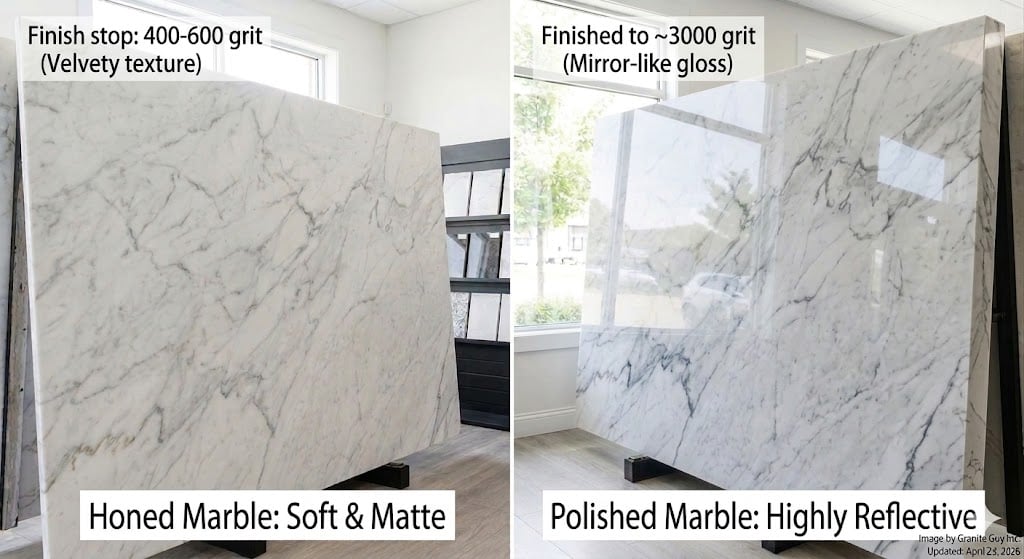
Polished is the more popular choice for backsplashes. The glossy surface wipes down easier because spills and splashes sit on top rather than absorbing into the stone.
Polished marble also reflects light beautifully, which makes kitchens feel brighter. In Massachusetts homes where natural light can be limited during winter months, that reflective quality makes a real difference.
✦ Honed Marble Backsplash
Honed marble has a soft, matte finish that gives a more relaxed, contemporary look. If you're drawn to the "quiet luxury" aesthetic that's dominating high-end kitchen design right now, honed is your finish. It's beautiful, but there's a trade-off.
Honed marble is more porous than polished. Near the stove especially, oil splashes can absorb into honed marble faster. You'll need to be more diligent about wiping down a honed backsplash after cooking.
✦ My Recommendation
For kitchen backsplashes, I lean toward polished. It's easier to maintain and the light reflection adds visual impact. For bathrooms and powder rooms, either finish works beautifully since there's no cooking grease to worry about.
💡 Pro Tip: Some clients do polished countertops with a honed backsplash (or vice versa) for contrast. Just make sure the two finishes are intentional, not accidental. Ask to see samples of both side by side before committing.
💰 Marble Backsplash Pricing
Most marble backsplash projects fall in the $55–150 per square foot installed range, depending on the material and complexity. A 4-inch backsplash adds roughly $300–900 to your project. Full-height can add $1,500–4,000+. For a full breakdown, check out my dedicated marble pricing guide.
What drives the price? Sourcing (we work with all suppliers and fabricate in-house, which keeps costs competitive — remnants work well for smaller backsplash jobs), project size, complexity, waste factor, and supply and demand.
✦ The Only Real Rule: Supply and Demand
The marble you choose is the single biggest cost driver. Common Carrara is widely available and priced accordingly. Rare Italian marbles like Calacatta or Statuario cost more because supply is limited and demand is high. That's it. That's the rule.
✦ So How Do You Budget?
Shop by the look you want, not the name on the label. Come visit our Southborough warehouse and we'll show you which materials deliver your preferred aesthetic at the right price point.
Long story short: we work with all suppliers and there's a marble for every budget. The best way to figure out yours is to come in, see the slabs in person, and have an honest conversation about what works for your project.
🪨 Marble Types and the Mesh Issue
Not all marbles are created equal when it comes to fabrication. This matters if you're considering a thinner backsplash profile.
✦ Stable Marbles (No Mesh)
The Calacatta vs Carrara marble debate is common for countertops, but for backsplashes they behave similarly. Both families are generally very stable materials.
They don't typically need reinforcing mesh and can often be thinned to 3/4-inch for a more delicate profile if desired.
✦ Reinforced Marbles (With Mesh)
Brazilian marbles usually have mesh reinforcement on the back. Most exotic marbles from around the world do as well.
The dramatic veining that makes these marbles so beautiful is also a structural weakness: those veins can disconnect or come apart during fabrication. The mesh holds everything together.
✦ Why This Matters for Backsplashes
To thin a stone, we mill the back side, not the finished face. If there's mesh on the back, removing it means the marble falls apart.
So if you select a meshed marble (most Brazilian and exotic varieties), you're stuck with standard thickness. There's no 3/4-inch option.
This isn't necessarily a problem, but it's worth knowing before you finalize your material selection.
🧱 Why Slab Beats Everything Else for a Backsplash
One thing I love about stone slab backsplashes that often gets overlooked: no grout lines.
Grout lines trap dirt, bacteria, and mold. They require more maintenance, more scrubbing, and they never quite look as clean after a few years.
A solid marble slab backsplash is one continuous piece of material. It's cleaner, more hygienic, easier to wipe down, and it looks better long-term.
In kitchens and bathrooms where hygiene matters, this is a significant advantage. And from a design standpoint, continuous veining across a full slab is simply more dramatic than anything broken up by grout joints.
🔧 Marble Backsplash Installation: What to Expect
The installation approach differs significantly between 4-inch and full-height backsplashes.
✦ 4-Inch Backsplash Installation
For 4-inch backsplashes, we handle everything in a single visit. We cut the backsplash from the same slab as your countertops, ensuring perfect color and pattern matching.
We install the countertops, level everything, then install the backsplash during the same visit using 100% silicone adhesive.
⚠️ Warning: Don't touch the backsplash for 24 hours. The silicone needs a full day to cure. Anxious homeowners sometimes test the bond too early and compromise the seal.
✦ Full-Height Backsplash Installation
For full-height backsplashes, it's a two-step process regardless of the stone type: marble, granite, or quartz — it's all the same approach.
We install the countertops first and get everything leveled. Then we remeasure for the full-height sections once the counters are in place, fabricate them to exact fit, and schedule a return visit for installation.
This typically adds 1–2 weeks to your project timeline.
Why the two-step process? Stone has tiny thickness variations. If we fabricate the full-height backsplash before the counters are installed and leveled, you get gaps that don't look good.
⚠️ Real-World Complications
I want to be honest about potential challenges, especially with existing kitchens.
New construction is usually straightforward.
Existing kitchens can have complications: crown molding in the way, existing trim, electrical outlets and switches that need attention. Sometimes you need to bring in a carpenter or electrician to deal with obstacles.
Full-height backsplashes in existing kitchens can be more of a pain to coordinate. It's not a dealbreaker, just something to factor into your planning and budget.
🧹 How to Clean and Seal a Marble Backsplash
Good news: marble backsplash care is straightforward.
✦ Daily Cleaning
Just use soap and water with a scrubby pad. Any pH-neutral cleaner works fine. For a deeper dive on products I recommend, check out my guide on how to clean marble countertops.
It's the same care as marble countertops but even simpler because the backsplash doesn't get the same abuse.
✦ Sealing
Marble backsplashes need less frequent sealing than countertops because they have less exposure to spills and stains.
The best way to know when sealing is needed? The water test. Let the stone tell you.
Put a few drops of water on the surface: if it absorbs quickly, time to seal. If it beads up, you're still protected. Read the full walkthrough in my guide on how to seal marble countertops.
🏛️ Projects That Made a Statement
One commercial project that stands out is the Boston Harbor Hotel Cafe, right next to the main entrance.
We did a full-height Calacatta backsplash behind the service area. When you look at it from across the room, you see all those pronounced veins going up the wall, matching the countertop patterns perfectly. The veining flows from counter to wall as one continuous design.
On the residential side, we recently finished a project for a home designed by Patrick Ahearn. It was a guest house on a larger estate: a beautiful in-law suite done entirely in Carrara marble. We installed a full-height marble backsplash that matches the kitchen counters.
It's what I call a "buttery" job. The stone is soft, the look is incredibly clean, and it captures that quintessential New England style perfectly.
❓ Frequently Asked Questions
Q. Is a marble backsplash a good idea?
A. Absolutely. The backsplash is the safest place to use marble: no knife cuts, hot pans, or acidic spills. All the beauty, minimal worry.
Q. How much does a marble backsplash cost?
A. A 4-inch backsplash adds roughly $300–900. Full-height can add $1,500–4,000+. Material selection is the biggest cost driver.
Q. Should I choose honed or polished marble for a backsplash?
A. For kitchens, polished wipes down easier and handles grease splashes better. Honed works great in bathrooms and powder rooms where cooking grease isn't a concern.
Q. Should I do 4-inch or full-height in my kitchen?
A. In kitchens, commit to either full-height stone slab or a clean 4-inch strip. If full-height throughout is beyond budget, consider full-height behind the stove only, with a 4-inch strip elsewhere.
Q. Why is a marble slab better than other options for a backsplash?
A. A solid marble slab has no grout lines, which means less maintenance, better hygiene, and a cleaner look long-term. Continuous veining also looks more dramatic.
Q. Can marble backsplash be thinned to 3/4 inch?
A. Carrara and Calacatta can be thinned. Brazilian and exotic marbles have reinforcing mesh and must stay at standard thickness.
Q. How do you clean a marble backsplash?
A. Soap and water with a pH-neutral cleaner. Same as countertops but even simpler.
Q. How often should I seal a marble backsplash?
A. Less often than countertops. Use the water test: if water absorbs quickly, time to seal. If it beads up, you're still good.
Q. Is full-height marble backsplash behind the stove worth it?
A. If budget is a concern, this is the best compromise. You get the dramatic marble statement at the focal point without the cost of full-height everywhere.
✅ Final Recommendations
After 30 years of installing marble throughout Greater Boston and MetroWest, here's my honest guidance.
For bathrooms: A 4-inch marble slab backsplash matching your vanity top is almost always the right call. It provides water protection, looks elegant, and the proportions work beautifully.
For kitchens: Commit to either full-height stone slab or a clean 4-inch strip in that 18-inch space. If full-height marble throughout is beyond budget, consider the smart compromise: full-height behind the stove, 4-inch strip elsewhere.
For powder rooms: This is your chance to make a statement. Consider a taller backsplash with decorative details. This small space is where creative marble work really shines.
And remember: a marble backsplash is actually the safest way to enjoy marble in your home. All the beauty, minimal worry.
📚 Related Articles
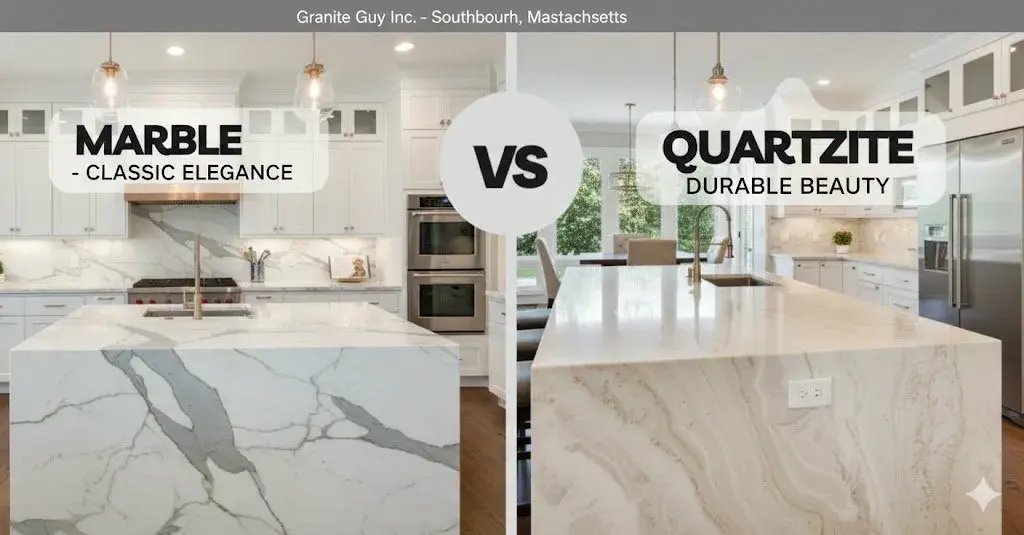
- Marble Kitchen Islands: Waterfall Edges & Cost Guide
- Marble vs Granite: A 30-Year Fabricator's Guide
- Quartzite Backsplash Guide: 4-Inch vs Full-Height
🏠 Visit Our Southborough Showroom
Still figuring out which marble is right for your backsplash? Come see us. Nothing beats standing in front of the actual slabs, comparing colors, patterns, and finishes in person. That's how you make the right decision.
Stop by our countertop store at 43 Turnpike Road (Route 9), Southborough, MA 01772 during business hours. We keep a large inventory in our heated warehouse, so there's always plenty to see.
Already done your homework and know what you want? Email us or give us a call.
📞 508-460-7900
📧 info@graniteguyinc.com