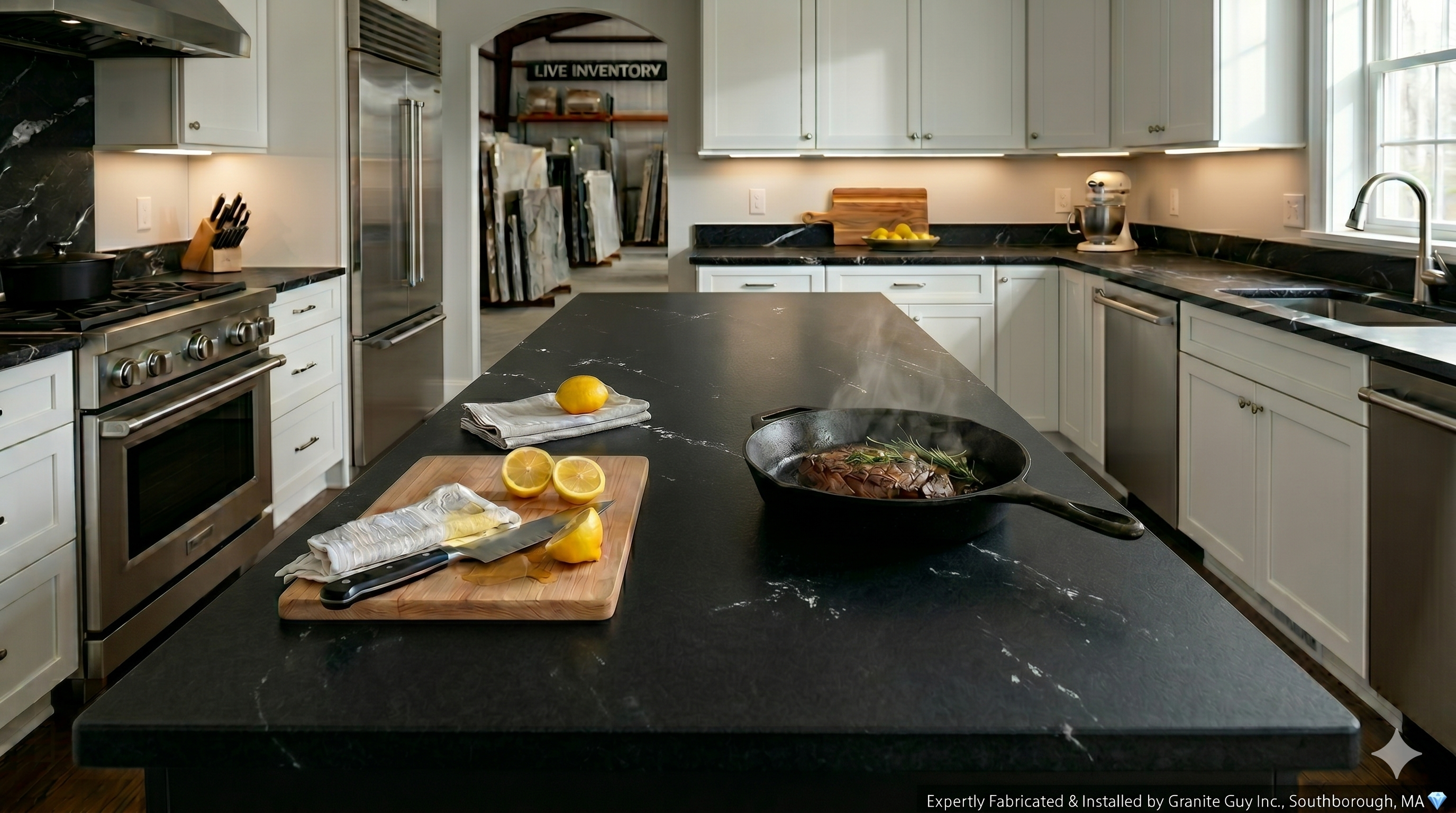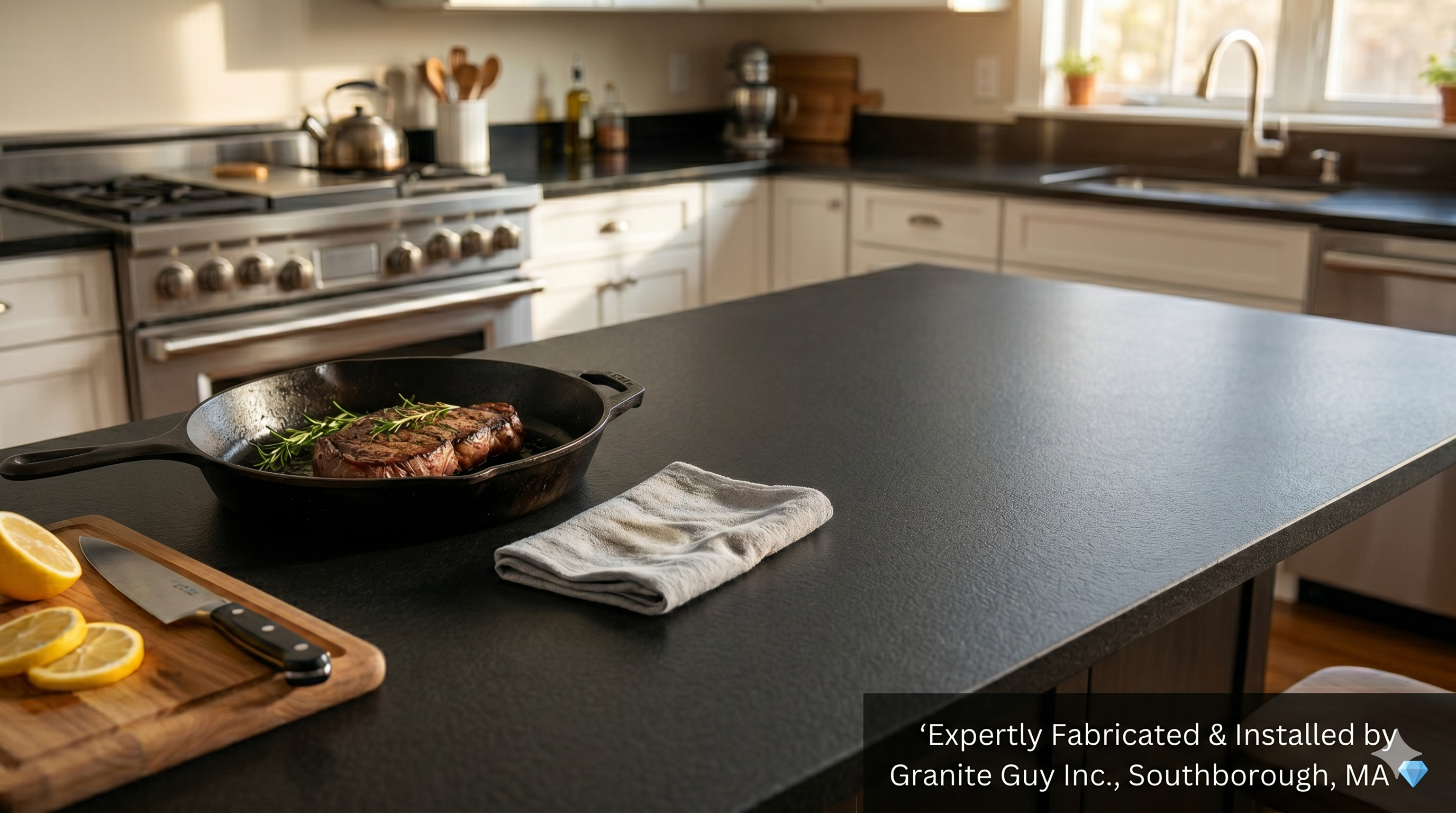
How Professional Stone Fabrication Works: A Behind-the-Scenes Look

Updated December 2025 | Granite Guy Inc. | Southborough, MA
Most homeowners have never seen the inside of a stone fabrication shop.
Usually, the process looks like magic. You pick out a slab at a showroom, sign a contract, and a few weeks later, beautiful countertops appear in your kitchen.
But what actually happens in between?
Understanding the fabrication process helps you make better decisions. It helps you ask the right questions. Most importantly, it helps you recognize quality work when you see it. Our process page covers how a job runs with us, from first visit to install.
Not all fabricators operate the same way. The equipment they use, their quality control standards, and their attention to detail can dramatically affect your final result.
Here is how professional stone fabrication actually works, based on over 30 years of experience and 10,000+ projects completed right here in Greater Boston and MetroWest Massachusetts.
When homeowners search for countertop companies near me, they usually find showrooms that outsource the work. But understanding stone fabrication—the actual cutting and polishing—is how you ensure quality. Here is how the process works, based on over 30 years of crafting Kitchen Countertops in Massachusetts.
What Is Stone Fabrication?
Stone fabrication is the industrial art of transforming raw stone slabs into finished custom surfaces.
A raw slab arrives at our shop as a large, flat piece of stone—typically around 9 to 10 feet long and 5 to 6 feet wide.
The fabricator's job is to cut that slab into pieces that fit your exact space. We finish the edges, cut the sink openings, and handle every detail so installation goes smoothly.
This requires specialized equipment, technical skill, and a deep understanding of geology.
Granite cuts differently than marble. Quartzite is harder than both. Quartz (engineered stone) requires different blade speeds than natural stone.
A skilled fabricator understands these differences and adjusts their approach accordingly.
The Equipment That Makes Precision Possible
At Granite Guy Inc., we believe that while craftsmanship is vital, modern technology ensures consistency. Here is the "tech stack" behind a perfect countertop.
CNC Machines: Computer-Controlled Accuracy
Modern fabrication shops use CNC (Computer Numerical Control) machines to cut stone with accuracy down to thousandths of an inch.
The digital template of your kitchen feeds directly into the CNC, which cuts each piece exactly to specification.
What does this mean for you?
- Tight-fitting seams: When pieces meet, they align perfectly.
- Perfect corners: No gaps against your walls or cabinets.
- Consistent Edge Profiles: Whether you choose an ornate Ogee or a clean, modern eased edge countertop, the CNC ensures it is uniform across the entire kitchen.
⚠️ The "Boch Outlet" Test: Modern kitchens often include flush-mount electrical outlets. These require holes cut to a tolerance of 3 to 5 thousandths of an inch. If the hole is even slightly off, the outlet won't sit flush. Only high-precision CNC machining can achieve this look.
Waterjet Cutting: Intricate Work Without Stress
Waterjet machines use a high-pressure stream of water mixed with abrasive particles to cut through stone.
Unlike saw blades, waterjets don't create heat or vibration. This prevents "stressing" or cracking the stone.
This matters most for delicate cutouts like undermount sinks and faucet holes. Shops without waterjet capability often risk micro-fractures in these areas.
Note on Porcelain: For Porcelain (Sintered Stone), waterjet cutting is not optional; it is essential. Porcelain is too brittle for traditional saws.
Digital Templating: Eliminating Human Error
The old way of templating used cardboard, wood strips, or plastic to create a physical pattern of your counters.
The problem? These templates can shift during transport or be transcribed incorrectly.
We use laser measurement systems to capture your space with millimeter precision. The templater records every dimension, angle, and obstacle digitally. That data goes directly into our fabrication software—no manual transcription, no rounding, and no "close enough."
Precision isn't just about aesthetics. Reducing material waste through exact measurements is how to save money on countertops without compromising quality. If you want to save money on countertops, avoiding fabrication errors is the most effective way to do it.
The Fabrication Process: Step by Step
Step 1: Material Selection and Slab Inspection
Before a single cut is made, we inspect the slabs.
Natural stone varies. Even within a single slab, you will find differences in color and veining. We check for:
- Structural integrity: Hidden fissures or weak points.
- Color consistency: Variations that might look odd at a seam.
- Surface quality: Pits or chips that need addressing.
Step 2: Digital Layout (Slabsmith) and Approval
This is the most critical step for customer satisfaction.
Using the digital template and photos of your actual slabs, we create a "digital layout." This isn't a rough sketch; it is a precise rendering.
You will see exactly where the veins flow, where the seams will be located, and how the grain direction aligns.
You approve this layout before we cut.
If you want to shift a seam away from a focal point, we do it now. This prevents the "that's not what I expected" moment on installation day.
Step 3: Cutting and Shaping
With the layout approved, the CNC and Waterjet machines go to work. This involves:
- Primary cuts: Breaking the slab into countertop shapes.
- Edge profiling: Shaping the exposed edges.
- Cutouts: Creating openings for sinks, faucets, and outlets.
Step 4: Edge Finishing and Polishing
Even with CNC precision, edges often need hand finishing to achieve furniture-grade smoothness.
We polish the edges through increasingly fine grits until they match the surface finish—whether that is high-gloss, honed, or leathered.
Step 5: Quality Control and Dry Fitting
Before leaving the shop, we often perform a "dry fit."
We arrange the pieces on tables exactly as they will sit in your kitchen. This allows us to verify seam alignment and check that the color transition is perfect before we arrive at your home.
Step 6: Preparation for Installation
We label every piece and organize them in installation sequence. When our team arrives at your home, everything is ready. No surprises.
What Separates Quality Fabrication from the Rest
In-House vs. Outsourced
Many "countertop companies" are actually just sales offices. They outsource the actual work to third-party shops.
This creates communication gaps and finger-pointing.
At Granite Guy, we are the fabricators. We handle sales, templating, cutting, and installation. Accountability is clear.
Indoor Heated Facility
Stone fabrication generates dust and requires water. Many shops operate in outdoor or semi-outdoor yards.
Our facility in Southborough is fully indoors and heated.
- For the stone: Temperature extremes can stress raw slabs. Our stone is stored safely.
- For you: When you select slabs, you aren't standing in a freezing yard or a sweltering warehouse. You can take your time comfortably.
On-Site Inventory Plus Supplier Network
We stock popular materials on-site, but with today's vast selection, no fabricator can inventory everything.
For specialty materials or specific slabs, we work with local suppliers. You can visit supplier showrooms to browse their inventory and select your exact slabs. They ship the materials to us—they only supply stone, no fabrication or installation.
Whether the slabs come from our inventory or our supplier network, you're always choosing the exact pieces that will become your countertops.
Material Specifics: What's Possible (and What's Not)
Different materials dictate different fabrication rules. While we are experts in engineered quartz, our true specialty lies in natural stone countertops like granite, marble, and soapstone.
Quartzite: Strong but Stubborn
Quartzite is harder than granite, making it incredibly durable. However, it is difficult to "mill" (thin down).
The Limitation: We cannot easily mill a 3cm slab down to 2cm for a specific detail without risking cracks. If you need thin profiles for shower niches or thresholds, we may need to discuss design alternatives.
Marble: More Capable Than You Think
"Can you do a mitered edge on marble?"
Yes. Years ago, marble was too soft for complex miters. Today, with better tooling, we can create stunning mitered edges and intricate profiles on marble.
The Caveat: Marble etches. We highly recommend honed or leathered finishes rather than polished. These finishes hide the etching caused by acidic foods (lemon, wine) much better.
Porcelain: The Waterjet Requirement
Porcelain offers a modern look but is incredibly brittle during cutting. We use waterjet cutting exclusively for porcelain to prevent chipping.
The Warning: Porcelain patterns are often printed on the surface. If chipped, the plain body underneath shows. Repairs are very difficult to hide.
Quartz: The "Printed" Problem
Recently, manufacturers have started making Quartz with printed patterns on top (similar to porcelain) rather than patterns that go all the way through the stone.
While they look realistic, you cannot polish out a scratch or repair a chip without removing the pattern and exposing the plain resin underneath. Be careful when selecting these "printed" Quartz colors.
Granite: The Workhorse
Granite is the workhorse material. Great for indoor and outdoor use, accepts leathered, honed, or polished finishes beautifully, and extremely durable.
Limitation: Color selection. The trend lately requires whitish colors, and granite doesn't offer many true whites. That's its biggest drawback.
Common Pitfalls (And How We Avoid Them)
The Workstation Sink Issue
Trendy "workstation sinks" (with built-in cutting boards) are deeper front-to-back than standard sinks. They are often 18 inches deep, while standard sinks are 16 inches.
- The Problem: Even the best kitchen sinks—like trendy workstation models—can cause installation headaches. They are often 18 inches deep, while standard sinks are 16 inches. If you choose a large workstation sink, there is often no room left for the faucet behind it.
- The Fix: Consult with us before you buy your sink. We need to ensure your cabinet run can accommodate that specific sink depth.
The Truth About Seams
Seams are the #1 worry for homeowners, but they are overrated.
With modern epoxy and slab matching technology, seams are hairline-thin and blend well. We use Slabsmith software to ensure grain direction matches perfectly at the seam, making it visually disappear.
Communication vs. Assumptions
The biggest project killer isn't machinery; it's bad communication.
Writing "91 inches" instead of "19 inches" can cost thousands of dollars. We prevent this by documenting everything via email and asking a standard set of questions during templating. We confirm details even when we think we know the answer.
Choosing the Right Material for Your Lifestyle
Countertops are the masterpiece of the kitchen. Your choice should be based on your lifestyle, preferences, and taste.
Soapstone: Heritage, Not Trend
Soapstone isn't trendy—it's heritage. If you're looking for something timeless, soapstone is the way to go.
It's well-known in New England and has been used for centuries. It's softer than other stones and requires periodic oiling, but it develops a beautiful patina over time.
Marble: Beauty Requiring Care
The most beautiful stones out there are marble. But marble has the etching problem—acids from wine, lemon, tomatoes will dull the surface.
Our recommendation: Choose honed or leathered finishes instead of polished. These finishes hide etching much better.
Granite: The Workhorse
Granite is the workhorse material. Great for indoor and outdoor use, accepts leathered, honed, or polished finishes beautifully, and extremely durable.
Limitation: The trend requires whitish colors, and granite doesn't offer many true whites.
Quartzite: Best of Both Worlds
Quartzite gives you the marble look with granite durability. It's natural stone that's harder than granite but offers the elegant appearance people love about marble.
Quartz: Engineered Consistency
Quartz is engineered stone—many companies make it with many different colors and patterns. It's getting better every year, with more realistic-looking patterns.
Advantages: No sealing needed (it's non-porous), consistent appearance, great durability.
Main drawback: Heat and UV sensitivity. It doesn't handle high heat like natural stone, and UV exposure can cause discoloration over time.
Porcelain: Modern with Limitations
Porcelain doesn't need sealing and offers ultra-modern looks, but it's brittle and usually only available in thinner profiles (1/2" to 3/4" maximum).
Main issue: The finish is often printed on the surface, making repairs extremely difficult.
Our Approach: The Granite Guy Difference
I came to the United States from Minas Gerais, Brazil—the heart of the world's stone industry—30 years ago. I grew up around this material.
My background brings a perspective on stone that you won't find at every shop. Especially with materials like Soapstone (Pedra Sabão), traditional techniques and deep material knowledge make a difference. Soapstone is a heritage stone here in New England, and we know exactly how to fabricate it to enhance its natural patina.
We have handled over 10,000 installations, from simple galley kitchens to complex commercial projects like the Four Seasons Hotel in Boston.
We invite you to see the difference for yourself.
Ready to Start Your Project?
Stop searching for a middleman and work directly with a countertop fabricator near you. Visit our showroom to explore materials, meet our team, and see our fabrication process firsthand.
Granite Guy Inc. 43 Turnpike Road, Southborough, MA 01772 (508) 460-7900 info@graniteguyinc.com
Serving Greater Boston, MetroWest, and Central Massachusetts since 1995.