Written by Granite Guy Inc., Southborough, Massachusetts
Updated: October 4, 2026
Cheap granite countertops are real, and the low price comes from supply, not from lower quality. Slabs don't carry price tags, so the way to pay less is to ask a fabricator which stones cost less and compare a few.
The quick answer: Tell us your budget and ask to see the lower-priced granites in stock, where you pay only for what you use. Keep the edge simple, and ask for an itemized quote. Granite is durable and handles heat across the price range.
After 30+ years of experience and 10,000+ projects completed across MetroWest and Greater Boston, this is what I tell clients at the counter when the budget is tight. Our granite countertops page covers the stone itself, and this guide covers how to pay less for it.
Why Cheap Granite Countertops Are Not Lower Quality
The price of a granite follows supply and demand. The more there is of a stone, the less it costs.
Ubatuba, often written Uba Tuba, is the example I use. It has been quarried for decades, the quarry is enormous, and there is still a lot of it, so it has been one of the most used colors in the country for a long time.
The lower-priced stones are just about the same in quality as the expensive ones. Some stones take more sealer than others, at any price, and that is about it.
The colors more buyers want, and the ones there is less of, cost more. That is the whole difference.
Which Granite Colors Cost Less
Every country has a cheap granite, and these are some of the most common. From Brazil there is White Ornamental, Ubatuba, Giallo Ornamental and Caledonia. From India there is Black Pearl and Steel Gray, and from Spain, Azul Platino.
That is not the whole list. About 20 colors fall in the lowest-priced group, and Caledonia, for one, has a similar look to Ocre Itabira.
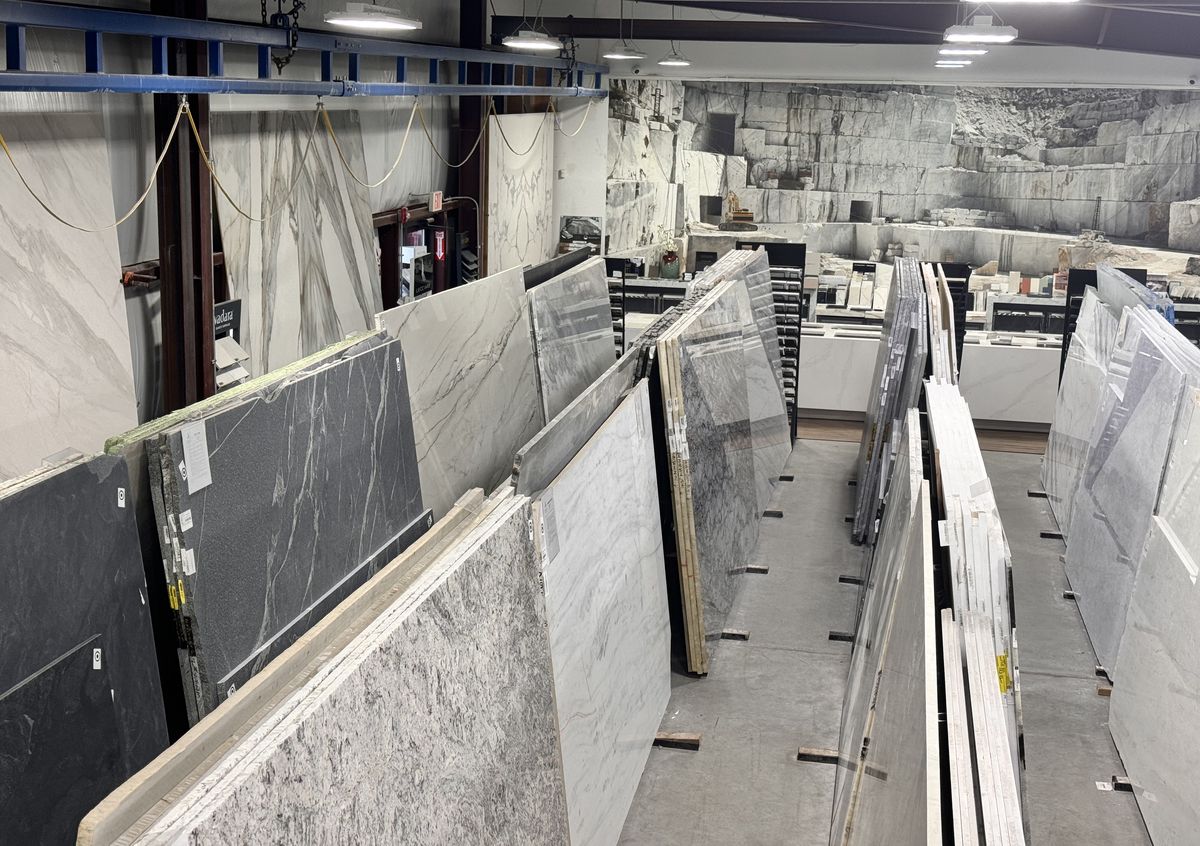
We don't always have every one of these on the floor. They are either in our warehouse or at the slab yards we work with.
Start with the granite slabs in stock, then see yours in person. Every slab varies.
Share Your Budget Up Front
I used to think asking about budget was rude. Now I think it is rude not to ask.
The number starts the conversation. It lets me show you stones in your range from the first minute, and it saves you from falling for a slab that was never going to fit.
A rough range is enough. You don't need an exact figure.
Two Kitchens That Came In on Budget
This one happens often. A client walks in and says, "I want soapstone, I love the look, I live in a farmhouse," and soapstone is beyond the budget.
I show them leathered Ubatuba. It has a greenish-black undertone, the stone costs well under soapstone, it resists scratching, and it does not need oiling. One client loved it.
Honed black granite such as Jet Mist gives a similar matte look, and our leathered granite guide covers the finish.
Another client told me, "I love the look of white quartz, but I want something heat resistant, and this is not our forever home." I asked the budget and showed a white ornamental granite that fit it.
They put it in and loved it. Their words: "I couldn't believe I could actually afford granite countertops."
Get the Best Yield Out of Every Slab
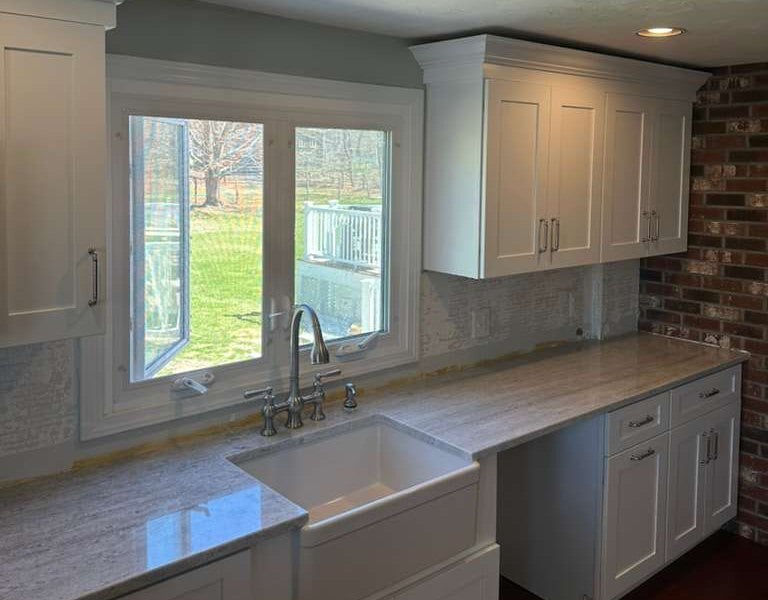
Yield is how much of each slab ends up in your kitchen, and it matters on small jobs and large ones alike. An average slab is roughly 60 to 65 square feet, and about 25 to 30 percent of the material we buy for a job usually ends up as waste.
As a guide, a kitchen of about 40 square feet usually comes out of one slab comfortably. Past 45, you have to be lucky, and a larger kitchen faces the same question on its second or third slab.
Sometimes a small change, moving a seam or adjusting an overhang by an inch, saves a slab. We lay out every piece digitally on the actual slab before fabrication, and if an adjustment would save material, I will tell you.
If budget is the deciding factor, try to like more than one stone. With two or three choices, you can settle on the one that gives you the best value.
Here is why. Say you are deciding between two stones, and one costs less than the other. Slabs are not all the same size, and the stone that costs less may come in a smaller slab.
If your kitchen fits on one of the bigger slabs but needs two of the smaller ones, the job in the more expensive stone can cost you less, because we need to order less material for it.
Pro tip: Ask how many slabs your layout takes in each stone you like, or ask to be part of the layout decision.
In Stock Versus Special Order
This is one of the many things that can help you save, and it is where our inventory comes in. If you choose from the slabs we have in stock, you pay for the material you use. If nothing in stock works and we order for you, the order comes by the whole slab.
So when a layout needs one slab and part of another, choosing in stock means you pay for the part, not for a second whole slab.
Keep the Edge Simple and the Thickness Standard
Labor is part of every quote. A simpler edge, few cutouts and straight pieces take less labor, but the big driver of the price is the material.
An eased edge is the simplest profile, and it is what most clients choose. A decorative profile such as an ogee, or a mitered edge, takes more work and costs more. Our edge profile guide shows each one.
For a kitchen, 3 cm is the standard. A 2 cm slab costs less, but it sometimes needs a built-up substrate under it, unless you are happy with the thinner look, about 3/4 of an inch.
On a simple bathroom vanity, 2 cm can work fine.
Remnants: Where They Save and Where They Don't
A remnant is the piece left over from a larger job. It is not damaged, and it is the best fit for a small application: a bathroom vanity, a fireplace, a laundry counter.
You could piece two remnants of the same color into a kitchen. If they are from the same lot, they will match, and you can do it. Most of the time they are not, and then the veining will not match and the shade will be off.
Remnants work best alongside a bigger job. If the yield runs short on your kitchen, a remnant can cover a pantry, a desk or a piece off to the side.
If you are doing the kitchen and the bathrooms together, ask about remnants for the vanity tops. Ordering them with the kitchen is where the bigger savings are.
Sometimes a single slab is left from a lot we bought. A kitchen that needs a slab and a half cannot use it, because a new slab would not match, so we can usually offer it for less to a kitchen that fits on it. See the remnants in stock.
For a Large Job, Ask About Overstock
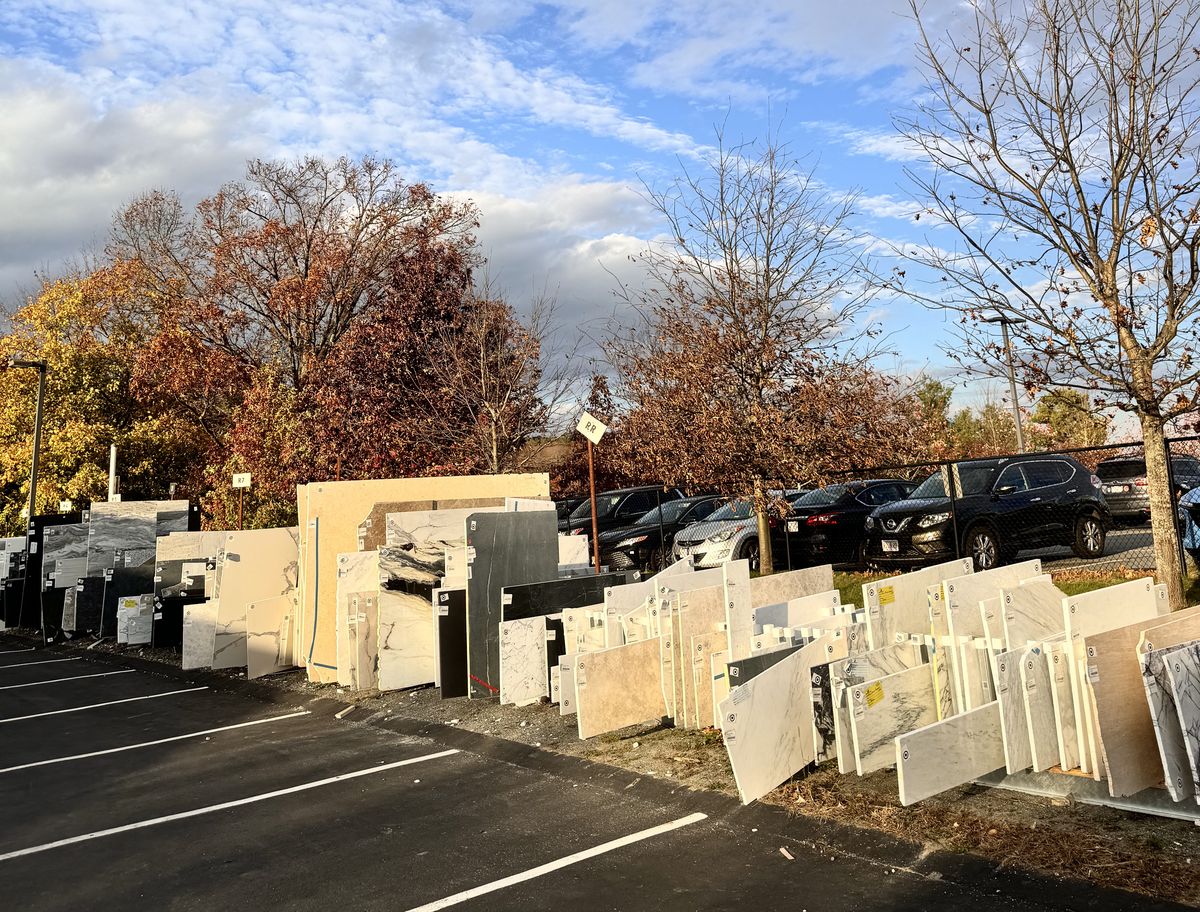
The slab yards we work with often have stone set aside: colors that stopped moving for a while, or a large lot that was bought and never sold through. When there is a lot of one stone waiting, the price is usually good.
That suits a job that needs a lot of stone, such as a multi-unit building, a landlord with several kitchens to remodel, a building exterior or a pool surround.
Tell us the size of the job up front and we will call the slab yards ahead of time. You can also ask when you visit one.
What Does Not Save Money
- Installing it yourself: it is an option for a contractor, a tile installer or anyone who has handled stone before, on one straight piece. A kitchen often has a seam and needs the right equipment and epoxies, and granite weighs about 20 pounds per square foot. Without experience, I recommend against it.
- Granite tile instead of slab: once you add up the time, the tile and the labor, it is usually not worth it.
- Prefab tops from a retailer or an online listing: you do not know if it will fit your space or what the quality is, and there is transport and breakage to deal with. If it does not fit, you hire a professional to fix it, and it still will not look right.
How to Compare Granite Quotes
An itemized quote makes a big difference. Ask for the material and the labor as separate lines, then compare the final total: same stone, same edge, same cutouts.
These questions put two quotes on the same basis:
- Is this quote for 2 cm or 3 cm material?
- Which edge profile is this quote for?
- How many slabs does the layout take?
- Can I see the actual slab before fabrication?
- Are the sink cutout and the installation included?
- What does the warranty cover?
- Are you licensed and insured?
Look at the slab itself, too. Check it for cracks or damage before you approve it.
We are glad to build a job on a tighter budget. We price it fairly, and we show every line of the quote so you can compare.
Who fabricates the job matters as much as the stone. Our fabricator vs. middleman guide covers how to choose.
If Granite Is Not the Answer
Quartz has lower-priced colors too, usually the solid, uniform ones, so it competes with granite on price. Marble has lower-priced options, usually Carrara with a less white background or busier veining.
Soapstone and quartzite are not budget stones.
For the full picture on a kitchen, from materials to layout, see our kitchen countertops page.
Getting a Real Number
Granite pricing comes down to which stone you choose and how many square feet your job takes. We break down everything else that goes into a quote on our pricing page.
My Recommendation
If the budget is tight, tell me the number first. Then pick from the lower-priced granites in stock, keep the edge eased, and let the layout decide between two stones you like.
A granite that costs less is still granite. Come see the slabs, and you may be surprised by what fits.
Frequently Asked Questions About Saving on Granite
Q. What is the cheapest way to get granite countertops?
A. Tell your fabricator your budget and ask to see the lower-priced granites they have in stock. Keep the edge simple, and ask for an itemized quote.
Q. What is the cheapest granite?
A. There is no single one, because about 20 colors sit in the lowest-priced group. Ubatuba, White Ornamental, Giallo Ornamental, Caledonia, Black Pearl and Steel Gray are among them.
Q. Is cheap granite good quality?
A. Yes. Lower-priced granites are just about the same in quality, and the price follows supply and demand.
Q. Does low-priced granite need more sealing?
A. No. It depends on the stone, not the price: drop water on the counter, and if it beads you are sealed, and if it soaks in and darkens the stone it is time.
Q. Is granite cheaper than quartz?
A. Not always. Quartz has lower-priced colors too, so the two overlap in price.
Q. When is the best time to buy countertops?
A. There is no special season, so the best time is when you need them. Start shopping early, because the sooner you start comparing, the more time you have to make a good decision.
Q. Can I use remnants for a whole kitchen?
A. Only if the pieces come from the same lot, and most of the time they do not. Otherwise the veining and shade will not match, so remnants are best for vanities, fireplaces and small pieces.
Related Articles
- Black Granite Countertops: Pros, Cons, and the Truth About Maintenance
- What Is Soapstone? A 30-Year Fabricator's Complete Guide
- How to Clean Granite Countertops: A Step-by-Step Guide
Visit Our Southborough Showroom
Still figuring out which stone is right for you? Come see us. Nothing beats standing in front of the actual slabs, comparing colors, patterns, and finishes in person. That's how you make the right decision.
Stop by our countertop store at 43 Turnpike Road (Route 9), Southborough, MA 01772 during business hours. We keep a large inventory in our heated warehouse, so there's always plenty to see.
Already done your homework and know what you want? Email us or give us a call.
Phone: 508-460-7900
Email: info@graniteguyinc.com