Marble Kitchen Islands: Waterfall , Bookmatching, and Statement Design
Written by: Granite Guy Inc., Southborough, MassachusettsPublished: January 13, 2026
If you are going to invest in marble countertops, the kitchen island is where you make your statement. It is the centerpiece of the home, the place where guests gather, and the focal point of the design.
After thirty years of fabricating marble kitchen islands across MetroWest and Greater Boston, I have seen how a well-designed island transforms a kitchen from ordinary to extraordinary. But I've also seen how complex these projects are. A waterfall island isn't just a countertop; it's a piece of custom furniture built from stone.
🏆 Real Projects, Real Challenges
When you look at a photo on Instagram, you don't see the engineering required to get it there. Some installations push the limits of what is physically possible.
The "Westwood Monster"
In Westwood, I recently installed a 78 by 132-inch Calacatta Caldia waterfall island. It was 2 inches thick, massive for a single piece. That slab weighed over 2,000 pounds.
Most fabricators would have cut it into smaller pieces, but that ruins the look. To keep it seamless, we needed two tow trucks: one to transport the stone and one for the forklift just to move it into the house.
Getting that piece through the door took a coordinated team of six. When we finally set it onto the cabinets, you could actually hear the wood structure settle and creak under the weight.
The homeowner nervously asked if she needed to reinforce the floor. I assured her the structure was sound, but her reaction made sense: Her kitchen renovation cost over $100,000, and when she saw that slab in place, she knew nothing else would have done it justice.
The Dover Lift
In Dover, we tackled another massive piece: Imperial Danby at 2 inches thick. It was too heavy for standard offloading. The supplier had to send their boom truck to help us pick it up at the shop and unload it directly at the client's home.
These are high-stakes installations. One slip, one wrong measurement, and a $15,000 slab is ruined. But this is the level of work we do regularly for clients across MetroWest and with partners like Patrick Ahearn's team on Cape Cod.
🎯 Why Focus on the Island?
The island is where marble for counter applications makes the most sense. Unlike perimeter counters, which see heavy cooking, oil splatter, and acidic lemon juice, islands are primarily used for gathering, serving, and entertaining.
When comparing marble vs granite for your kitchen, both are excellent choices. But for islands specifically, marble's beauty shines because it's not taking the daily abuse that perimeter counters endure.
My Recommendation:
Many of my customers use durable quartz or granite on the perimeter work surfaces (near the range and sink) and reserve the premium marble for the island. This gives you the best of both worlds: bulletproof durability where you cook, and unmatched, artistic beauty where you entertain.
💧 What is a Waterfall Edge?
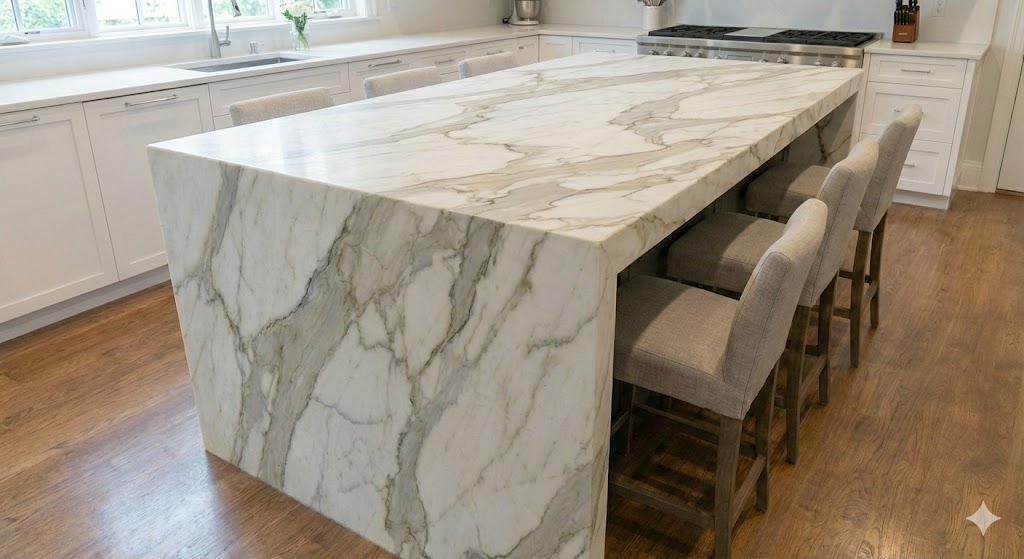
A waterfall edge is a design technique where the countertop continues at a 90-degree angle down the sides of the cabinets to the floor. It creates a continuous flow of stone that looks like water cascading over a cliff.
The Technical Challenge: The Miter Joint
To make a waterfall look like a solid block of stone, we don't just butt two pieces together. We perform a 45-degree miter cut.
This is where the expertise matters.
The Cut: Both the top slab and the side panel are cut at exactly 45 degrees.
The Glue: We use a specialized epoxy that is color-matched to the specific stone.
The Seam: When joined, the seam should be almost invisible, making the vein appear to "fold" over the edge.
Our CNC machinery and SlabSmith software help us plan the vein flow digitally before we ever make a cut, ensuring the transition is perfect.
📖 Bookmatching & Vein Matching
You will hear these terms often in high-end design, but it's important to know the difference.
Bookmatching
This is the "butterfly effect." We take two consecutive slabs from the same block of stone and polish opposite sides. When placed side-by-side, they create a mirror image, like an open book. This is stunning for very large marble kitchen islands that require a seam down the middle.
Vein Matching (The Waterfall Requirement)
This is critical for waterfalls. When the marble wraps from the horizontal top to the vertical side, the gray or gold veins must flow continuously.
Bad fabrication: The veins stop abruptly at the edge, ruining the illusion.
Good fabrication: The vein flows over the edge and continues down the side.
Not every slab can achieve a perfect match due to chaotic veining patterns. We hand-select consecutive slabs at the supplier to ensure we have the right material to make this work.
🎨 Island Design Options
Standard Overhang: The marble sits on top, and the painted cabinet sides are visible. This is the traditional, most affordable approach.
Single Waterfall: The marble cascades down just one end. This is great for asymmetrical kitchens or balancing impact with practicality.
Double Waterfall: The full statement piece. Marble flows down both ends, framing the cabinetry completely.
🏆 Best Marble Varieties for Islands
Calacatta: The "Queen" of marbles. It features a bright white background with thick, dramatic gold or gray veining. It creates the highest impact but comes with a premium price tag.
Statuario: Similar to Calacatta but with distinct, artistic gray veining. Very popular in modern, cold-tone kitchens.
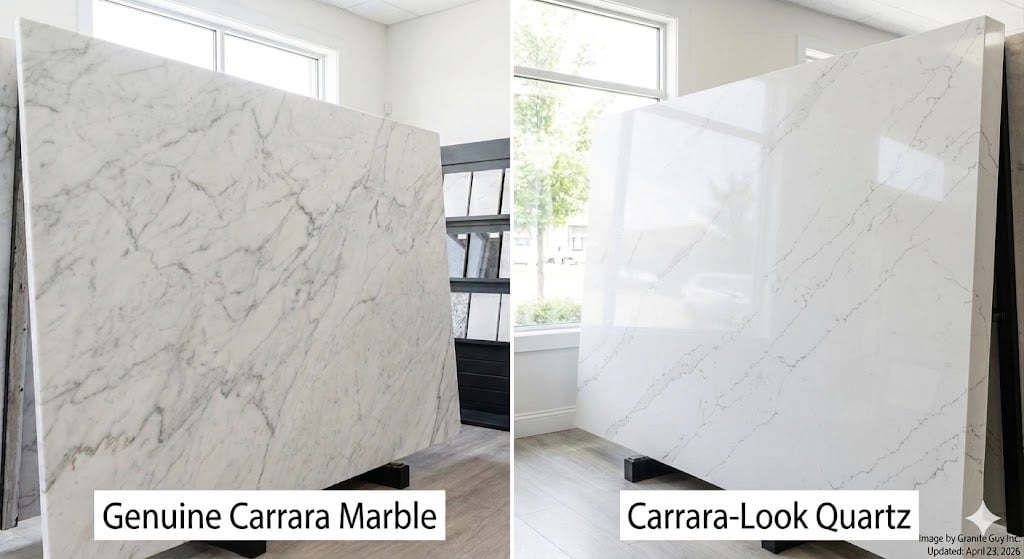
Carrara marble: The classic. It has a softer, grayer background with finer veining. It is elegant, timeless, and much more budget-friendly than Calacatta. When deciding between Calacatta vs Carrara marble, consider your budget and desired drama level. Calacatta makes a bold statement while Carrara offers subtle elegance.
Imperial Danby: A fantastic American marble from Vermont. It is denser than Italian marble (less prone to staining) and features a soft white background with light gold/gray veining.
⚠️ The Reality of Waterfall Fabrication
Creating perfect waterfall edges isn't just about having the right tools. It's about mastering every step of a complex process.
🔧 1. Shop Fabrication Challenges
Every material requires different handling. Marble is softer than quartzite but can be brittle along the veins. Getting that critical 45-degree miter cut perfect without chipping the edge requires sharp tooling and patience.
🚚 2. Transportation Risks
This is the part that keeps fabricators up at night. Waterfall panels glued with mitered edges are structurally fragile during transport. The L-shape or U-shape puts immense stress on the corners. One pothole or bump during transport can snap the joint. We use specialized A-frames and bracing bars to ensure it arrives safely.
📐 3. Installation Precision
If your cabinets aren't perfectly level, and I mean perfectly, the waterfall won't touch the floor correctly. We often have to shim and adjust the cabinetry on-site before we even bring the stone in. If the field measurements are off by 1/16th of an inch, the miter won't close tight.
💰 What to Budget for a Waterfall Island
Quick answer: Waterfall edges typically add roughly $1,500 to $2,500 per side to your island project.
Why that range? Let me show you the math using a standard 36-inch tall island and average-priced stone ($100/sq ft):
Standard countertop height is 3 feet. If your island is also 3 feet deep (front-to-back), the waterfall leg becomes a 3-foot by 3-foot square.
The Math: 3 ft height × 3 ft depth = 9 square feet of stone.
The Material: At $100/sq ft, that's $900 in material alone, before we even factor in the cutting and polishing.
The Fabrication: The complexity of miter cuts, vein matching, and installation adds labor costs.
Total: Approximately $1,500 for that one side.
If you have a 6-foot wide island, the surface area doubles (18 sq ft), meaning the cost roughly doubles. Doing both sides doubles it again.
But it all depends on the size of your island, which material you choose, vein matching, and waste factors. Come into our showroom and we'll create an itemized, clear quote with all the details.
🏠 What I'm Installing in Massachusetts
Waterfall islands are extremely popular in high-end renovations across MetroWest and Greater Boston. Our waterfall island countertops page covers materials, pricing and how the job runs.
Currently, honed (matte) finishes are trending. They feel contemporary and velvet-like to the touch, and they show etching less obviously than polished surfaces. The custom homes I work on with Patrick Ahearn's team often feature bookmatched marble kitchen islands as the absolute center of the home.
🧼 Caring for Your Marble Island
Wondering how to clean marble countertops? Daily care is simple: wipe with a soft cloth and mild soap. Avoid acidic cleaners like vinegar or lemon-based products.
For marble kitchen islands, we recommend sealing annually to protect against stains. Your island will develop a gentle patina over time, which many homeowners love.
❓ Frequently Asked Questions
Q. How much does a marble waterfall island cost?
A. Waterfall edges typically add $1,500 to $2,500 per side to your island project. The total cost depends on island size, marble variety, and design complexity. A 3-foot wide waterfall side is about 9 square feet of stone.
Q. What is a waterfall edge on a kitchen island?
A. A waterfall edge is when the countertop marble continues down the sides of the island to the floor at a 90-degree angle, creating a continuous flow of stone like water cascading over a cliff.
Q. What is bookmatching in marble countertops?
A. Bookmatching uses two consecutive slabs from the same block, polished on opposite sides and placed together to create a mirror image, like an open book. It's ideal for large islands needing a seam.
Q. Is marble a good choice for kitchen islands?
A. Yes. Islands are used more for gathering than heavy cooking, so etching from acidic foods is less of a concern. Many homeowners use quartz or granite on work surfaces and reserve marble for the island.
Q. How do you match veins on a waterfall edge?
A. We hand-select consecutive slabs and use SlabSmith software to digitally plan the vein flow before cutting. The 45-degree miter cut allows veins to "fold" over the edge seamlessly.
Q. What is the difference between Calacatta and Carrara marble?
A. Calacatta features a bright white background with bold, dramatic veining and commands premium pricing. Carrara has a softer, grayer background with finer veining and is more budget-friendly. Both are Italian marbles, but Calacatta makes a bolder statement.
📞 Let's Design Your Statement Island
Ready to see waterfall-worthy slabs in person? Visit our countertop store in Southborough, where you can walk through hundreds of colors and watch our SlabSmith vein-matching process in action.
No appointment needed. Just stop by and browse our full slab inventory.
Granite Guy Inc.43 Turnpike Road, Southborough, MA (right on Route 9)Serving MetroWest, Greater Boston, and all of Massachusetts. We'll go anywhere in New England for the right job.
Call us: 508-460-7900