Carrara Marble vs Quartz Countertops: Is the Look-Alike Worth It?
Written by Granite Guy Inc., Southborough, Massachusetts
Updated: September 15, 2026
Carrara marble gives you one-of-a-kind natural character with occasional maintenance, while marble-look quartz gives you the Carrara aesthetic with almost none. They are not the same material. They do not live the same way, and the pricing often surprises homeowners.
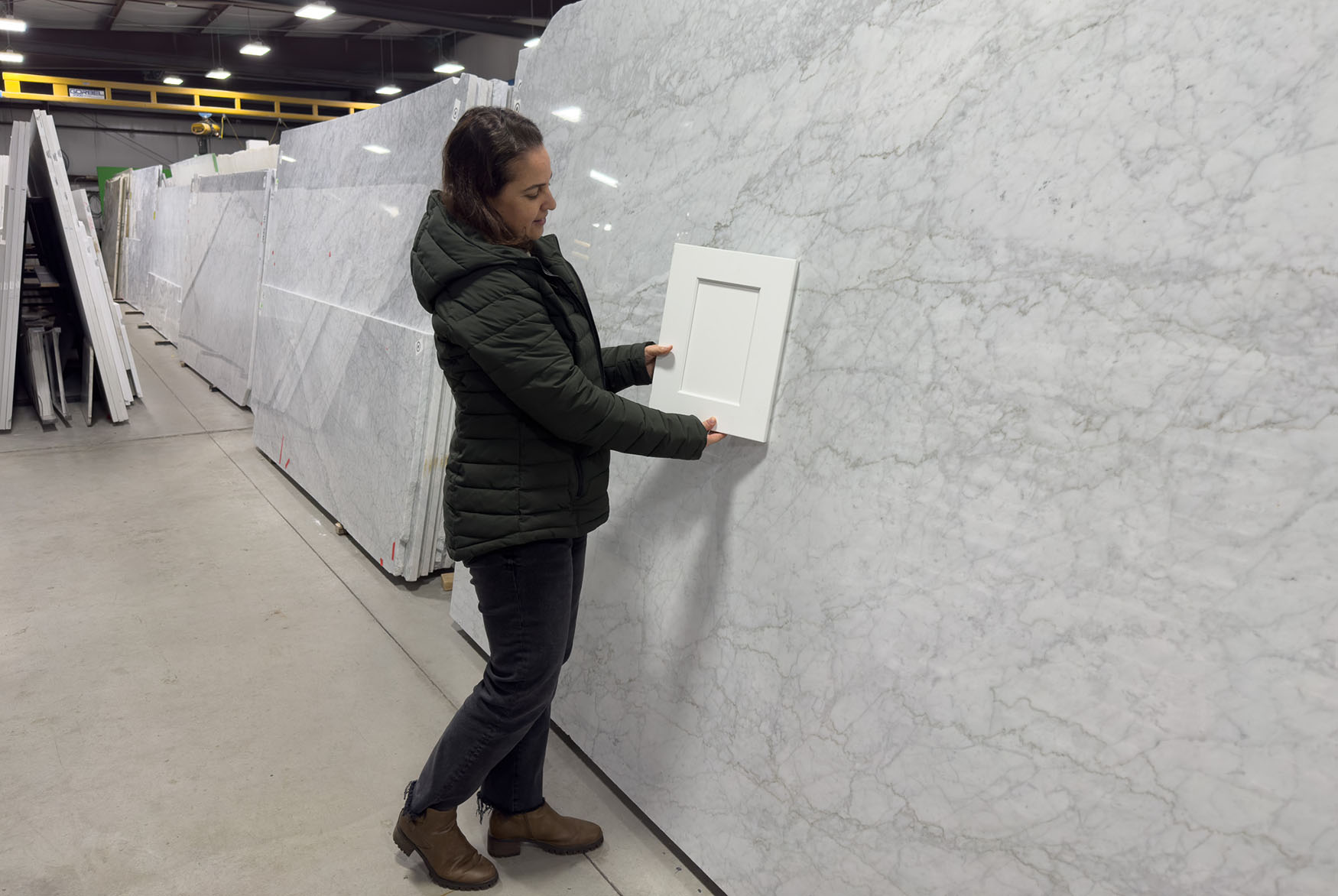
Real Carrara is a natural Italian marble with organic veining, a cool surface great for baking, and needs occasional sealing. Marble-look quartz is engineered stone that tries to mimic Carrara, with almost no upkeep, but cannot handle high heat. Carrara comes in multiple grades, and pricing often overlaps with marble-look quartz. The lower Carrara grades come in below quartz, and the premium Carrara grades often run higher.
If you are a Massachusetts homeowner torn between the two, this guide walks you through the honest differences. It is written by a fabricator who installs both every week in MetroWest and Greater Boston kitchens.
Along the way it answers the questions I hear most: Carrara marble countertops cost, Carrara marble grades, what color cabinets go with Carrara marble, and is Carrara marble outdated.
🔬 Why Quartz Got So Good at Mimicking Carrara Marble
Engineered quartz is roughly 90 to 93 percent crushed natural quartz bound together with resins and pigments. Modern marble-look quartz uses advanced printing and layered pigment technology to mimic Carrara's soft blue-gray veining, and over the last decade the look has come a long way.
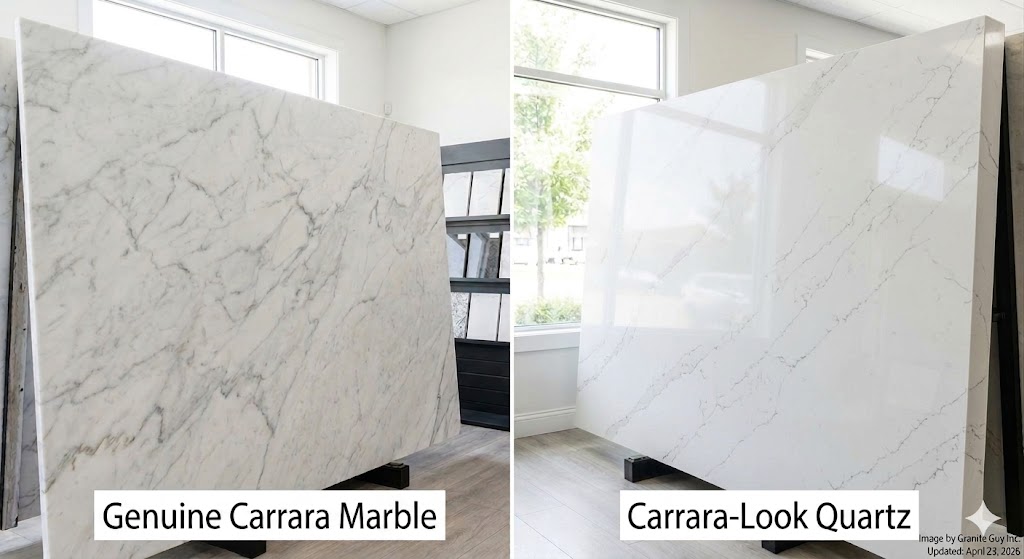
Some brands do a better job than others. At a glance, in a showroom or a photo, a good marble-look quartz can pass for the real thing. But experienced eyes, like designers, fabricators, and homeowners who have lived with stone, usually pick up the differences pretty quickly.
For a broader look at how marble stacks up against quartz across all marble types, see our marble vs. quartz guide.
🔍 Where the Illusion Breaks
Once you know what to look for, the tells become obvious.
✦ Vein Continuity Through the Slab
In real Carrara, the veins run all the way through the stone. Cut it, and the pattern continues into the cross-section because the veining is the geology of the slab.
Most quartz is built with layered pigments, so the pattern does carry through to some degree. But it is not the same continuous geology you get with natural stone, and on some printed-style quartz lines the veins really do stop near the surface.
✦ Depth and Translucency
Natural marble has a subtle depth to it. Light penetrates the surface a millimeter or two before bouncing back, which gives Carrara its characteristic soft glow regardless of finish. Honed actually shows the translucency more, while polished adds reflection on top of it. Quartz does not do this. It looks opaque in a way marble does not.
✦ Vein Flow and Randomness
Real Carrara veins flow organically with no repeating pattern. Quartz patterns repeat across slabs because they are manufactured from a limited set of templates. In a small kitchen with one slab, you would never notice. In a large kitchen with three or four slabs that need to match, the repetition becomes visible.
✦ Bookmatching
Bookmatching is when you take two consecutive slabs, flip one, and install them as mirror images so the veining flows across the seam like a Rorschach test. It is one of the main reasons designers specify dramatic stone on statement islands, waterfall islands, and full-height backsplashes.
Both materials can be bookmatched. With real Carrara, every bookmatch is one of a kind because the veining is the actual geology of that block. No two pairs are alike.
With quartz, manufacturers design slabs in bookmatched pairs, so the look is consistent and reproducible from project to project. Both look terrific. The question is whether you want a result that is genuinely unique or one that is predictable.
🧼 The Maintenance Conversation, Done Honestly
Most comparison articles get this wrong. They treat marble like a fragile museum piece and quartz like it is indestructible. Reality is more nuanced.
✦ Etching vs. Staining (They Are Not the Same Thing)
Most homeowners use these terms interchangeably. They should not.
Staining is absorption. Red wine, oil, or coffee sits on an unsealed marble surface and soaks in. Preventable with sealing, usually removable with a poultice.
Etching is a chemical reaction. Acidic foods like lemon juice, tomato sauce, vinegar, or wine react with the calcium carbonate in marble and dissolve a microscopic layer of the surface. Sealer does not stop it.
Quartz does not etch because the crystals do not react with household acids, and it does not stain because it is non-porous. A genuine advantage for busy kitchens.
✦ The Honed Finish Changes Everything
Etching is mostly a polished-marble problem. On polished Carrara, an etch shows up as a dull spot against the shine, which is visually obvious. On a honed (matte) surface, etching is far less visible because the surface is already matte. Most etches you would never notice.
This is why experienced marble owners often choose honed finishes, especially in kitchens. If the etching talk scares you, honed is the answer nobody tells you about. For the full breakdown, see our honed vs. polished marble guide.
✦ Sealing, Realistically
Skip the calendar and use the water test. Put a few drops of water on your counter and let them sit. If the water beads up, you are fine. If the spot darkens as the water soaks in, it is time to reseal.
That test works on any natural stone, and it tells you what your counter actually needs instead of what a schedule guesses. For the full walkthrough, see our how to seal marble countertops guide.
✦ Patina: Damage or Character?
Over years, a marble countertop develops small etches, softens at the edges where it gets used most, and acquires what the industry calls patina.
Some homeowners see this as damage. Others see it the way they see a leather jacket that is broken in, a record of a life lived in the kitchen. Quartz looks the same on day one as it does on day two thousand. That is either a feature or a bug, depending on who you are.
🔥 Heat and Kitchen Use
Carrara is cool to the touch and great for baking because marble naturally dissipates heat. You can set a hot pan on marble without thermal damage.
The main risk is thermal shock, a sudden temperature swing. For example, if you leave a cold bowl from the freezer sitting on the counter and then set a hot pan directly on top of it, the extreme temperature difference can cause the stone to crack. A trivet is still smart practice to avoid this or sealer discoloration.
Quartz has a different problem. The resin binders start to soften at around three hundred degrees Fahrenheit. A hot pan left sitting on quartz for more than a few minutes can leave a mark or permanent damage. If that happens, replacing the damaged section is expensive. Usually you need to replace the entire countertop unless the damage is in an isolated corner piece.
💰 The Real Cost Difference
Most homeowners assume marble is expensive. Carrara and quartz have overlapping pricing, and the choice often comes down to maintenance tolerance and aesthetic preference, not budget. For a detailed breakdown of what affects Carrara pricing, including grades, complexity, seaming, and waste, see our Carrara countertops pricing guide.
✦ Next Steps
Visit our Southborough showroom to see slabs in person, compare finishes, and get a quote on your project.
🏝️ The Hybrid Kitchen (The Answer Most Homeowners Miss)
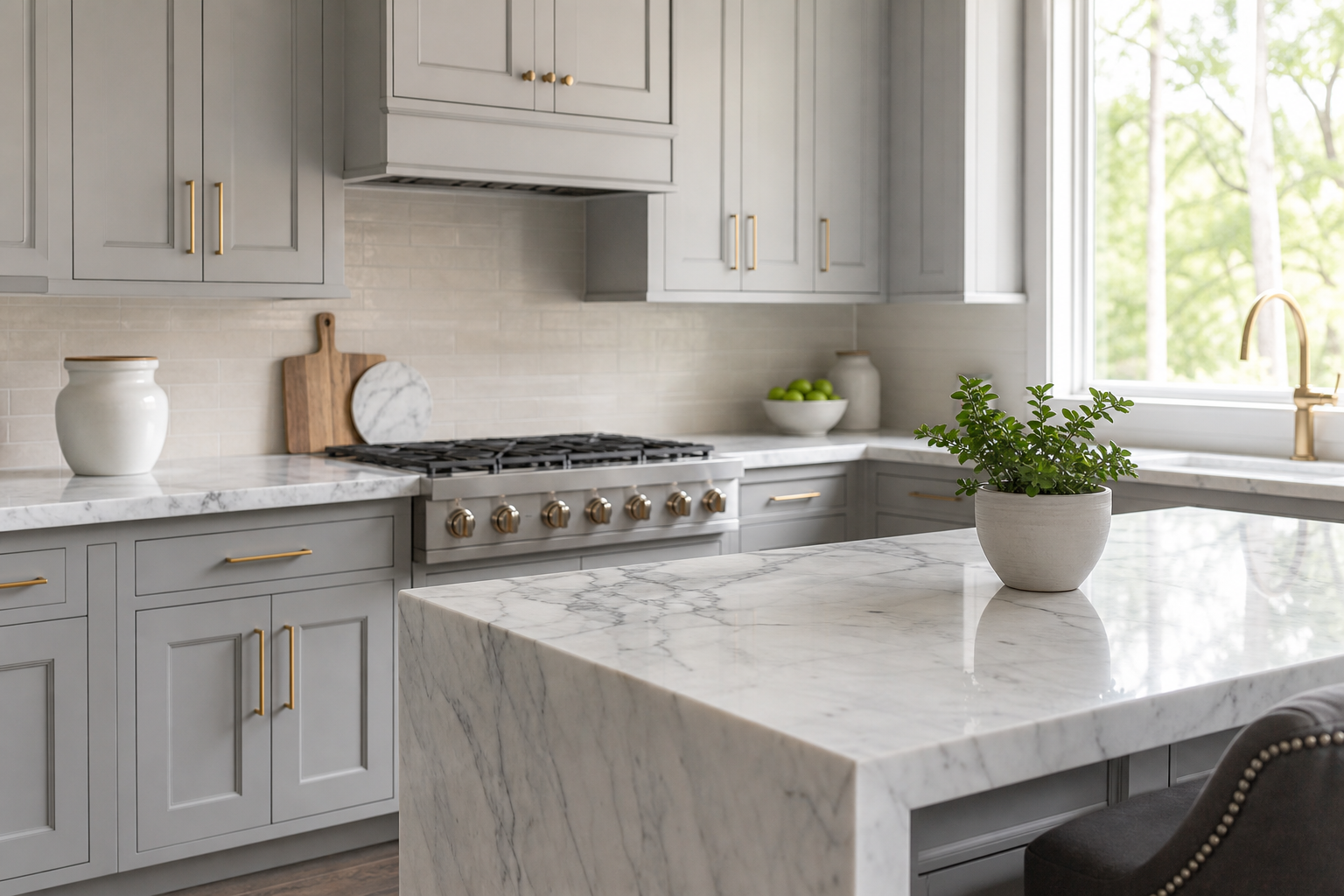
Here is a layout my team installs more and more across MetroWest: real Carrara marble on the island, marble-look quartz on the perimeter counters.
It is not a compromise. It is a smart design decision.
The island is where you want the showpiece. The bookmatched veining, the depth, the one-of-a-kind slab that guests notice. It is also typically where you are not running a gas burner or prepping tomato sauce. The perimeter counters take the daily beating.
The coffee station, the sink, the cooktop, the kids' snack zone. That is where quartz's durability earns its keep.
You get real stone where it matters visually and engineered stone where it matters functionally. Cost-wise, it often lands within a few percentage points of an all-quartz or all-marble layout.
🔗 Seams and Slab Matching
If your kitchen is large enough to need multiple slabs, this becomes a real factor.
Quartz slabs from the same production run match almost perfectly. Seams disappear visually because the pattern is consistent from slab to slab. For a big kitchen with a long run of counter, that is a legitimate advantage.
Real Carrara slabs are never identical. We pick slabs together when possible, laying them out to flow the veining naturally across seams, but it is an art, not a guarantee.
Some customers love this. The kitchen feels like it is made of real earth, not a manufactured product. Others find it inconsistent. If a uniform appearance across a large surface is a top priority, quartz has the edge. If organic, one-of-a-kind character is the priority, marble wins.
🏠 Resale and Buyer Perception in MetroWest
I get asked this often. Does marble or quartz hold resale value better in the Greater Boston market?
Honest answer: both perform well, and neither is a dealbreaker for buyers.
High-end buyers in towns like Weston, Wellesley, and Sudbury often prefer real stone. Marble and granite carry a perception of permanence and authenticity that engineered stone does not.
Younger buyers and busy families often see quartz as the upgrade because it signals low-maintenance living.
The real resale killer is dated material or poor installation, not the material category itself. A beautifully installed Carrara kitchen and a beautifully installed quartz kitchen both help your Massachusetts home sell.
🎯 Is Carrara or Quartz Right For You?
Choose real Carrara marble if: You love the idea that your counter is a piece of natural history. You bake, or you want a cold stone surface for dough and pastry. You see patina as character, not damage. You want bookmatched veining on an island. You are willing to wipe up acidic spills and reseal occasionally. You are open to a honed finish.
Choose marble-look quartz if: You want the Carrara look without the maintenance conversation. Your kitchen is a high-traffic family hub with kids and pets. You do not want to think about sealing or etching. You have a large kitchen where seam consistency matters. You prefer a surface that stays looking new for decades.
Consider the hybrid if: You want both the real-stone statement and the workhorse durability. You have an island worth showcasing and perimeter counters that take daily abuse.
👋 My Recommendation
After 30+ years of experience and 10,000+ projects completed across Massachusetts, here is my honest take. There is no universal winner. Both materials are legitimate choices, and I install both every week.
If I had to steer most busy MetroWest families toward one option, it would be marble-look quartz on the perimeter with honed Carrara on the island. You get the visual soul of real marble where it counts, and the bulletproof practicality of quartz where daily life happens.
It is the layout that has made the most customers happy over the last decade.
But if you are a baker, a design purist, or someone who loves the idea of a kitchen that ages with your family, go with real Carrara. Honed finish, the water test when you need it, and stop worrying about a lemon slice.
It is a material that has been used in kitchens for centuries, and it earns that staying power.
❓ Frequently Asked Questions
Q. Is Carrara marble the same as Calacatta?
A. No. Calacatta has bolder gold or gray veining on a whiter background and costs substantially more. For the full comparison, see our Calacatta vs. Carrara guide.
Q. Does marble-look quartz ever look fake?
A. Cheaper quartz lines can look printed up close. The biggest tell is usually the edge, where printed veins stop instead of carrying through.
Q. How long does Carrara marble actually last?
A. With reasonable care, a Carrara countertop easily lasts fifty years or more. The real question is not durability, it is whether the natural patina will bother you.
Q. Does quartz need any upkeep?
A. Very little. Soap and water is all it needs, but avoid direct heat above 300 degrees Fahrenheit and harsh chemicals.
Q. Can I put a hot pan on Carrara marble?
A. Yes, marble handles heat better than quartz, but I still recommend a trivet to avoid thermal shock or sealer discoloration over time.
Q. Which is better for a bathroom vanity?
A. Either works beautifully. Acidic spills are rare in bathrooms, so marble's maintenance profile is easier there.
Q. Do you stock both in your Southborough warehouse?
A. Yes. We keep Carrara slabs on-site and source marble-look quartz from every major manufacturer.
Q. Does Carrara work in New England kitchens?
A. Absolutely. Marble is stable in any Massachusetts climate, and thousands of Boston-area homes have original marble surfaces from generations ago.
📚 Related Articles
- Carrara Marble Countertops: The Complete Guide
- Carrara Marble Grades Explained
- What Color Cabinets Go With Carrara Marble
🏠 Visit Our Southborough Showroom
Still figuring out which material is right for you? Come see us. Nothing beats standing in front of the actual slabs, comparing colors, patterns, and finishes in person.
Stop by our countertop store at 43 Turnpike Road (Route 9), Southborough, MA 01772 during business hours. We keep a large inventory in our heated warehouse, so there is always plenty to see.
Already done your homework and know what you want? Email us or give us a call.
📞 508-460-7900
📧 info@graniteguyinc.com