Written by Granite Guy Inc., Southborough, Massachusetts
Updated: January 25, 2026
Soapstone is a metamorphic rock made primarily of talc. It's naturally non-porous, never needs sealing, and handles extreme heat without damage. You can set a pot directly from a 500-degree burner onto soapstone without any scorch marks.
This makes it particularly valued for kitchen countertops and fireplace surrounds, where heat resistance and low maintenance are essential. Our soapstone countertops page shows the varieties we work with.
With over 30 years of fabrication experience and thousands of installations across Massachusetts, I'll share what actually matters about this material. Not marketing speak, but the real facts from someone who has worked with it in kitchens, bathrooms, and historic homes throughout New England.
Soapstone at a Glance:
- 🔥 Exceptional heat resistance: set hot pots directly on the surface
- 🚫 Never needs sealing: naturally non-porous
- 🎨 Colors range from gray to black, some with green undertones
- 🔧 Scratches easily repairable with sandpaper and mineral oil
- 💰 Expect $80–$120 per square foot installed in Massachusetts
- ⏳ Develops beautiful patina over time: a feature, not a flaw
Jump to:
🪨 The Basics: What Soapstone Actually Is
Soapstone is a metamorphic rock formed over millions of years through intense heat and pressure deep inside the earth. Its main ingredient is talc, the same mineral in talcum powder, combined with chlorite, dolomite, and magnesite.
The high talc content gives soapstone its unique feel. Touch it, and you'll notice immediately: smooth, almost waxy.
Get it wet, and it genuinely feels like a bar of soap. That's where the name comes from.
Here's what most people don't understand: that soft, soapy feeling doesn't mean it's weak. The combination of talc and other minerals creates a surface that is extremely dense, even denser than granite. That density is what makes soapstone countertops practical for everyday use.
This is architectural soapstone, specifically designed for building and fabrication. It's about as hard as marble and significantly denser, despite the talc content.
✦ Artistic vs. Architectural: The Distinction Most People Miss
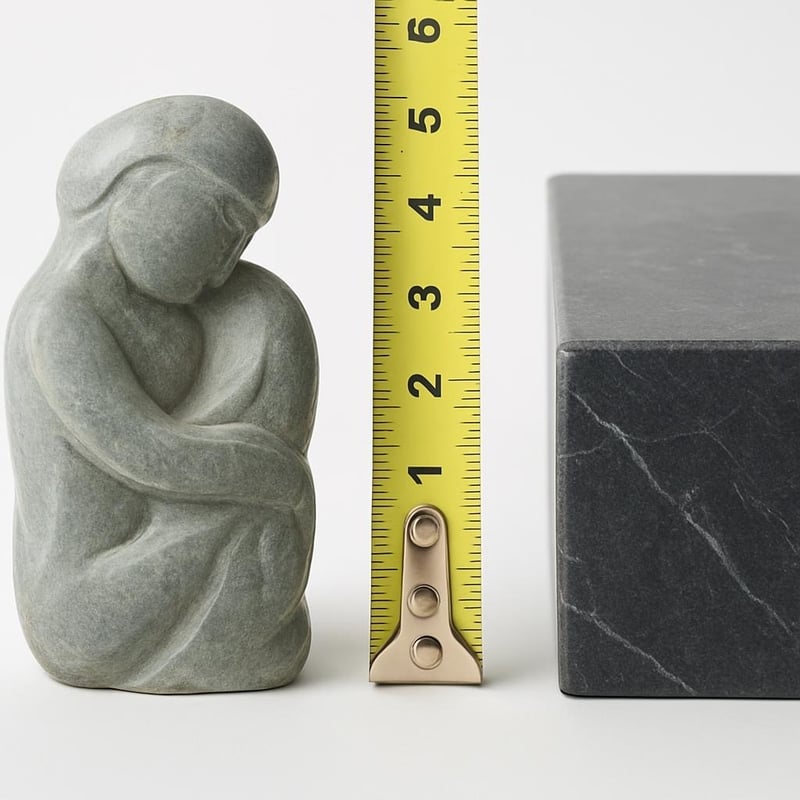
Here's where confusion starts. When people think of soapstone being "soft," they're thinking of artistic soapstone. That's the kind used for carving sculptures and decorative objects, with talc content as high as 80%.
Architectural soapstone is completely different. The slabs we use for countertops, sinks, and fireplace surrounds typically have around 30% talc content. The rest is harder minerals that provide real durability.
💡 Pro Tip: Artistic soapstone is soft enough to scratch with your fingernail. Architectural soapstone is about as hard as marble and significantly denser.
Soapstone has been used in New England homes for centuries. Colonial-era sinks, hearths, and countertops are still standing and functional today. If it were too soft for daily use, our ancestors would have figured that out quickly.
When you're shopping for soapstone kitchen countertops, you're looking at architectural grade. Don't let anyone confuse you by talking about carving stone.
🌎 Where Soapstone Comes From
Today, most architectural soapstone comes from Brazil. New England used to have its own quarries, mainly in Vermont and Virginia, that supplied the region for many years.
Many of those historic quarries have closed, but the legacy lives on in countless historic homes.
Brazil has become the dominant source for good reason. The country has extensive deposits of high-quality slabs, and Brazilian quarries have developed sophisticated extraction methods.
Other sources include Finland, India, and Canada. Each produces slabs with slightly different characteristics.
✦ Brazilian Soapstone: Pedra-Sabão
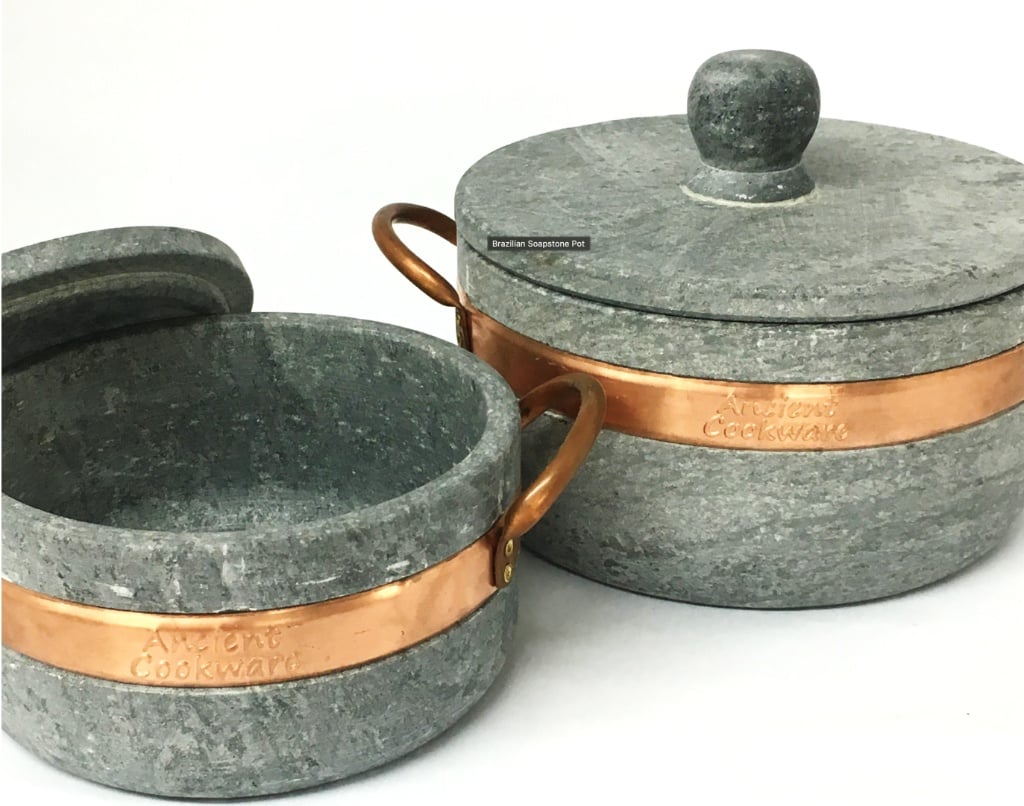
In Brazil, it's called pedra-sabão, literally "soap stone." But it's far more than just a building material there. It's part of the culture.
Brazilians have used soapstone for cookware for generations. The traditional panela de pedra (soapstone pot) is still common in Brazilian kitchens. My grandmother's cookware has been in use for decades and is still going strong.
Soapstone absorbs heat slowly and distributes it evenly. That makes it ideal for slow-cooked dishes like feijoada.
This cultural connection gives Brazilians deep understanding of soapstone's properties. The quarries know exactly what they're extracting. The quality of Brazilian architectural soapstone reflects generations of expertise.
✦ Regional Varieties
Soapstone comes from quarries in Brazil, India, Canada, Finland, and historically the USA. Each source produces slabs with slightly different characteristics.
Some are more uniform. Some have dramatic veining. Some lean green, others deep charcoal.
You might hear names like Barroca (known for dramatic veining), Belvedere (striking white veins against dark backgrounds), or Churchill (consistent deep black). Honestly, variety names matter more to fabricators than homeowners.
What matters to you is whether you like the look. When you visit our showroom, we'll show you the actual slabs available and help you find the right match.
⚫ Black Soapstone and Color Development
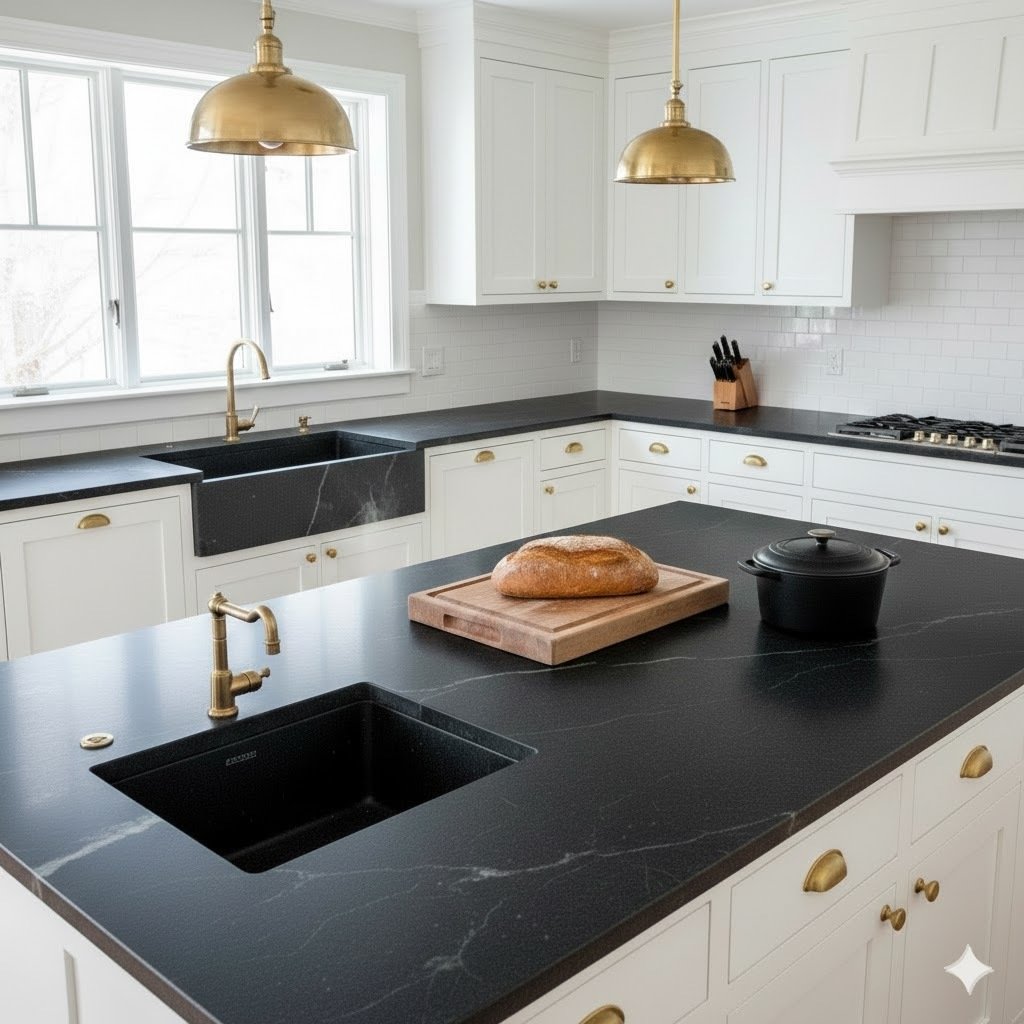
One of the most common questions is about color, particularly black soapstone countertops. Understanding how soapstone develops its color is key to knowing what to expect.
✦ The Color Journey: Gray to Black
Fresh-cut soapstone typically appears in various shades of gray, from light silvery gray to deep charcoal. The transformation to rich black happens gradually through exposure to oils and everyday use.
This isn't a flaw or aging issue. It's one of soapstone's most beautiful characteristics. The stone literally tells the story of your kitchen through its patina development.
✦ Natural vs. Accelerated Darkening
You have two approaches to achieve the deep black appearance:
Natural Development: Left untreated, soapstone darkens slowly over months and years as it's exposed to natural oils from cooking and handling. The areas you use most (around the sink, near the stove) darken first, creating a lived-in, organic pattern.
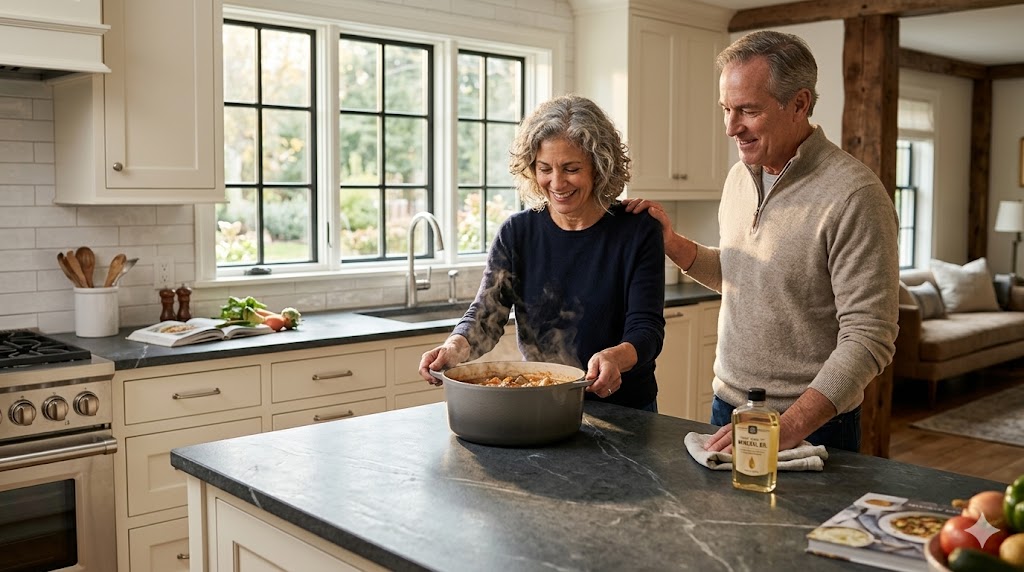
Accelerated with Mineral Oil: Applying food-grade mineral oil brings out the deep black color immediately. A single application can transform light gray soapstone to rich charcoal in minutes. Most homeowners who want the classic black appearance choose this route.
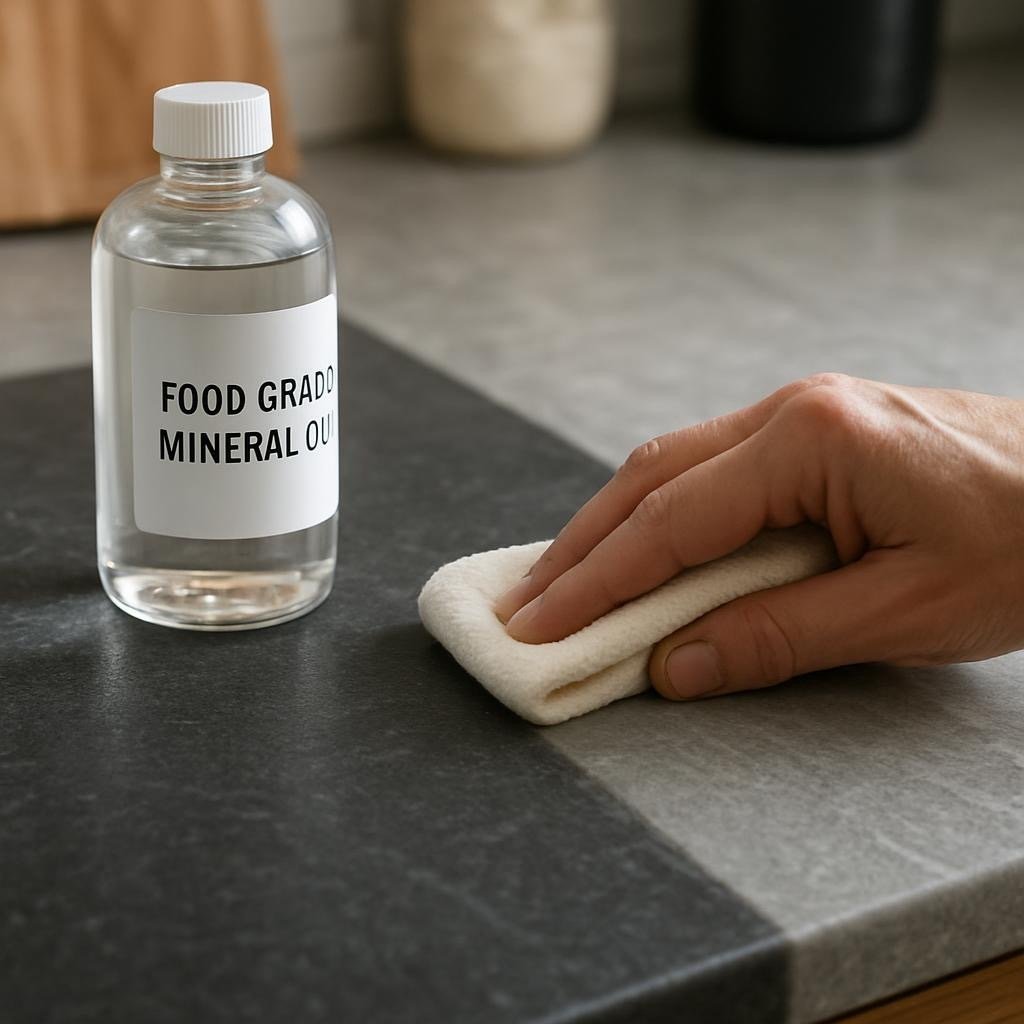
Neither approach is wrong. It's purely personal preference.
✦ Design Pairings for Black Soapstone
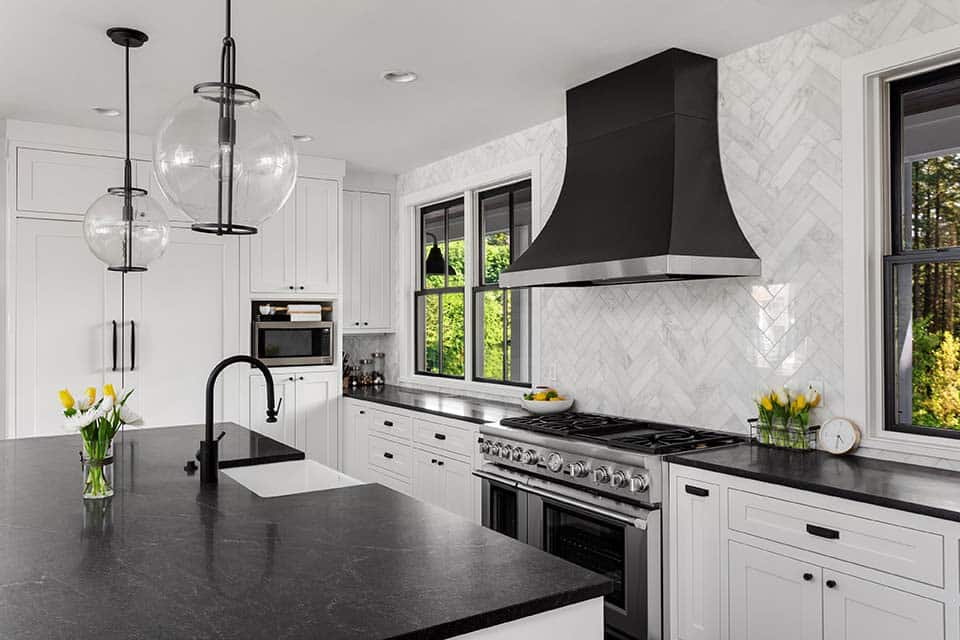
Black soapstone pairs beautifully with white or cream cabinets for classic contrast. Warm brass or copper hardware adds traditional warmth. Stainless steel appliances create modern sophistication.
Natural wood elements work well for rustic charm. Light-colored backsplashes balance the dark surface nicely.
The matte finish doesn't show fingerprints or water spots the way polished dark surfaces do. That makes it surprisingly practical for busy kitchens.
🟢 Green Soapstone: The Warmer Alternative
While black soapstone gets most attention, green soapstone offers a completely different aesthetic. It's warmer, more natural, less formal.
✦ The Key Differences
Green Soapstone:
- Stays lighter even when oiled
- Shows sage to olive green tones
- Feels more casual and earthy
- Pairs beautifully with warm wood cabinets
- Works well in rustic or farmhouse designs
Black Soapstone:
- Develops deep, dramatic black tones
- Creates stark contrast with white cabinets
- Looks more formal and sophisticated
- Works in both modern and traditional kitchens
- Shows more uniform color when oiled
💡 Pro Tip: Both handle heat and maintenance exactly the same. It's purely about the look you want. Most customers know within seconds which direction feels right.
Green soapstone works well in rustic or farmhouse designs, particularly with warm wood cabinets. These color and design recommendations get their own article soon.
🔥 Heat Resistance: Why Soapstone Handles Fire Like No Other
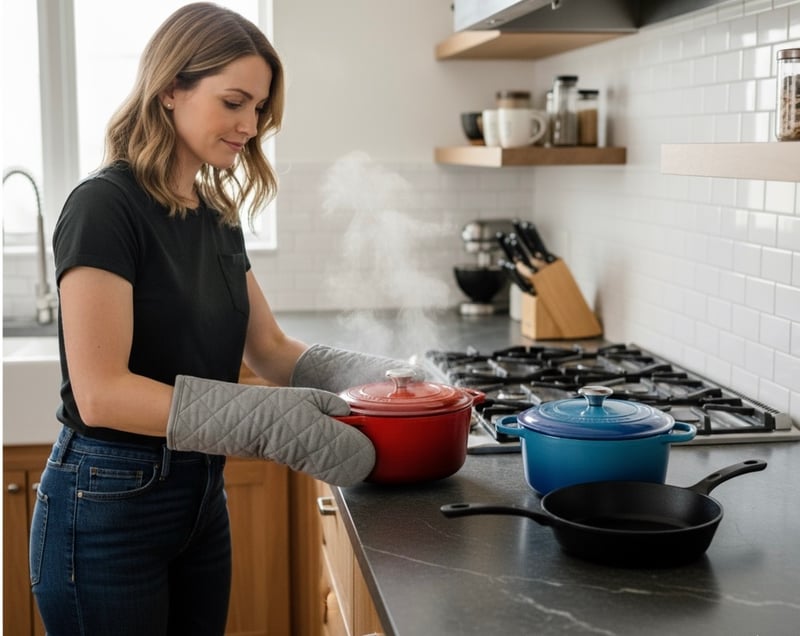
This is where soapstone truly stands apart from every other countertop material. Its heat resistance isn't just good. It's exceptional.
You can take a pot directly from a gas burner at 500 or 600 degrees and set it right on your soapstone countertop. No trivet needed. No scorch mark. No damage.
The stone absorbs the heat without any problem.
⚠️ Warning: Try setting a hot pot on quartz and you'll have a permanent burn mark. Soapstone? Not a scratch. I've never seen heat damage soapstone in 30 years.
✦ The Science Behind It
The heat resistance comes from soapstone's mineral composition and density. The talc and other minerals have high thermal mass. They absorb heat energy slowly and aren't damaged by it.
More importantly, soapstone doesn't just resist heat. It holds onto it. It absorbs warmth slowly and releases it slowly.
This property has made it invaluable for applications far beyond countertops.
✦ Traditional Heat Applications
Understanding how cultures have used soapstone throughout history tells you everything about its heat properties:
Brazilian cookware: The panela de pedra has been a kitchen staple for generations. It heats evenly and maintains consistent temperature, perfect for slow-cooking beans and stews. These pots last for decades.
Finnish wood stoves: Finland has built masonry heaters from soapstone for centuries. The stone absorbs heat from a fire and radiates it slowly for hours after flames die down. High-end wood stoves today still use soapstone cores.
Fireplace surrounds: In New England, soapstone fireplace surrounds have been common since colonial times. The stone can sit inches from an open fire without cracking, scorching, or deteriorating.
Industrial applications: Soapstone is used as a barrier in metal smelting operations. When something can handle those temperatures, your hot pan from the stove isn't going to be a problem.
Laboratory benchtops: If you took chemistry in high school, you probably worked on soapstone counters. Labs choose it because it handles heat from Bunsen burners and resists chemical damage.
🏛️ Soapstone Through History and Around the World
This isn't a trendy new material. Humans have used soapstone for thousands of years.
Ancient Egyptians carved amulets from it. Native Americans used it for cooking pots. Cultures across Africa, Europe, and South America have relied on it because it's durable, workable, and handles heat exceptionally well.
The real story for you, though, is New England heritage.
✦ New England Heritage: It's Not Trendy, It's Tradition
Soapstone in New England isn't trendy. It's heritage. Walk through Cambridge, Lincoln, Wellesley, or Weston and you'll see original soapstone sinks and countertops from the 1800s still in use.
Colonial homes throughout Massachusetts, Rhode Island, and Connecticut have featured soapstone for hundreds of years, since before the American Revolution. The deep laundry sinks, kitchen counters, and fireplace hearths are still functional. This is what your great-grandmother's kitchen was built with.
The quarries in Vermont and Virginia supplied the Northeast for generations. The Alberene Soapstone Company in Virginia was a key source, shipping trainloads throughout the region at their peak.
While most historic quarries have closed, original soapstone installations from the 1800s are still in use.
I've been fabricating and installing soapstone for over 30 years. I grew up in Brazil, where it's called pedra-sabão. My grandmother still uses soapstone cookware that has lasted decades.
Here in New England, I've learned what soapstone really means: not just a countertop, but a connection to the region's building traditions.
⚖️ What Makes Soapstone Different from Other Materials
Every countertop material has trade-offs. Here's what sets soapstone apart:
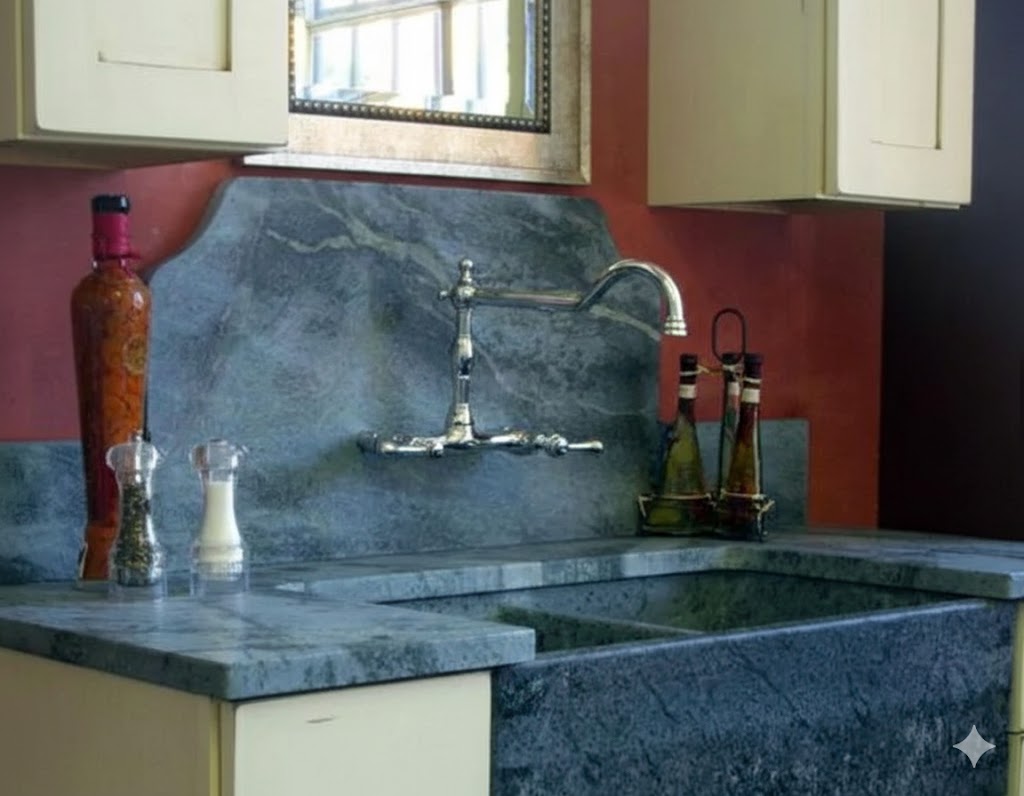
Non-porous. Unlike granite, marble, and quartzite, soapstone doesn't need sealing. The surface is essentially non-porous, so liquids don't penetrate.
Spill wine, coffee, or lemon juice? Just wipe it up. No deep staining, no etching, no panic.
Chemically inert. Marble etches from lemon juice. Granite can be damaged by certain chemicals.
Soapstone doesn't react to acids or bases at all. That's why labs use it for benchtops.
Develops character over time. The areas you use most will darken naturally with exposure to oils. Gradually the entire surface develops a rich patina.
Some people oil it to speed this up, others let it happen naturally. Either way, the surface tells the story of your kitchen.
Softer, but repairable. Yes, soapstone is softer than granite. It scratches and dents. But those scratches are a five-minute DIY fix with sandpaper and mineral oil. Try doing that with quartz or granite.
For detailed head-to-head comparisons, check out our guides on soapstone vs. granite, soapstone vs. quartz, and soapstone vs. marble (coming soon).
🏠 Soapstone Applications Throughout Your Home
While soapstone kitchen countertops are the most common application, its properties make it suitable for many other uses.
✦ Kitchen Applications
Countertops: The classic use. Heat resistance means you can set hot pots directly on the surface without trivets. Non-porous means no sealing and easy cleanup.
Integrated sinks: Seamless fabrication where countertop and sink are one continuous piece, popular for farmhouse-style kitchens.
Backsplashes: A matching soapstone backsplash handles cooking splatter easily and creates a unified look.
✦ Bathroom Applications
Vanity tops: Non-porous surface handles moisture without issues. Naturally antibacterial, making it ideal for bathrooms.
Heat from styling tools: Hair straighteners and curling irons won't damage soapstone. You can set them on the surface without worry.
✦ Fireplace and Heat Applications
Fireplace surrounds and hearths: Heat-resistant nature makes soapstone ideal for fireplaces. It can sit inches from an open fire without cracking.
Wood burning stoves: High-end wood stoves use soapstone cores because it absorbs heat while the fire burns and releases it slowly for hours.
✦ Other Uses
Floor tiles: Durable, easy to clean, and develops the same beautiful patina over time.
Pizza stones and cooking slabs: The heat properties that make it ideal for countertops make it excellent for cooking applications.
Bar tops and outdoor kitchens: Soapstone handles weather and UV exposure without deteriorating.
✅ Soapstone Countertops: Pros and Cons Summary
After 30 years of installations, here's the honest breakdown:
Pros:
- Exceptional heat resistance: set hot pots directly on surface
- Never needs sealing
- Naturally antibacterial and hygienic
- Easy scratch repair you can do yourself
- Develops beautiful patina over time
- Chemical resistant: acids won't damage it
- Historic New England authenticity
Cons:
- Softer than granite: will scratch and dent
- Limited color range (grays to black, some green)
- Patina development may not suit everyone
- Higher cost than some alternatives
- Requires understanding that it changes over time
Bottom Line: The right choice depends on whether you see the patina development as character or a drawback.
💰 Why Stone Pricing Isn't One-Size-Fits-All
How much is it per square foot? That's the most asked question. Unfortunately, it's not that simple. Let me explain why.
If you choose anything from our in-house inventory, it's a set price per square foot no matter the size of the job. If we need to special order material for your job, the pricing changes because in this industry, you can only order whole slabs at a time.
💎 Pricing Range: Total installed pricing for soapstone typically ranges from $80-$120 per square foot. This covers about 95% of available options.
Why Pricing Varies:
- Sourcing: We work with various suppliers to find the best value for your project. Stock material from our yard offers the best pricing, while special orders from specific suppliers may cost more.
- Complexity: Customization like integrated sinks, waterfalls, and full backsplashes require more fabrication time.
- Waste: Every project is like a puzzle. How efficiently we can fit your pieces on the slab affects the final cost. Intricate shapes mean less efficient cuts.
That's why visiting our showroom is the best way to decide. You'll see materials in person in our indoor heated warehouse, compare finishes, and get expert guidance to make the right choice.
🎯 Who Should Choose Soapstone, And Who Shouldn't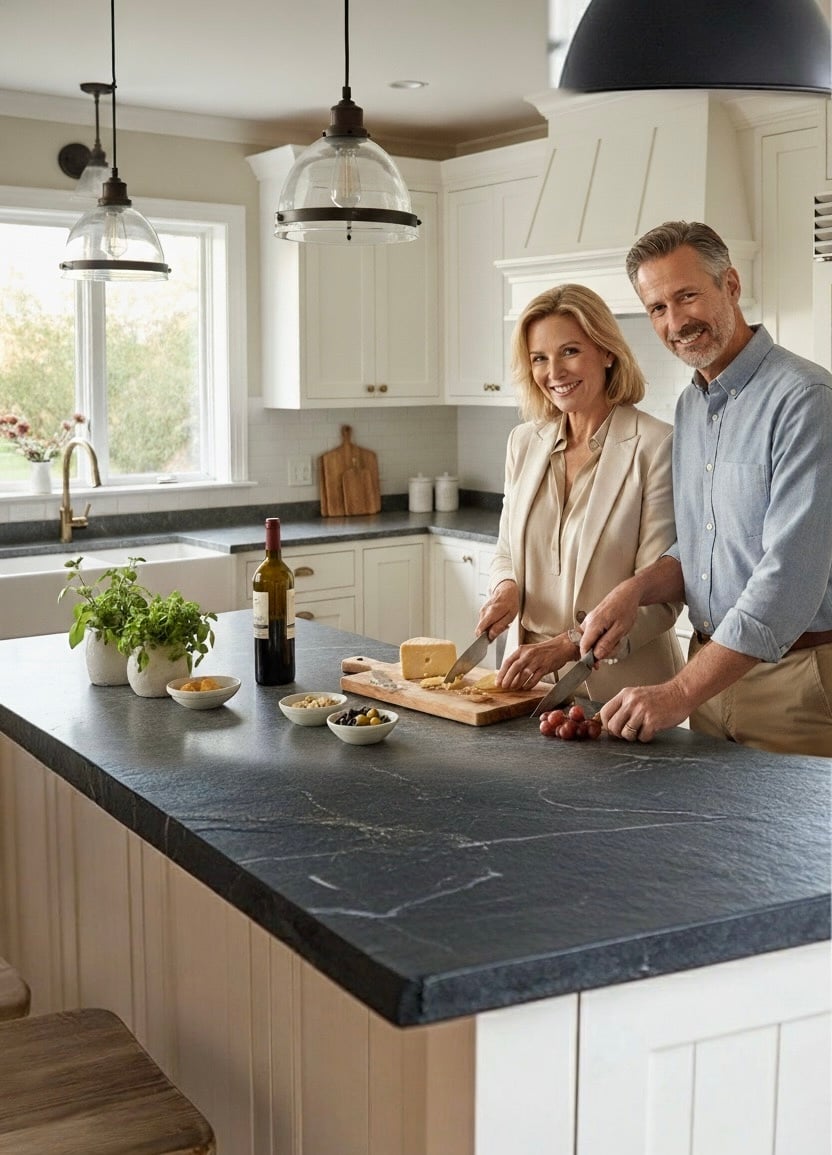
After 30 years in this business, I can tell you that soapstone isn't for everyone. And that's okay. The best countertop is the one that fits your lifestyle, your design goals, and your expectations.
✦ Soapstone Is Perfect for You If:
You appreciate surfaces that develop character over time. You want something that tells a story and gets better with age.
You value authenticity and natural materials. You'd rather have real stone with its quirks than an engineered surface that looks the same forever.
You cook seriously and want to put hot pots down without reaching for a trivet. Heat resistance matters to you.
You're renovating a historic home or designing something with traditional New England character. Soapstone fits that aesthetic perfectly.
You want low maintenance without sealing schedules. Wipe it clean and forget about it. Just an occasional application of mineral oil if you want to enhance the color.
✦ You Should Consider Other Materials If:
You have a busy household with rough teenagers. Heavy backpacks thrown on the counter, dropped cast iron pans, general mayhem. Soapstone handles daily use, but it's not indestructible.
If your kitchen is a combat zone right now, consider quartzite or quartz for this phase of life. Save the soapstone for your dream kitchen when things calm down.
Scratches and marks will bother you. If you want a surface that looks exactly the same in ten years as it does today, this isn't the right choice.
You want bright colors or bold patterns. The soapstone palette runs from gray to charcoal with some green undertones. It's elegant, not flashy.
You prefer broad mainstream appeal. While soapstone has devoted fans, it's more of a specialty choice. If you're planning to sell soon and want universal appeal, granite or quartz might be safer.
This isn't about soapstone being "worse" than other materials. It's about finding the right match for your life right now.
🔍 How to Evaluate Soapstone Quality
Not all soapstone is created equal. Here's what to look for when selecting slabs.
✦ Density and Hardness
Higher-quality architectural soapstone has lower talc content (around 30%) and higher concentrations of harder minerals. This makes it more resistant to scratching and denting. Ask your fabricator about the source and composition.
✦ Color Consistency
Colors range from light gray to deep charcoal, sometimes with blue or green undertones. Some slabs have dramatic veining, others are more uniform.
Neither is better. It depends on your design goals.
Make sure you're seeing the actual slabs that will go in your kitchen, not just samples.
✦ Veining Patterns
Veining in soapstone tends to be softer and more subtle than in marble or quartzite. Some varieties have bold white veins against dark backgrounds. Others have gentle, flowing patterns.
Consider how the veining will look across your entire countertop run, including any seams.
✦ Thickness
Standard soapstone countertops are fabricated at 3cm (about 1.25 inches) thickness. Thicker slabs are available for special uses. Your fabricator should discuss thickness options based on your design and structural requirements.
✦ Working with Your Fabricator
A good fabricator should show you the actual slabs you will get, not just samples. They should be honest about how soapstone behaves. It will scratch and develop patina over time.
Most importantly, they should have experience working with soapstone specifically. It requires different handling than harder materials.
⚠️ Warning: Be wary of anyone selling "soapstone" at prices that seem too good to be true. There are slates and other materials sometimes mislabeled. Real architectural soapstone has a distinctive feel and appearance that's hard to fake once you know what to look for.
🧹 Care and Maintenance
Maintaining soapstone countertops is straightforward.
✦ Daily Care
Wipe down with warm water and mild dish soap. Dry with a soft cloth to prevent water spots. Clean up spills as they happen, though staining isn't really a concern with soapstone.
✦ Mineral Oil (Optional)
Applying mineral oil is purely optional and aesthetic. It enhances the stone's color, bringing out the deepest black tones.
Some homeowners oil their countertops weekly at first, then monthly as the patina develops. Others let the stone darken naturally and never oil at all. Neither approach is wrong.
✦ Scratch Repair
Minor scratches often disappear with mineral oil. For deeper scratches:
- Use 120-grit sandpaper to sand out the scratch
- Follow with 220-grit for smoothing
- Finish with 400-grit for a polished result
- Apply mineral oil to blend the repair into surrounding stone
Takes about five minutes.
✦ What to Avoid
- Abrasive cleaners or scouring pads (they'll dull the surface unnecessarily)
- Harsh chemical cleaners (unnecessary and can strip oil)
- Leaving standing water for extended periods
That's it. No annual sealing appointments. No specialty cleaning products. No professional maintenance visits. Soapstone is about as low-maintenance as natural stone gets.
❓ Frequently Asked Questions About Soapstone Countertops
Q. Is soapstone good for kitchen countertops?
A. Absolutely. It handles heat better than any other material, never needs sealing, and resists stains and acids naturally.
Q. Does soapstone stain?
A. No. It's essentially non-porous, so liquids don't penetrate deeply. Temporary darkening from water isn't permanent staining.
Q. Can you put hot pots on soapstone?
A. Yes. Set pots directly from a 500-degree burner onto soapstone without damage. No trivet needed.
Q. Does soapstone scratch easily?
A. It's softer than granite and will show scratches. But scratches are easily repairable with mineral oil or light sanding in about five minutes.
Q. How much do soapstone countertops cost?
A. In Massachusetts, expect $80-$120 per square foot installed. Pricing depends on slab sourcing, customization, and installation complexity.
Q. Does soapstone need to be sealed?
A. Never. The stone is naturally non-porous, unlike granite which requires sealing every 1-3 years.
Q. What's the difference between black and green soapstone?
A. Black develops deep dramatic tones for formal kitchens. Green stays lighter with sage to olive tones for a more casual feel. Both handle heat and maintenance the same.
Q. Do you have to oil soapstone?
A. No. Oiling is purely optional and aesthetic. Some homeowners oil regularly, others let it darken naturally, some never oil at all.
Q. How long does soapstone last?
A. Centuries. Original soapstone sinks and countertops from the 1800s are still in use throughout New England.
Q. Can soapstone crack?
A. It's quite durable and less likely to crack than many stones due to its composition. Proper fabrication and installation prevent most issues.
📚 Related Articles
- Granite Countertops: The Complete Guide
- Quartzite Countertops: What You Need to Know
- Marble Countertops: Beauty and Maintenance
🏠 Visit Our Southborough Showroom
Still figuring out which stone is right for you? Come see us. Nothing beats standing in front of the actual slabs, comparing colors, patterns, and finishes in person. That's how you make the right decision.
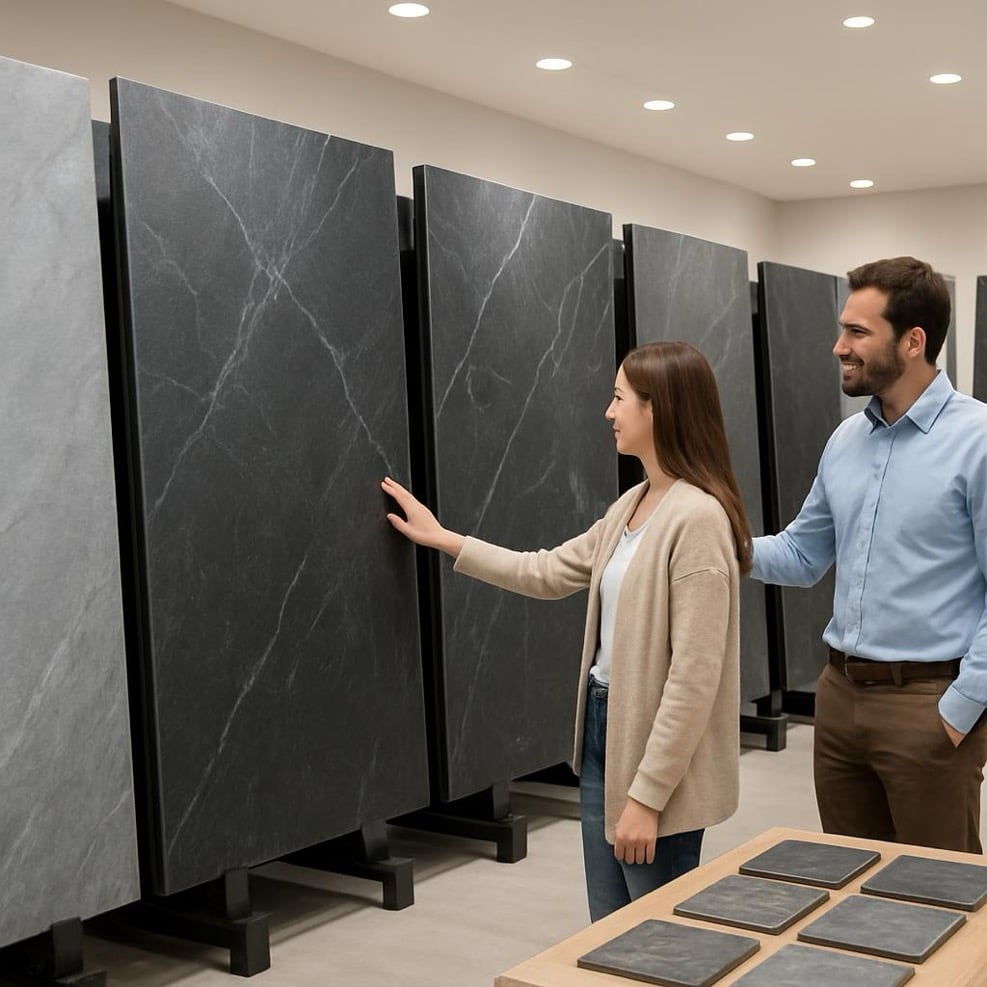
Stop by our countertop store at 43 Turnpike Road (Route 9), Southborough, MA 01772 during business hours. We keep a large inventory in our heated warehouse, so there's always plenty to see.
Already done your homework and know what you want? Email us or give us a call.
📞 508-460-7900
📧 info@graniteguyinc.com