Quartz Countertops Pros and Cons: A Fabricator's Honest Take
Written by Granite Guy Inc., Southborough, Massachusetts
Updated: March 15, 2026
Quartz kitchen countertops are durable, low-maintenance, and one of the most practical choices for a busy kitchen — but they're not right for everyone.
💎 The Quick Answer: Quartz is engineered stone (90–94% natural quartz + resin). It never needs sealing, resists stains beautifully, and handles New England hard water better than most natural stones. The trade-off: it can't take direct heat, can't go outdoors, and doesn't have the natural variation some homeowners want. If low maintenance is your priority, quartz is hard to beat.
I've been fabricating and installing countertops across Greater Boston and MetroWest for over 30 years. I've installed quartz in everything from Natick colonials to Newton Victorians to brand-new Seaport condos. Here's my honest take on where it excels — and where it falls short.
⭐ Quartz Countertops Pros and Cons: What You're Actually Weighing
Quartz countertops are engineered stone, not a solid piece of natural rock quarried from the ground. Manufacturers grind natural quartz crystals and bind them with polymer resins and pigments, producing a slab that's approximately 90–94% natural quartz by weight.
That resin is what gives quartz its superpowers — and its limitations. Understanding that one fact will help you make sense of every pro and con in this article.
✅ The Pros of Quartz Countertops
✦ Zero Maintenance — Seriously, None
This is the biggest reason Massachusetts homeowners choose quartz.
No sealing. Ever. Unlike granite, marble, or quartzite, quartz is completely non-porous straight from the factory. The resin binders fill every pore.
That means no annual sealing appointments, no worrying whether your countertop is protected, no mystery stains soaking in overnight.
✦ Hard Water Is a Non-Issue
If you live in MetroWest or Greater Boston, you know the water is hard. Really hard.
I've replaced marble vanity tops in Sudbury and Natick that were damaged by mineral deposits before they should have been. Quartz doesn't have that problem. Minerals sit on the surface and wipe right off.
For Massachusetts homeowners, this is a bigger deal than most people realize until it's too late.
✦ Stain Resistance That Actually Works
Coffee, red wine, olive oil, tomato sauce — none of it penetrates quartz.
Because the surface is non-porous, spills sit on top where you can wipe them away. You don't need to panic and grab a towel the second something spills.
Permanent markers and strong chemical dyes can leave marks if left for extended periods, but in 30 years of real-world installations, I've seen very few staining complaints on quality quartz.
✦ Consistent, Predictable Appearance
With natural stone, what you see in the showroom and what gets installed in your kitchen can look different. Slabs vary. Veining shifts. Colors run different from one slab to the next.
Quartz is engineered, so what you pick is what you get. That consistency is genuinely valuable — especially for large kitchens with multiple slabs where matching matters.
✦ Wide Range of Colors and Styles
Quartz comes in options that don't exist in nature: pure whites, concrete grays, dramatic blacks, and patterns that convincingly mimic Calacatta marble without any of the marble maintenance.
For Massachusetts homes where resale value matters, the ability to get a high-end marble look with zero upkeep is a real selling point.
✦ Scratch Resistant for Daily Life
Quartz rates 7 on the Mohs hardness scale — harder than most kitchen knives. Daily use won't scratch it.
I still recommend using a cutting board. Cutting directly on quartz won't scratch the surface, but it will destroy your knives — the stone is harder than your blade. Better to protect both.
❌ The Cons of Quartz Countertops
I'd rather tell you this now than have you find out after installation.
✦ Heat Is Its Weakness
This is the most important limitation to understand.
The resin that makes quartz non-porous has a heat threshold of around 150°F for the polymer and around 300°F for the quartz itself. A hot pan coming off the stove or out of the oven easily exceeds those temperatures.
Direct contact with hot cookware can discolor, crack, or warp quartz permanently. Warranties don't cover heat damage.
Always use trivets. Always. This isn't optional advice — it's a hard rule for quartz ownership.
⚠️ Warning: Air fryers, Instant Pots, and electric skillets sitting directly on quartz are a common cause of heat damage. The bottom of those appliances gets extremely hot during use.
✦ No Outdoor Use — At All
If you're planning an outdoor kitchen, quartz is not your material.
Prolonged UV exposure breaks down the resin binders, causing colors to fade and the surface to potentially warp or crack. Every manufacturer voids the warranty for outdoor installations.
For outdoor kitchens, I recommend granite or natural quartzite. Both handle sun and temperature swings beautifully.
✦ It Looks Engineered — Because It Is
Some homeowners love quartz's consistency. Others find it too uniform.
If you want the natural movement, variation, and character of a stone that came out of the earth, quartz won't fully satisfy that. Even the best marble-look quartz patterns repeat in a way that a trained eye can spot.
If the "natural stone" feeling matters to you, it's worth considering whether quartz will still feel right five years after installation.
✦ Visible Seams on Large Projects
Quartz slabs come in standard sizes. Large kitchens with big islands or full-perimeter countertops will require seams.
A skilled fabricator minimizes seams and places them strategically. But they're there, and quartz doesn't hide them as naturally as some stones with more movement and variation.
✦ Can Chip on Edges
Quartz is hard, but it's not indestructible. Edges — especially thinner profiles — can chip from a sharp impact.
The good news: small chips on quartz edges can usually be repaired with color-matched epoxy. It's not a catastrophe. But it's worth knowing that dropping something heavy on a corner can leave a mark.
🆚 Quartz vs. the Alternatives
This is where I can save you a lot of time.
✦ Quartz vs. Granite
Granite is natural, heat-resistant, and each slab is one of a kind. It needs sealing once a year or so, but it's genuinely more forgiving around the stove.
If you cook a lot with high heat and don't want to think about trivets, granite may be a better fit. Read the full comparison: Quartz vs. Granite Countertops.
✦ Quartz vs. Quartzite
Don't confuse the names — they're completely different materials.
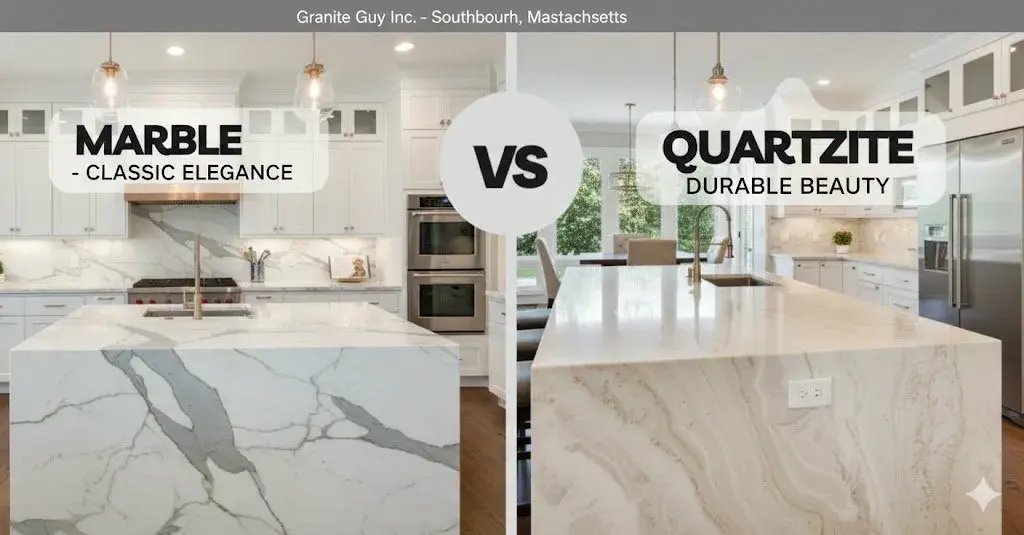
Quartzite is a natural stone that needs sealing and offers better heat resistance than quartz. It typically costs more and has more natural variation. If you want the look of marble with better durability than marble, quartzite is worth a serious look.
✦ Quartz vs. Marble
Marble is beautiful and timeless, but it etches and stains more easily than almost any other countertop material. If you're torn between marble and quartz, the honest answer is: quartz wins on practicality every time.
If you want marble's aesthetic without marble's maintenance, a high-quality marble-look quartz is a genuinely good solution.
✦ Quartz vs. Porcelain
Porcelain is UV-stable (great for outdoors), extremely thin, and very durable. It's worth considering for specific applications. For a full breakdown: Quartz vs. Porcelain Countertops.
💰 Why Stone Pricing Isn't One-Size-Fits-All
How much is it per square foot? That's the most asked question. Unfortunately, it's not that simple. Let me explain why.
If you choose from our in-house inventory, it's a set price per square foot no matter the size of the job. If we need to special-order material for your project, pricing changes — in this industry, you can only order whole slabs at a time.
💎 Total installed pricing typically ranges from $55–150 per square foot. This covers about 95% of available quartz options.
Why pricing varies:
- Sourcing: Stock material from our yard offers the best pricing. Special orders from specific suppliers may cost more.
- Complexity: Waterfalls, integrated sinks, and custom edges require more fabrication time.
- Waste: Every project is a puzzle. Intricate layouts or bold-veined patterns that need to align mean less efficient cuts and more material used.
That's why visiting our showroom is the best way to decide. You'll see materials in person in our indoor heated warehouse, compare finishes, and get expert guidance.
🤔 Is Quartz Right for Your Kitchen?
After 30 years of doing this, here's how I frame it for customers in the showroom.
Choose quartz if:
- You want zero maintenance and no sealing ever
- Hard water is a concern (MetroWest and Greater Boston, I'm looking at you)
- You want consistent color and pattern matching across multiple slabs
- You have kids, pets, and a busy kitchen where practicality beats everything
- You love a marble aesthetic but don't want marble's upkeep
Consider alternatives if:
- You cook with high heat and know you'll forget trivets
- You want an outdoor kitchen or covered patio countertop
- The natural variation and "aliveness" of real stone matters to you
- You're drawn to a specific natural stone that quartz can't truly replicate
There's no wrong answer here. I've seen quartz thrive in kitchens it was perfect for and get replaced in kitchens where the homeowner wanted something different. Better to know before you commit.
❓ Frequently Asked Questions
Q. Does quartz need to be sealed?
A. No. Quartz is non-porous and never needs sealing — that's one of its biggest advantages over natural stone.
Q. Can I put hot pans on quartz countertops?
A. No. The resin in quartz can discolor or crack from direct heat above 150°F. Always use trivets or hot pads.
Q. How long do quartz countertops last?
A. Indefinitely with proper care. Most manufacturers back quartz with 10-year to lifetime warranties. People replace quartz because styles change, not because it fails.
Q. Does quartz stain?
A. It's highly stain resistant. Coffee, wine, and oils won't penetrate the surface. Permanent markers or strong dyes can leave marks if not cleaned promptly, but everyday spills are a non-issue.
Q. Can quartz crack?
A. Yes, under the right conditions — extreme heat, a heavy impact, or improper installation. It's not fragile, but it's not indestructible. Here's what actually causes quartz to crack.
Q. Is quartz better than granite?
A. Different strengths. Quartz wins on maintenance and stain resistance. Granite wins on heat resistance and natural uniqueness. The right choice depends on how you cook and what aesthetic matters to you.
Q. Can quartz be used outdoors?
A. No. UV exposure degrades the resin binders, causing fading and potential warping. All manufacturers void warranties for outdoor installations.
Q. Is quartz a natural stone?
A. It's made from natural quartz crystals (90–94%), but the slabs are engineered — crushed quartz bound with resin and pigments. It's not quarried as a solid slab the way granite or marble is.
Q. How do I clean quartz countertops?
A. Warm water and mild dish soap handles daily cleaning perfectly. For stubborn spots, a 50/50 mix of isopropyl alcohol and water works well. Avoid bleach, vinegar, and abrasive cleaners. Full quartz cleaning guide here.
Q. Does quartz add resale value to a Massachusetts home?
A. Yes. Quartz is widely recognized as a high-end material by buyers and appraisers. In the Greater Boston and MetroWest market, it reads as a quality upgrade — especially in kitchens.
🏠 Visit Our Southborough Showroom
Still figuring out if quartz is the right call for your kitchen? Come see us. Nothing beats standing in front of actual slabs, comparing colors, patterns, and finishes in person. That's how you make a decision you'll be happy with for decades.
Stop by our countertop store at 43 Turnpike Road (Route 9), Southborough, MA 01772 during business hours. We keep a large quartz inventory in our heated warehouse, so there's always plenty to see and compare.
Already done your homework and know what you want? Email us or give us a call.
📞 508-460-7900
📧 info@graniteguyinc.com