Written by Granite Guy Inc., Southborough, Massachusetts
Updated: January 25, 2026
Can you cut directly on a quartz countertop? Technically, yes. Should you? That's a different question.
After 30 years of fabricating and installing countertops, I've seen what happens when homeowners skip the cutting board. Let me give you the full picture so you can make your own call.
🪨 What Happens When You Cut on Quartz
Quartz is an engineered stone made of about 90-95% crushed natural quartz bound together with resins and pigments. It's tough, ranking around 7 on the Mohs hardness scale.
That hardness means your knife blade isn't going to leave deep gouges with every slice. But here's what most people don't realize: just because the surface can handle it doesn't mean it's the smart move.
✦ The Real Risk Isn't Deep Scratches
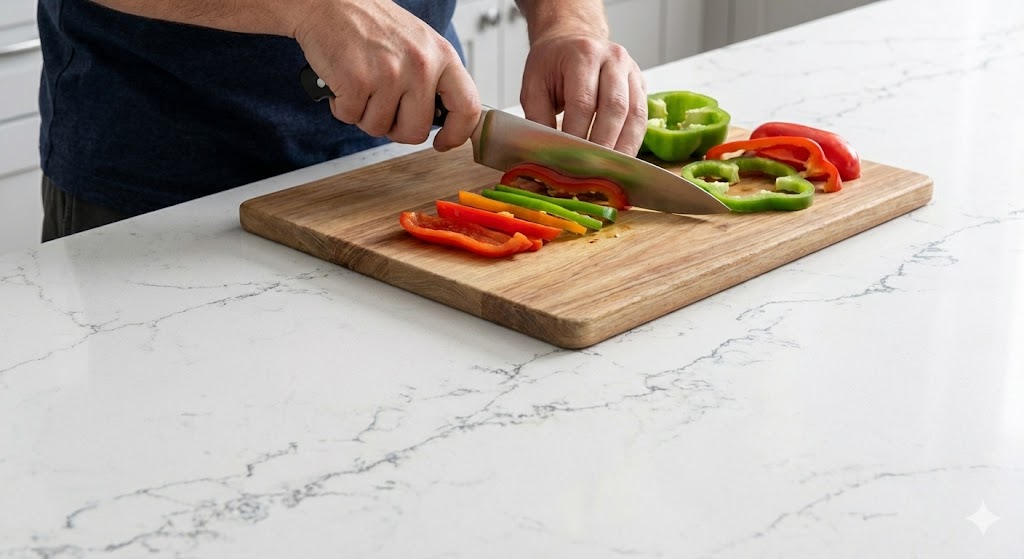
Light cutting won't destroy your countertop overnight. But over time, repeated knife contact creates micro-abrasions on the surface.
These tiny scratches dull the polished finish. In direct light, you'll start to see a hazy pattern where you do most of your chopping.
The homeowner thinks the counter is fine until they stand at a certain angle and notice the wear marks. By then, the damage is done.
🔪 Your Knives Will Suffer More Than the Quartz
Here's the thing most articles don't mention: quartz is harder than your knife blade.
Every time you cut directly on quartz, you're dulling your knives. That $200 chef's knife you bought? It'll need sharpening far more often if you're using your countertop as a cutting surface.
Over time, you'll either spend more on knife maintenance or end up with dull blades that make prep work harder and less safe. A $15 cutting board is a lot cheaper than constant resharpening.
🦠 The Sanitation Factor
This is the part that matters most in my opinion.
When you cut raw meat directly on any countertop surface, bacteria can settle into microscopic imperfections. Quartz is non-porous, which helps, but it's not a substitute for proper food safety.
A cutting board gives you a dedicated surface you can sanitize thoroughly or toss in the dishwasher. It also keeps raw meat juices away from areas where you prep other foods.
🧽 What About Cleaning Products?
When you cut directly on quartz and then clean up with harsh chemicals, you're compounding the problem.
Strong disinfectants can slowly degrade the resin surface of quartz over time. The more you cut and sanitize, the faster you wear down the finish.
Stick to mild soap and water for daily cleaning. If you use a cutting board, you won't need to hit your countertops with heavy-duty cleaners after every meal prep.
🍋 Acidic Foods Are a Concern
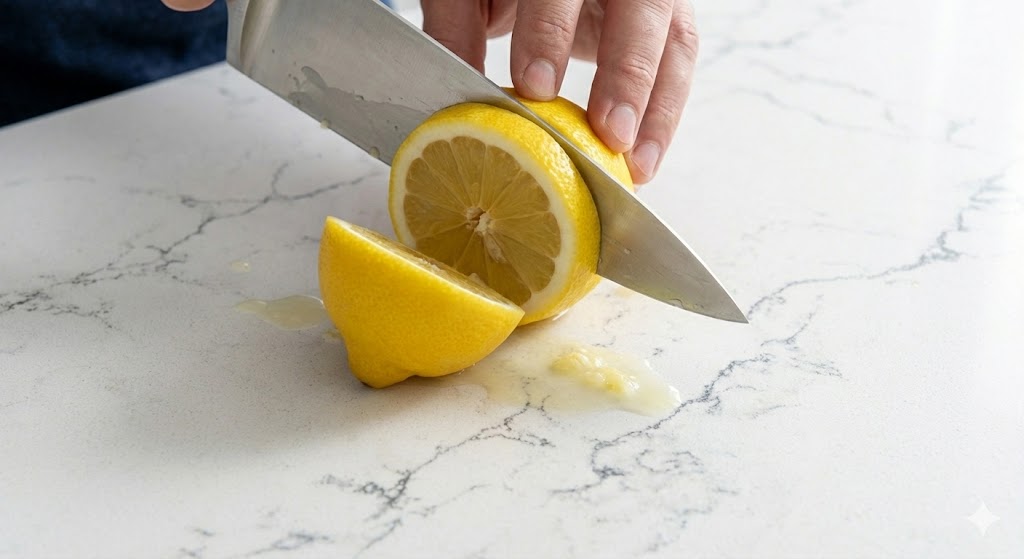
Cutting citrus, tomatoes, or other acidic foods directly on quartz exposes the surface to substances that can affect the resin binders over time.
Will one lemon slice ruin your counter? No. But regular exposure to acidic juices, especially if they sit for a while, can cause subtle discoloration or dullness in certain quartz colors.
A cutting board eliminates this risk entirely.
✅ The Bottom Line: Use a Cutting Board
Here's my honest advice after thousands of quartz kitchen countertop installations:
Use a cutting board. Every time.
It protects your countertop finish, keeps your knives sharp, maintains food safety, and eliminates any worry about acidic foods or harsh cleaners.
Quartz is a durable, beautiful material that can last decades. Why risk shortening that lifespan or dulling the finish to save yourself three seconds grabbing a cutting board?
💡 Quick Care Tips for Quartz
Do: Wipe up spills quickly with mild soap and water. Use trivets under hot pots and pans. Keep a cutting board handy for all food prep.
Don't: Cut directly on the surface. Use abrasive scrubbers or harsh chemicals. Set hot cookware directly on the counter.
Quartz handles everyday life well, but a little care goes a long way. Most damage I see comes from shortcuts that were easy to avoid. For a deeper dive, check out our guide on how to clean quartz countertops.
❓ FAQ
Q. Will one cut ruin my quartz countertop?
A. No, occasional light cutting won't cause visible damage. But repeated cutting over time creates surface wear you'll eventually notice.
Q. Is quartz harder than granite?
A. They're comparable. Quartz rates around 7 on the Mohs scale, similar to granite. Both are harder than your knife blade.
Q. Can I put hot pans on quartz?
A. I don't recommend it. The resin in quartz can discolor or even lead to quartz countertop cracking under extreme heat. Always use a trivet.
Q. How do I remove knife marks from quartz?
A. Light surface scratches can sometimes be buffed out by a professional. Deep damage is usually permanent. Prevention is easier than repair.
Q. What's the best cutting board material?
A. Wood and plastic both work well. Wood is easier on your knives. Plastic is easier to sanitize. Pick what fits your cooking style.
Q. Does quartz need to be sealed?
A. No. Unlike granite or marble, quartz is non-porous and doesn't require sealing.
📚 Related Articles
- Quartz Countertops
- How to Clean Quartz Countertops
- Quartz vs. Granite: Which Is Right for Your Kitchen?
🏠 Visit Our Southborough Showroom
Thinking about quartz for your next kitchen project? Come see the difference in person. Nothing beats standing in front of actual slabs, comparing colors and finishes before you decide.
Stop by our countertop store at 43 Turnpike Road (Route 9), Southborough, MA 01772 during business hours. We keep a large inventory in our heated warehouse, so there's always plenty to see.
Already know what you want? Email us or give us a call.
📞 508-460-7900
📧 info@graniteguyinc.com