Where Does Granite Come From? A Fabricator’s Guide
Written by Granite Guy Inc., Southborough, Massachusetts
Updated: February 10, 2026
Granite is one of the most abundant rocks on Earth. It's everywhere: the US, Canada, Brazil, India, Africa, Europe, Russia. So why does most countertop granite come from just a few places?
Because it all comes down to demand.
No demand, no quarry. Doesn't matter how much granite exists in the ground.
The places that supply your countertops aren't the only places with granite. They're the places where someone decided it was worth digging up. The color is desirable, the labor is affordable, the quarry is accessible, and the infrastructure exists to ship slabs halfway around the world.
🪨 Granite is everywhere. The real question isn't where it exists, it's where someone decided to dig it up.
A particular granite color usually comes from only one place on Earth. The minerals present in that specific location when the stone formed determine its unique appearance.
That's why Blue Bahia only comes from the state of Bahia in Brazil, and why Black Galaxy only comes from one region in India. Nature made it there and nowhere else.
After 30 years of fabricating granite, I can often tell where a stone comes from just by looking at it. Certain color families and patterns are unmistakably Brazilian, or Indian, or Italian.
And once I know the origin, I know how it's going to behave: the best way to cut it, the best way to handle it. The stone tells you its story if you know what to look for.
With over 10,000 installations across Greater Boston and MetroWest, I've worked with stone from every major quarrying region. Let me walk you through where granite actually comes from, and why.
🕰️ How the Granite Industry Went Global
When I started in this business 30 years ago, almost all granite countertops came from the US. Maine, Vermont, Massachusetts, Virginia, Texas, South Dakota. American stone for American kitchens. And you had maybe 8 colors to choose from. That was it.
Then the industry exploded. Demand grew faster than domestic quarries could keep up. First came Mexico and Canada. Then Brazil, India, Europe.
Once international shipping became cost-effective, the trade went both ways. US stone going overseas, foreign stone coming here. It snowballed into the global market we have today.
✦ Where US Countertop Granite Comes From Now
If you're shopping for granite countertops in Massachusetts today, there's a good chance your stone came from Brazil. Over half of the granite used for countertops in the US comes from Brazilian quarries. India is the second biggest supplier, followed by smaller amounts from China and other regions.
📊 Today's US countertop market: ~50%+ Brazil, India second, small amounts from everywhere else.
And that American granite from Maine and Vermont? Most of it now goes to other applications: monuments, building facades, landscaping. The countertop industry moved on.
✦ The Italy Secret
Here's something most people don't know: Italy doesn't actually have that much granite. What they have is expertise and business savvy.
Italian companies own quarries all over the world, ship the raw blocks back to Italy for processing, and export the finished slabs with a "Made in Italy" stamp. You're paying for Italian craftsmanship, not necessarily Italian stone.
🇮🇹 "Made in Italy" often means processed in Italy, not quarried there.
✦ Why This Is Great for You
For consumers, the global market is a huge win. You went from 8 color options to thousands. Every year, new quarries open up and new colors hit the market. You have more choices than any generation of homeowners before you.
But there's a flip side: quarries close too. Some run out of material. Some become economically unviable. That stunning granite you see in the showroom today might not exist in five years. If you find something you love, don't assume it'll be there forever.
The world has plenty of granite. It's just a matter of desirability and demand.
✦ Stones From Around the World
Brazil and India dominate the market, but popular granites have come from all over:
Finland produces some of the most distinctive stones in the industry. Emerald Pearl and Blue Pearl, with their iridescent flecks, come from this region and remain popular today.
Russia gave us Vogue Blue, a striking stone with blue flakes that stood out from anything else on the market.
Iran is the source of Costa Esmeralda, a beautiful light green stone with a quartzite-like appearance. It typically gets shipped to Italy for processing before being distributed worldwide.
Canada used to supply several popular granites: Blue Eyes, Cambrian Black, and Caledonia were common in US kitchens. You don't see them as much anymore.
Egypt produced Tropical Brown and Violetta, both very popular at one point. Demand dropped off, and they're harder to find now.
✦ Why Stones Disappear
Some of the most popular granites from 10 or 15 years ago are nearly impossible to find today. Kashmir White from India was everywhere. Ubara Green, Ubara Gold, Kinawa Rose, all extremely popular at one point. Now? Hard to source or gone entirely.
And it's not always because the quarry ran out of stone. Sometimes it's economics: the stone falls out of fashion and it's no longer profitable to extract. Sometimes it's politics.
I heard the Kashmir White quarry closed because of a change in local government and the owner lost his operating rights. The stone is still in the ground. You just can't get it.
This is why I tell customers: if you see something you love in the showroom, don't wait too long. That color might not exist in five years.
🪨 That's the beautiful thing about stone. It may be around at one point, and then you never see it again.
🪨 How Granite Forms
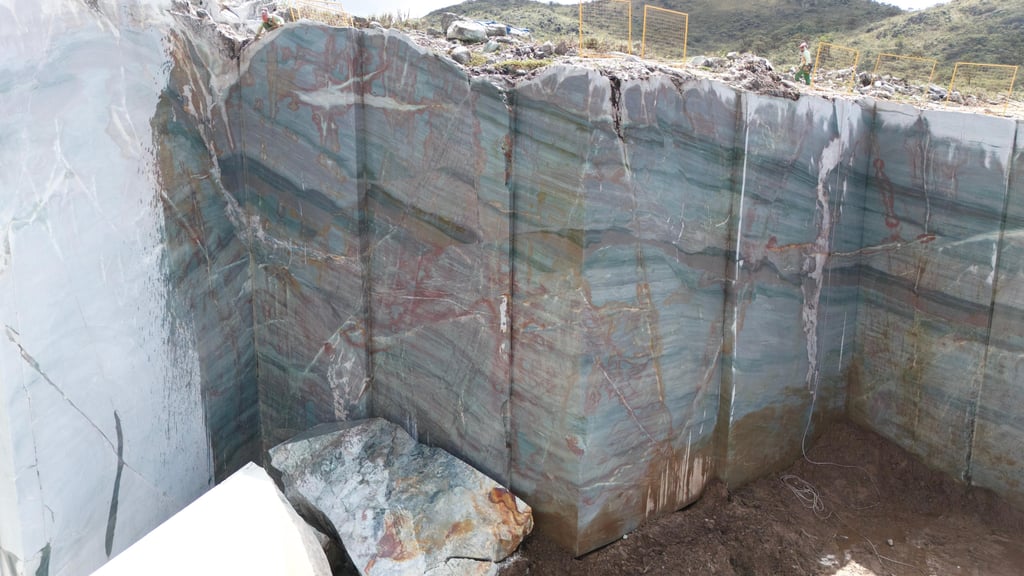
Granite starts as magma trapped miles below the Earth's crust. Unlike lava that erupts and cools quickly, this magma stays underground where it cools extremely slowly over thousands of years.
That slow cooling is what makes granite special. It gives minerals time to form large, visible crystals. The result is a dense, hard stone with the distinctive speckled appearance you see in granite countertops.
✦ What's Inside Granite
Granite is primarily made of three minerals: quartz, feldspar, and mica. The exact mix determines the stone's color and character.
Quartz provides hardness and typically appears as gray or clear crystals. Feldspar gives granite most of its color, whether pink, white, or gray depending on the variety. Mica adds those shimmering flecks you see catching the light.
Other trace minerals create the exotic colors that make certain granites so striking. Iron oxides produce reds and browns. Hornblende and biotite add black specks.
Rare minerals can create blues, greens, and golds that only exist in specific locations around the world.
🌍 Where Does Granite Come From?
Granite exists on every continent, but only certain regions produce stone with the quality, consistency, and beauty required for countertops. The four major sources are Brazil, India, Italy, and China.
✦ Brazil
Brazil is the world's largest exporter of granite and produces some of the most exotic stones on the planet. The country's ancient geological formations create granites you simply can't find anywhere else.
🇧🇷 Brazil is the #1 source for countertop granite in the US, especially for exotic colors and dramatic patterns.
Brazilian quarries are known for dramatic movement, bold veining, and rare colors. If you've seen a granite with deep blues, striking golds, or complex flowing patterns, it probably came from Brazil.
Some of the most sought-after Brazilian granites include Blue Bahia (one of the rarest blue stones in existence), Delicatus (a white granite with soft gray movement), and Giallo Ornamental (a warm gold that's been popular in New England kitchens for decades).
✦ India
India produces more granite varieties than any other country. Literally hundreds of distinct colors and patterns come from Indian quarries, and the infrastructure for extraction and processing has been established for thousands of years.
Indian granites tend to be consistent and reliable. When you order a specific Indian granite, you generally know what you're going to get. This predictability makes them popular for larger projects.
Black Galaxy is probably India's most famous export. It's a black granite with golden flecks that's been a Massachusetts kitchen staple for 25 years. Other popular Indian stones include Tan Brown, Kashmir White, and Steel Gray.
✦ Italy
Italy has been quarrying stone since Roman times, and Italian granite carries a reputation for exceptional quality. Italian quarries produce less volume than Brazil or India, but what they produce is often extraordinary.
The craftsmanship tradition in Italy also means their processing and finishing standards are among the highest in the industry. When you're looking at Italian granite, you're typically looking at premium material.
Bianco Sardo (a classic white-gray) and Rosa Beta (a soft pink) are two Italian granites I've installed in high-end Massachusetts homes for decades.
✦ China
China has become a major granite producer over the past few decades. Chinese quarries offer competitive pricing and a wide selection, particularly in more common colors like grays and blacks.
G603 (a light gray) and G654 (a dark charcoal) are Chinese granites you'll see frequently in commercial applications and budget-conscious residential projects.
🏆 Most Popular Granites in New England Kitchens
In my three decades serving Massachusetts homeowners, I've seen trends come and go. But certain granites have proven themselves over time. Here's what I see most often in MetroWest and Greater Boston kitchens.
✦ White and Light Granites
White Ice, Alaska White, and Colonial White remain consistently popular. These Brazilian and Indian stones offer a bright, clean look that works with both traditional and modern kitchen designs.
For Massachusetts homes with limited natural light, a lighter granite can make a kitchen feel more open.
✦ Warm Golds and Browns
Giallo Ornamental, Santa Cecilia, and Venetian Gold have been New England favorites for years. Their warm tones complement the wood cabinetry still common in many Massachusetts homes.
These granites also tend to be forgiving. They don't show water spots or minor wear as readily as darker stones.
✦ Classic Blacks
Black Pearl, Absolute Black, and Uba Tuba remain popular choices for homeowners wanting a bold, dramatic look. These work particularly well in contemporary kitchens and as accent islands.
✦ Exotic Statement Stones
Blue Bahia, Azul Macaubas, and Van Gogh (Blue Fire) are for homeowners who want their countertop to be the first thing people notice. These rare Brazilian stones command premium prices but deliver truly unique results.
💎 How Origin Affects Quality and Price
Where your granite comes from matters more than most people realize. Here's what origin tells you.
✦ Why Each Granite Is Unique to Its Location
This is the key thing to understand: the specific combination of minerals present in a particular location millions of years ago created that stone's unique color and pattern. You can't recreate it somewhere else.
That's why certain colors are rare and expensive. Nature only made them in one place, in limited quantities. When a quarry runs out, that stone is gone forever.
✦ Geological Age and Density
Older geological formations generally produce harder, denser granite. Brazilian stones from ancient cratons (stable continental cores) tend to be extremely dense and durable. This affects long-term performance.
✦ Quarrying Methods
Different regions use different extraction techniques. High-quality quarries use diamond wire cutting that minimizes stress fractures. Less sophisticated operations may use explosives, which can create internal weaknesses in the stone.
✦ Processing Standards
Italian and Brazilian processing facilities typically maintain the highest finishing standards. The quality of polishing, edge work, and quality control varies significantly by region.
✦ Shipping and Handling
Stone travels a long way to reach Massachusetts. The handling chain, from quarry to port to distributor to fabricator, affects the condition of the material. Established supply chains with experienced handlers reduce the risk of damage.
🏠 Why Origin Matters for Massachusetts Homeowners
New England homes have specific demands that make granite an excellent choice. But not all granites perform equally well here.
✦ Temperature Swings
Massachusetts kitchens experience significant temperature and humidity changes throughout the year. Dense, well-formed granite handles these swings without issue. Lower-quality stone with micro-fractures can develop problems over time.
✦ Resale Value
In the Greater Boston real estate market, quality matters. Buyers recognize premium materials. A kitchen with Brazilian Blue Bahia or high-quality Italian granite tells a different story than one with budget material.
✦ Longevity
I've seen granite countertops I installed 25 years ago that still look fantastic. The key is starting with quality stone from reputable sources. Cheap granite often reveals its origins within a few years.
💰 Why Stone Pricing Isn't One-Size-Fits-All
How much is it per square foot? That's the most asked question. Unfortunately, it's not that simple. Let me explain why.
If you choose anything from our in-house inventory, it's a set price per square foot no matter the size of the job. If we need to special order material for your job, the pricing changes because in this industry, you can only order whole slabs at a time.
💎 Total installed pricing typically ranges from $55-150 per square foot. This covers about 95% of available options.
Exceptions: Rare blue colors fall outside this range. Granites like Blue Bahia and Blue Louise command premium prices because blue is nature's scarcest color in stone.
Why pricing varies:
- Sourcing: We work with various suppliers to find the best value for your project. Stock material from our yard offers the best pricing, while special orders from specific suppliers may cost more.
- Complexity: Customization like waterfalls and integrated sinks require more fabrication time.
- Waste: Every project is like a puzzle. How efficiently we can fit your pieces on the slab affects the final cost. Intricate shapes mean less efficient cuts.
That's why visiting our showroom is the best way to decide. You'll see our materials in person in our indoor heated warehouse, compare finishes, and get expert guidance to make the right choice.
✅ Is Granite Right for You?
Choose granite if:
- You want a natural stone with unique character (no two slabs are identical)
- You need a surface that handles heat without damage
- You're planning to stay in your home long-term and want lasting value
- You appreciate the look of natural materials in your kitchen
Consider alternatives if:
- You want zero maintenance (granite needs periodic sealing)
- You prefer perfectly uniform patterns (consider quartz countertops instead)
- You're working with a very tight budget
- You want bright white with no variation marble countertops or quartz may suit you better)
🎯 My Recommendation
After 30 years in this business, I can tell you that where your granite comes from matters. But what matters most is seeing the actual slab you're buying.
Photos on a website don't capture the depth, movement, and character of natural stone. A small sample doesn't show you how the pattern will look across an 8-foot island. That's why I always encourage customers to visit our showroom and see slabs in person.
We stock a wide selection from all the major sources: Brazilian exotics, reliable Indian classics, and everything in between. We work with every supplier in the industry, so if you have something specific in mind, we can source it.
The right granite for your kitchen exists. Let's find it together.
❓ Frequently Asked Questions
Q. Where does most granite come from?
A. The majority of countertop-grade granite comes from Brazil, India, Italy, and China. Brazil leads in exotic varieties, while India produces the widest range of colors.
Q. Is Brazilian granite better than Indian granite?
A. Not necessarily. It depends on the specific stone. Brazilian granites are known for rare colors and dramatic patterns, while Indian granites offer consistency and reliability. Both can be excellent choices.
Q. Does where granite comes from affect its durability?
A. Yes. Geological age, density, and quarrying methods all impact long-term durability. Higher-quality sources typically produce more durable stone.
Q. Why are some granites so much more expensive than others?
A. Rarity drives price for natural stone. Colors that nature produced very little of, like blues, cost more than abundant colors. Processing quality and transportation costs also factor in.
Q. Is there granite quarried in the United States?
A. Yes. There are granite quarries in Vermont, Georgia, and other states. Domestic granite is available but represents a small fraction of the countertop market compared to imported stone.
Q. How can I tell if my granite is good quality?
A. Look for consistent density (no soft spots), tight crystal structure, and professional finishing. Quality granite feels solid and heavy. Cheap granite often has visible pits or inconsistent areas.
Q. Does granite need to be sealed?
A. Most granite benefits from periodic sealing, typically once a year for kitchen countertops. Some very dense granites like Absolute Black may not need sealing at all.
Q. How long does granite last?
A. With proper care, granite countertops can last a lifetime. I have customers with 25-year-old installations that still look beautiful. Quality material and professional installation make the difference.
🏠 Visit Our Southborough Showroom
Still figuring out which granite is right for you? Come see us. Nothing beats standing in front of the actual slabs, comparing colors, patterns, and finishes in person. That's how you make the right decision.
Stop by our countertop store at 43 Turnpike Road (Route 9), Southborough, MA 01772 during business hours. We keep a large inventory in our heated warehouse, so there's always plenty to see.
Already done your homework and know what you want? Email us or give us a call.
📞 508-460-7900
📧 info@graniteguyinc.com